
‘It Stops Here’ a timely message
Published:Wednesday | September 4, 2019 | 12:21 AM
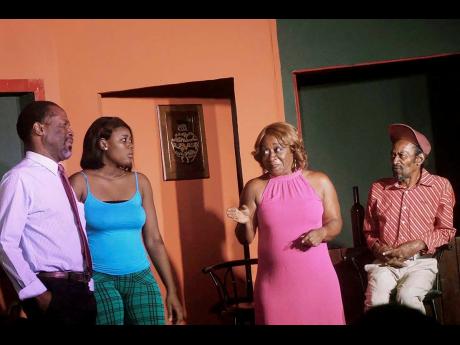
The Andrew Roach-penned and directed play, It Stops Here, is an attempt at addressing domestic violence. But, in exploring the reasons why a male spouse abuses his partner (in this case it is due to substance abuse), the playwright may have crowded a fine storyline with too many anticlimaxes. And so, these numerous twists and turns, which often fizzle into another cliff-hanger, have the audience on an emotional roller-coaster ride.
Staged at the intimate Jamaican Shopping Club Theatre, located on Cargil Avenue in St Andrew, It Stops Here is set in a nondescript town house, and spans an undefined period of time in the lives of four characters: Olivia (Kay-Ann Dennis); her abusive married lover, William (John Chambers); Olivia’s mother Duchess (Rosie Murray); and Uroy, (Peter Heslop), a vagrant and the voice of reason.
The plot begins slowly with a steady dose of verbal and physical abuse, before it picks up with a trot, taking some predictable and unpredictable turns, carrying everyone along the way. The language of the characters is philosophical, humorous and stateless. But alas, Roach may have erred in telling the story, by having Olivia voicing her desire to change, when she has been established as the victim.
The play is well cast and the four give an entertaining depiction of their goals and objectives. Veterans Murray and Heslop give their anticipated brilliance, in the execution of their roles. Murray, as the money-greedy Duchess, makes the despicable character likeable. Heslop, too, is convincing as the “conscionable” drug addict.
Lapses of credibility
However, that was not the case for Chambers and Dennis. Both having the more complex roles to play, they did so with flashes of inconsistency. This, mainly due to not internalising their roles. Thus, there were lapses in believability.
Dennis, whose character spent the most time on stage, was the guiltier of the two.
She seemed unable to grasp the various emotional states of her Olivia. Roache’s directing was also wanting. This perhaps was in part due to the placement of set, like the lone sofa, placed centre stage.
Also, the director’s tendency to have Olivia’s fainting spells occurring by the bar stool, placed upstage left, smacked creativity in its face. But, all was not lost, his entrances and exits were well defined. The outside door was always opened by a well-timed doorbell.
Except for the sofa, the set, costumes, props lighting and sound showed signs of creativity. Duchess’ love for material things was reinforced by her fashionable costumes and handbags.
From the outset, William’s status was established in his costumes, too. And so, Sunday’s production was well worth seeing. The message of It Stops Here is timely and impactful.
M.R.