
Walter Molano | The geopolitical chessboard
Published:Friday | November 1, 2019 | 12:00 AM
The rise and fall of empires are tumultuous events, with far-flung consequences. World War I and II were the spasmodic death throes of a handful of empires and their replacement with a new set of hegemonic actors.
It is a regenerative dialectic that is as old as humanity, and it is one that is still going on. Each episode is replaced with greater sophistication and technology, but the consequences are the same. They are power grabs for resources and populations.
In economic terms, they are contests for land and labour, the two basic factors of production. Today’s waning power is the United States and the rising power is China, with a cast of ancillary actors sitting on the sidelines.
The battlefields are no longer on sea, air or land. They are in trade, investment flows, cyberspace, social media and politics. The new instruments may be less blunt, but they are just as effective. Up for grabs are two of the richest continents, in terms of commodities and population, and they are the intense focus of geopolitical positioning.
Africa is the second-largest continent on the planet, with the second-largest population. It is 65 per cent of the Asian land mass, and has a population of 1.2 billion. Moreover, it has the youngest population, along with the fastest population growth rate.
Despite such impressive figures, Africa has usually been considered to be a backwater by the West. Except for an interest in a handful of strategic commodities, such as oil, uranium, cobalt, gold and diamonds, as well as an ancillary interest in keeping it from falling into the Communist orbit, the West ignored Africa for most of the 20th century.
It is no wonder that China was able to enter Africa with relative ease at the start of the 21st century. In fact, western development agencies welcomed China’s arrival, reducing their need to provide aid and assistance. In the mid-1990s, Chinese companies began making investments across the continent, investing in mines, oilfields and transportation.
Soon, bilateral trade began to explode, and Africa became a major source of commodities for China’s ravenous industrial machine. It quickly replaced the United States as the continent’s most important trade partner.
Last year, imports from Africa were US$99 billion, very close to the US$120 billion China imported from the US, while exports were US$104 billion, marking a small trade surplus in China’s favour. At the same time, China has poured US$300 billion in investment since 2015, becoming the region’s largest creditor and investor.
A diaspora of Chinese have arrived in Africa, landing them in prominent positions across industry and commerce. Chinese companies are also opening up factories across the continent, taking advantage of the abundant and cheap labour pool.
Not surprisingly, Africa has realigned politically with China, signing a series of defence treaties and becoming an integral part of the Belt and Road Initiative. Of course, this alarmed the West, and it now observes China’s foray into Latin America and the Caribbean with suspicion.
Like Africa, the West has always looked upon the region with a jaundiced eye; as another backwater of poverty and corruption, with a predilection for leftist subversion and a source of unstoppable immigration. There were no protestations when China made its first forays into the region.
Chinese trade with Latin America has been growing. Last year, the region exported a total of US$149 billion to China and imported US$159 billion. A few years ago, China displaced the US and western Europe as the region’s most important trade partner. Today, Chinese brands, such as Huawei and Haier, dominate the Latin American consumer space. Meanwhile, cars made by Chery and Geely choke Latin American streets and highways.
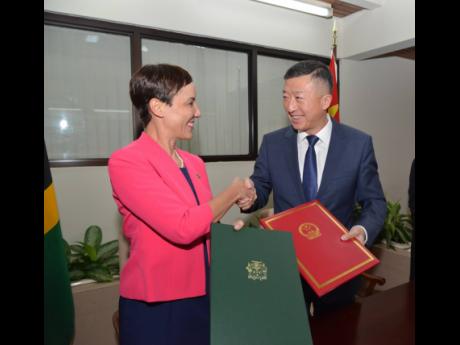
China has poured US$141 billion into foreign investment. While there has been some pushback from countries, such as Brazil and Ecuador, other countries, such as Jamaica and Trinidad & Tobago, continue to wave the Chinese into strategic industries and projects. It is for these reasons why the West, and in particular Washington, is using one of its most powerful weapons, the International Monetary Fund, to fend off the Chinese foil. Its recent accommodative stance towards Ecuador is a sign that the West wants to keep some of the more marginal countries onside.
The big question will be Argentina. Most likely, Washington will also try to woo the new government of president-elect Alberto Fernandez, but it is too early to tell. The IMF seems to be hell-bent on wrecking the future of the new administration by demanding a draconian restructuring. Let’s see if their main shareholders make them change their minds.
These regional countries are pawns on a geopolitical chessboard. At stake is not the future of individual regimes or governments, but the rise and fall of imperial systems.
Dr Walter T. Molano is a managing partner and the head of research at BCP Securities LLC.