
Peter Espeut | Education inequality causes increasing crime
Published:Friday | January 3, 2020 | 12:00 AM
As we enter the last year of the second decade of the 21st century, at the same time we enter the first year of the decade of the 2020s.
Some people expect dramatic changes at the beginning of a new year, or a new decade, or a new century, or a new millennium. Those of us who are veterans of decades of new decades know that it is much more likely that the new year and new decade will be pretty much like the last one.
If you deny the majority of Jamaicans good-quality education, not allowing matriculation to higher studies, and access to higher paying jobs; and then at the same time you dangle in front of them (on television or elsewhere) fast cars, luxury homes, and expensive high-tech gadgets – none of which they will ever be able to afford – why would you be surprised at a high crime rate?
The statistics show that Jamaica is one of the most unequal countries in the world, which makes us a very sick society; but many consider this normal, and not worthy of remediation. And so it won’t happen!
The OXFAM Commitment to Reducing Inequality Index 2018 is a global ranking of governments based on how they tackle the gap between rich and poor, based on social spending, taxation and labour. On the list of 157 countries, Jamaica is in the bottom half at 96, and out of 25 countries in Latin America and the Caribbean, Jamaica ranked four from the bottom at 21.
The elevation in 2017 of the income tax threshold to J$1.5 million has been much lauded, and has put more money in the pockets of high earners; but the increase in the rate of consumption taxes used to offset it has placed a greater burden on the poor, and has increased Jamaica’s income inequality gap.
I am not sure that many people see the connection between increasing crime and the “1.5”, as it has been called.
The fact is that for the vast majority of Jamaicans, this country is not the place of choice to live, work, raise families and do business, and will never be as long as the issue of inequality is not seriously addressed.
A GENERATION TO SUCCEED
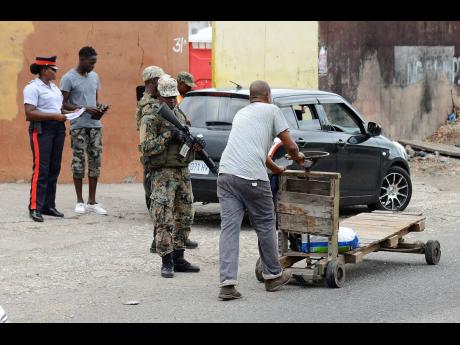
The zones of special operations (ZOSOs) were defined as having three components: ‘clear’, ‘hold’, and ‘build’. The strength of the ZOSO was not the first two (which are basically the make-up of a state of emergency) but the ‘build’ aspect: community renewal and development.
When ZOSOs were first declared, I predicted their failure because that sort of strategy takes at least a generation to succeed. Besides, the government does not possess the in-house skills to do community development, otherwise they would be doing it right across the island.
I find it comical – no, tragic – that the minister of national security is blaming NGOs for failure to administer social interventions, which reduce crime, when it is the government itself that is the huge failure.
As public support for the two gangs of Gordon House wanes, I would not be surprised if the passion of patriotic Jamaicans for peace and an end to political corruption overflows in 2020.
Yet we still have hope!
Today is the tenth day of Christmas, when we celebrate the “The Word becoming flesh, and dwelling amongst us”. Those whose only use for Christmas is the profits they expect to reap have long stopped playing and singing Christmas songs and carols.
Those of us for whom the celebration is ongoing until January 6 believe that the Kingdom of peace and justice may be small as a mustard seed, but that it is growing, and will soon explode into reality, as long as we work hard to build it.
Brothers and sisters: I wish you a holy and joyful Christmas. Let us continue to work in 2020 and beyond to build the Kingdom, the coming of which we petition for every time we utter the Lord’s Prayer.
Peter Espeut is a development scientist, and a Roman Catholic deacon. Email feedback to columns@gleanerjm.com