
Editorial | Definitive action to save Jamaica’s ecosystem
Published:Saturday | June 4, 2022 | 12:06 AM
In the South Pacific Ocean, 1,500 miles (2,800 kilometres) northeast of New Zealand, is Niue, one of the world’s largest coral islands of around 260 square kilometres and home to 1,600 people. Last month, Niue made a big decision. It announced that it intends to protect 100 per cent of the ocean in its exclusive economic zone – an area spanning 317,500 square kilometres. Previously in 2020, Niue committed to protecting 40 per cent of its waters in its Exclusive Economic Zone (EEZ).
Niue’s action is significant on at least two notable fronts.
One, the waters around this atoll are important to global biodiversity. They have one of the world’s highest concentrations of reef sharks; annually, humpback whales travel from the Arctic to give birth in these waters; and spinner dolphins make their home in the waters. And, notably, Niue’s waters are the only place in the world where the katuali, a variety of sea snakes in underwater cases, is found. Additionally, this fragile ecosystem is under threat from climate change. The warmer oceans have damaged corals, while illegal fishing and overfishing have upset the marine balance. Further, increasingly extreme weather events, including more violent typhoons, have damaged the physical environment and posed dangers to Niue’s infrastructure.
Two, that Niue, a tiny country with limited enforcement capacity, decided to undertake this venture – it has banned fishing in some sectors; will allow traditional canoe fishing in another, permit fishing in another; mark a zone for commercial fishing; and, in another, is a conservation stone through which vessels can pass but not stop – has lessons for Jamaica and the Caribbean. Niue intends to police and enforce its protected zone with the help of its neighbours, Tonga, Samoa, the Cook Islands and New Zealand, with which it is in a self-governing association – a relationship roughly analogous to that between Britain and its overseas territories, such as the Cayman Islands.
FACING A CRISIS
Jamaica, too, is facing a crisis of its marine ecosystem, as well as a worsening threat to its coastal areas from rising sea levels. These dangers are coming into sharper focus as the island enters into the 2022 Atlantic hurricane season, which is predicted to be very active with possibly 21 named storms.
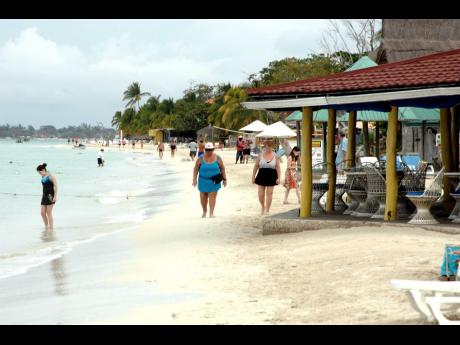
Already, Jamaica is showing the effects of rising sea levels. From Hellshire in St Catherine to Negril, coastal erosion has eaten away beaches, threatening infrastructure. But matters could grow worse.
It is estimated that the sea level in the Caribbean has risen at about 3.1mm/year from 1950 to 2000. The Intergovernmental Panel on Climate Change (IPCC) suggests that, by the end of the century, sea levels will be 0.35 metres to 0.59 metres higher. More recent research suggests, as a conservative estimate, that sea-level rise could approach two metres by the end of the century.
This is a matter of grave concern. Studies suggest that a one-metre rise in sea level would put 100 per cent of port lands, 20 per cent of airport lands, and approximately two per cent of the road network, under water. The bottom line: Jamaica has an interest in the fight against global warming and climate change, and in protecting the world’s, and its own, biodiversity.
Indeed, Jamaica and the island nations in the Caribbean Basin are part of Small Island Developing States (SIDS), which were recognised as a special case, both for their environment and development, at the 1992 United Nations Conference on Environment and Development in Rio de Janeiro, Brazil. The aggregate population of all the SIDS is 65 million, slightly less than one per cent of the world’s population, yet this group faces unique social, economic, and environmental challenges.
Given the limited land mass in each of the islands, it is critical to preserve the natural resources and biodiversity from which the region’s communities have drawn food supply, clean water and other resources. Protecting them is important to our existence.
Jamaica’s governments have long declared their commitment to doing this, but declared policy is often at odds with what happens. This should change. Niue’s ambitious plan for its EEZ should be an inspiration for Jamaica.