
Delano Franklyn | Pelé, Brazil and Jamaica
Published:Monday | January 9, 2023 | 6:03 AM
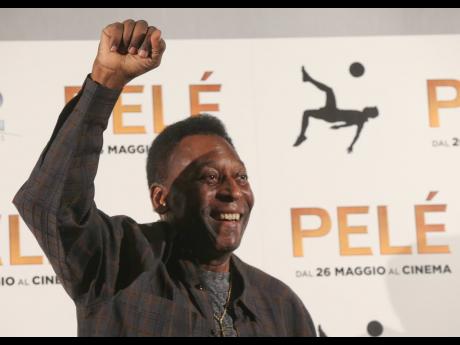
Pelé, at the age of 82, closed his eyes permanently on December 29, 2022. His death has left most of us in a state of shock and trepidation.
From the age of 17, when he played his first World Cup in 1958, he demonstrated that he was way above the rest of footballers. Statistics have since borne this out. In 1,363 games, he scored 1,281 goals. No one has done better.
In the 1950s and onwards, when it was tough and hazardous for black people to survive and escape the grinding poverty, daunting and humiliating racism and classism which polarised Brazil, Pelé was able to use his football talent to become the ‘first black global sport superstar’, giving millions of people the hope that if he can, so can they.
He rose from the bowels of Brazil to become the greatest footballer of all time. Cross-generational comparisons, as to who is the greatest in any sport, are usually froth with danger, as so many variables have to be taken into consideration.
As an example, Pelé was born in 1940, Diego Maradona in 1960, Cristiano Ronaldo in 1985, and Lionel Messi in 1987. When Pelé retired from playing football in 1977, 46 years ago, Messi and Ronaldo were not with us, and Maradona was just 17 years of age. Each generation of football lovers and supporters will give support to who they consider to be the best footballer of their time.
PELÉ HAD ALL THE SKILLS
All the football skills exhibited on the field by others since Pelé’s retirement were already carried out by him. He was not the inventor of all the moves, but he brought drama, flair, style, and panache to all.
The way he dribbled past players and protected the ball as he did so; his mastery of the overhead, or’ bicycle’ kick; the way he trapped the ball; the way he passed the ball without even looking at his teammates; his dead-ball kicks; the way he propelled his five-foot eight-inch frame in the air to head the ball; the way he rifles the ball towards goal, using either his left or his right foot; his lightening movements away from his markers; and his positioning on the field made him special. Great players have executed some of these moves, but the totality of doing these things rest only with Pelé.
Technically and strategically on the field, he was incomparable. No wonder João Saldanha, one of his coaches leading up to the 1970 World Cup, was led to say then, “Ask me who is the best right back in Brazil, and I will say Pelé. Ask me who is the best left back, or midfield or centre forward and I will say Pelé. There is only one Pelé.”
Pelé played and popularised football without the existence of any form of instant mass communication during his time. No brand marketing. No social media promotion. No livestreaming. No YouTube. Only black-and-white, reel-to-reel tapes, photographs, radio, and newspapers existed then.
He played under dreaded conditions when compared to latter-day players. As Stewart Stephenson, former president of the Kingston and St Andrew Football Association , said recently, “While he played with a real leather ball with laces which absorbed water, today’s ballers play with a beach ball that floats on water. And whereas today’s strikers are protected by overzealous referees, Pelé was butchered from all sides by sadistic defenders.”
JAMAICA AND BRAZIL
When Jamaica declared its Independence on August 6, 1962, the country decided on October 14 of the same year to establish diplomatic relations with Brazil. Since then, both countries have enjoyed very good bilateral and multilateral relations.
At the time of the establishment of diplomatic relations with Brazil in 1962, football was not the main reason but, with Brazil having won the World Cup in 1958 and 1962, and being the world’s fifth-largest country with a huge economic base, populated by large segments of black people, it was only fitting for Jamaica to identify Brazil, from very early, as a key partner in international foreign relations.
By 1964, two years after Jamaica’s Independence, Kingston College (KC) had, by then, developed the most dominant local schoolboy football team, with outstanding players such as Neville Oxford, Tony Keys, Trevor ‘Jumpy’ Harris, Lloyd McLean, Franklyn ‘Bowla’ Morant and Dennis Johnson, among others.
The leadership of the Kingston College Old Boys Association (KCOBA), at the time, sought competition for the team from outside of Jamaica. The KCOBA invited, in 1964, the national Brazilian under-23 football team to play KC, as well as a second match against an all-school football team, which consisted of a record nine KC players. Some of the players from the Brazilian under-23 team went on to play for Brazil, two years later, in the World Cup of 1966.
So dominant and influential were Pelé and the Brazilian football team that our own Santos Football Club, when formed, also in 1964, took its name from Pelé’s Santos Football Club in Brazil.
In Pele’s last World Cup in 1970, which Brazil won, he had playing alongside him some of the best players in the world, such as Carlos Alberto, Jairzinho, Gerson, Tostao, Rivelino, Colodoaldo, Brito, Pizza, and Everaldo, with Felix in goal, but it was Pelé who clearly marshalled the troop.
Thereafter, every country wanted to see him play on their home soil. They wanted to see him in the flesh.
One year later, in 1971, Cavalier Football Club in Jamaica, under the leadership of Leighton Duncan, extended an invitation to Santos Football Club of Brazil to play an invitational match against Cavalier. National players such as Vester Constantine, in goal, Mutty Scott, Neville Oxford, Alan ‘Skill’ Cole, Corsel Blair, the Welsh brothers – Arthur and Asher – and others paraded their skills.
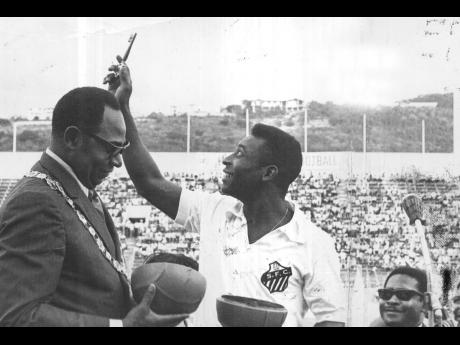
When Emerson Barrett, then mayor of the Kingston and St Andrew Corporation (KSAC) handed Pelé the Key to the City, before the start of the match in 1971, those in the stadium roared their approval. That key, to this day, symbolises the locking in of Brazil as the main country most Jamaicans have given, and continue to give, their support during every World Cup competition.
Pelé and the Cosmos football team of the USA, the club for which Pelé was playing at the time, were invited in 1975 to Jamaica, through the instrumentality of the influential Winston Chung Fah, on behalf of our local Santos Football Club, to play an invitational football match. Not one seat was left empty.
Pelé played for about 60 minutes before he was forced to leave the field due to an injury inflicted upon him by one of our exuberant defenders, the infamous Billy Perkins, of blessed memory.
JAMAICA AND THE WORLD CUP
It was always felt by many in Jamaica, that Jamaica had sufficient Jamaican football pedigree to qualify for the World Cup. It was not by chance, therefore, that Jamaica turned to a Brazilian football coach, René Simões, to be the national coach leading up to the 1998 World Cup competition, for which Jamaica qualified.
As part of the Reggae Boyz preparation, the leadership of the Jamaica Football Federation (JFF) and Simões invited the Santos football team of Brazil, on June 3, 1998, just before the start of the World Cup, to play a match against a team consisting of past Jamaican players, before the Reggae Boyz played its preparatory match. Pelé was invited to Jamaica as a special guest to watch both matches.
Pelé, Brazil, and Jamaica shared a common bond. This, in large measure, is what has caused Jamaicans to have a special place in our hearts for Brazilian football, despite the fact that the last time Brazil have won the World Cup was in 2002, over 20 years ago.
The number of cars adorned with the Brazilian flag in Jamaica during a World Cup football competition shows the love and deep affection for Brazilian football.
This, in no small measure, is due to Pelé, who has left an unparalleled legacy, yet to be fully understood by the few who, wrongfully, thinks otherwise.
Delano Franklyn is an attorney-at-law and the former minister of state in the Ministry of Foreign Affairs and Foreign Trade. Send feedback to columns@gleanerjm.com.