
Happy birthday, Miss Lou
Published:Wednesday | September 6, 2023 | 12:06 AM
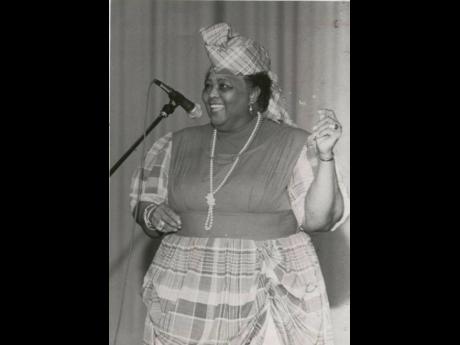
THE EDITOR, Madam:
In every society, the cosmology of a culture is to be found in its indigenous expression, its various art forms, and specifically in its language which is an expression of the ethos of the people.
What is language and its function? Simply put, language allows people to communicate and interact and identify and name their environment.
Born September 7, 1919, Louise Bennett-Coverley aka Miss Lou knew and understood this, which is why she studied folklore at Friends College in Highgate, St Mary before going to England to study drama at The Royal Academy of Dramatic Arts (RADA), as the first black person and first Jamaican. Miss Lou realized that in order for the culture to be preserved and evolved there need to be documentation of our idioms.
Upon her return home, Miss Lou picked up where she left off by working for the Jamaica Social Welfare Commission for the next four years, moving around the island, collecting stories, proverbs, riddles and recording games from 1955 to 1959, while simultaneously teaching drama and folklore at The University of the West Indies. This dual role as collector and teacher allowed her to share and expand upon what she was unearthing in the rural villages and towns of Jamaica.
What is often overlooked or not understood is that Miss Lou had embarked on an anticolonial project. She knew instinctively, with towering intellect and razor-sharp wit, that in order to liberate the Jamaican people she had to excavate and disseminate their ancestral fables and contemporary anecdotes. Within this diverse, organic canon of oral history, African culture was embedded and retained, constituting a mercurial, impenetrable (to outsiders) mechanism of resistance to oppression.
Language is a form of domination, which is why the British strategically separated the enslaved Africans from the same linguistic group and forbade them from speaking in their native tongue. However, language is also a form of resistance to oppression, and the Jamaican language, which is now recognized globally, and which a few universities in North American has already accepted as a foreign language, has been fundamental in allowing the Jamaican masses to express both their love and resilience as well as their outrage to hundreds of years of brutal, physical and psychological oppression.
Miss Lou understood this, so despite ridicule and not being recognized as a legitimate poet, Louise Bennett insisted and persisted in writing in the Jamaican national language. Thus, Miss Lou’s anti-colonial cultural project was not only strategic but supported the anti-colonial and pre-independence movement in fundamental ways as it not only shored up the people’s sense of self, but it also gave them a fluid structure of cultural foundation; feet on which to stand proud and make demands on their own behalf.
Likewise, Louise Bennett came to realize that she had to filter and recalibrate much of what she was learning from and among the people, hence she developed a radio monologue, entitled Miss Lou’s View, which ran from 1965 to 1982, three years short of 20 years. What were the content and timbre of these views? What was Miss Lou advocating for? If we were to have access to this body of work, we would be able to extrapolate much about the society then and the various sentiments that were being expressed.
A warrior of words, Miss Lou took on Jamaican culture and singularly hoisted it up for the masses to appreciate and respect so they knew dem was smaddy and who dem was being was good enough. Dem neva ahfi imitate nubodi.
Tenk yu fah mekin we sweet talk get respect
Tenk yu fah tekin de time fi collect wi proverbs and riddles
Tenk yu fah localizin pantomime
Tenk yu fah Aunty Roachy and chattin people bizness
Tenk yu fah lovin the best and worse ah we
Tenk yu fah bein a proud Jamaican
Wi honor yu as wi ancestor
Have a boonoonoonus birthday!!!
PROFESSOR OPAL
PALMER ADISA
Cultural and Gender Activist