
Editorial | In Gladstone Wilson’s image
Published:Friday | September 8, 2023 | 12:06 AM
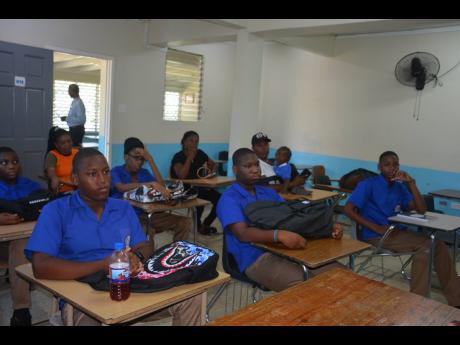
If success were merely vicarious, then Monsignor Gladstone Wilson College, which began its first in-person classes in Montego Bay this week, would need go no further than its name.
Except that Jamaica is littered with schools named for outstanding people, whose performance, either in educational outcomes or discipline, would shame the persons they purport to honour. Those in charge, the managers at the institutions and government policymakers, seem inured to these failures.
Although Monsignor Wilson – dead now for nearly half a century – is a monumental act to follow, the Roman Catholics are known for running good schools that attract the best and brightest children, who go on to shine in exams.
In this case, though, performance, at least from the perspective of this newspaper, shouldn’t be measured only by the excellence of academic outcomes – although that, too, is crucial. We look forward also to a nuanced approach to the delivery of education that teases out the talents of our boys, who too often lose their way in the education system. Which is how we interpret the remarks of Ronald Thwaites, former education minister and Roman Catholic deacon, who has oversight for the church’s school projects in the island.
DISTRACTED
For, as Mr Thwaites observed in remarks to The Gleaner, boys and girls learn at a different pace, which sometimes leads to boys becoming distracted or disillusioned as they lag behind and in their frustration come to believe that there is little merit in staying in school. “And we know the social problem that causes,” Mr Thwaites quipped.
That, in part, is the reason why the Catholics, who own around 120 schools in Jamaica, opted for a boys institution in their Montego Bay endeavour. A rebalancing of sorts in a city where there is only one other all-boys school.
The learning gap between boys and girls begins to show in primary school. For instance, in this year’s Primary Exit Profile (PEP) test of grade-six children, who are about to begin secondary education, 60 per cent of all students were deemed proficient in language arts. Notably, of the girls 61 per cent made the cut in that subject, against 47.4 per cent of boys. In mathematics, 57 per cent of all students were proficient. But with respect to the gender breakdown, there was a 10 percentage point difference in proficiency between boys and girls – 54.4 per cent and 44.4 per cent, respectively.
Boys drop out of high school at a higher rate than girls. And in the Caribbean Secondary Education Certificate (CSEC) exams, girls generally outperform their male counterparts, getting better grades in 95 per cent of the subjects that they sit. Further, females account for nearly 70 per cent of the enrolment at tertiary institutions.
It is against this backdrop that Mr Thwaites’ observation about the difference in the learning styles of boys and girls has especial relevance with respect to how students are recruited to, and nurtured at, Monsignor Gladstone Wilson College, which at present remains a totally private institution, without grant aid from the government. Apparently, the school is financed by tuition fees and aid from a Roman Catholic diocese in Canada.
CLEAR ASPIRATIONS
Significantly, the school is twinned with Campion College, an elite Roman Catholic high school in St Andrew, which mostly receives exceptional performers from the PEP exams and delivers concomitant results in CSEC tests and other school-leaving exams. In that regard, it is appropriate that Monsignor Wilson’s name is attached to an institution with the clear aspirations to emulate Campion College.
Gladstone Wilson, born in 1906 and died in 1974, was a poor black Jamaican who attended another Roman Catholic school, the then Jesuit-run St George’s College where he was an exceptional student. He became a Catholic priest, after studying in Rome.
By the age of 30 he had accumulated three PhDs, including a doctorate in canon law, among many other great scholastic achievements. His thesis for his first doctorate was written in Latin. He also earned a master’s degree in sociology and taught at Pontifical Vatican University.
It is surprising – or perhaps not – that Gladstone Wilson isn’t, on the basis of those achievements, lionised in Jamaica and named, posthumously, to the Order of Merit. That’s a failure to be cured.
Maybe he wouldn’t have approved of such earthly honours. What he clearly would welcome is the mission of the school in Montego Bay, even if he might have objected to its name.
In concert with his Jesuit educational upbringing he would embrace its potential pathway to human excellence, and, keenly, the role and responsibilities of those who teach in helping to liberate that excellence. He would probably also argue that one needn’t possess Gladstone Wilson’s intellect, or have Aquinas’ insights to be allowed to traverse the path to wholeness.