
Jalil Dabdoub | Caribbean Court of Justice and Palestine: A changing perspective
Published:Wednesday | January 10, 2024 | 12:06 AM
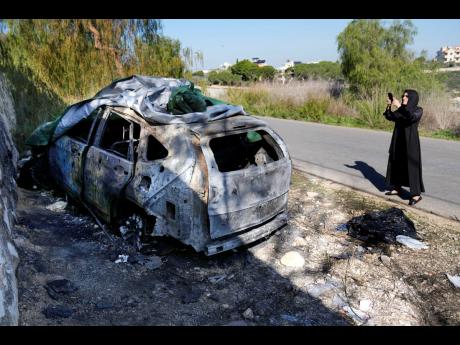

The Israeli genocide in Palestine continues with support from the United States, United Kingdom, and Europe, despite South Africa charging Israel before the International Court of Justice with the crime of genocide.
These events shape one’s view of the world and cause us to reflect on the philosophy supporting the political structures in our country. The continued denial of the Palestinian right to self-determination forces us to reflect on the issues of final sovereignty in Jamaica.
There are persons, me included, who have reservations about the Caribbean Court of Justice (CCJ) being Jamaica’s final court of appeal.
We must ensure that our own local courts are properly funded, competently staffed, and have adequate physical infrastructure prior to acceding to the CCJ. While it is to be acknowledged that there has been much improvement, there remains much to be done.
In small societies like Jamaica, the spectre of corruption is more likely. It is not limited to the purposeful and direct variety. It also includes inadvertent corruption of the systems and principles which govern the judicial process.
Inadvertent corruption can occur, for example, because in smaller societies the prevalence of familiarity among persons is far greater than in larger societies. One example is that judges before whom a lawyer appears may well be a former tutor at one of the regions law schools (from which the vast majority of judges and lawyers graduate). This familiarity can lead to an inadvertent corruption of the process as opinions would have been formed by these now judges of their former students.
In larger societies, lawyers and judges are trained in a diverse cross section of legal institutions. Each institution imparts different philosophies. The Caribbean has a limited number of law schools all with more or less similar philosophies, resulting in less diversity of philosophies. This results in less judicial debate at the level of a final court of appeal given that the philosophies of the judges are generally more or less aligned. Jurisprudential development is possibly hindered.
BROADER EXPOSURE
As a developing nation, our courts may not encounter certain legal issues as early as the more developed nations. Privy Council (PC) judges may have a broader exposure to more issues which may not have yet been placed before a CCJ. This broad exposure allows judges to develop a much deeper experience in the various areas of jurisprudence. These judgments would, if we remain with the PC, be areas of settled law for us. Clarity on the state of the law is beneficial in national development and growth.
The law can and has been used to oppress sectors of society contrary to democratic principles. This is evident in US Supreme Court decisions during slavery, the Jim Crow, civil rights eras, and the fascist laws in Italy and Germany prior to World War II.
The Zionist colonial project in Israel has traditionally, despite its racist ideology, had strong support from Europe, the United States, and Canada. Today, extensive criticism is being levelled at Zionism by well-thinking people, including Jews, in large part because its philosophy is repugnant to the very core of humanity.
Zionist principles of racial supremacy, that certain people by virtue of their religion are entitled to forcibly colonise and viciously remove the indigenous Palestinian people from their lands are some examples. The current genocide of Palestinians in Gaza is but an extreme example of the principle in operation.
In an attempt to protect Israel and preserve Zionism, Western ‘democracies’ have enacted laws which strike at the very core of democratic traditions – laws designed to curtail criticisms of Israel and Zionism, its proponents and methods of propagation. These include laws which attempt to curtail citizens taking part in the Boycott, Divest and Sanctions movement against Israel and the “antisemitic” component of hate laws, which attempts to equate criticism of the state of Israel and Zionism to antisemitism.
WITHERING OF DEMOCRACIES
Will these attacks on democratic principles to protect Zionism lead to a withering of democracies? Will the PC in the future impose these philosophies through their judgments? Will Jamaica then be forced to implement similar laws by the powers that be? The PM’s announcement of anti-hate laws may well be a signal of things to come. Certainly, such laws which have already been enacted in some countries infringe on basic democratic principles.
These are among the concerns we are forced to consider when weighing whether to end our journey with the PC and commence with the CCJ. This decision must be supported by rigorous public debate and education. The effects of a final court on national development is far too important for us to do otherwise.
Regrettably, this administration seems wishy-washy on the issue of the CCJ. Given the importance of this decision and the hypocrisy of the Western “democracies” with their imperialist approach, it is time that this government set out in clear unequivocal terms its position on the CCJ and the time frame to have a decision made. The administration has been far too silent for far too long. Its leadership on this issue has been lacking. Its approach is to either kick the stone down the road or walk between the rain drops.
If we retain the PC we must accept that our self-determination is limited as they will retain a degree of influence on Jamaica’s national landscape. A degree of influence exerted by foreign judges.
Assuming solely for the purposes of argument that the CCJ will not be as competent a court as the PC, is it now the correct perspective that we accept that “there are no people on earth who would not prefer their own bad government to the good government of an alien power”.
Jalil S. Dabdoub is an attorney-at-law. Send feedback to columns@gleanerjm.com.