
Editorial | Beyond Charlemont, Mr Mayor
Published:Monday | January 15, 2024 | 12:06 AM
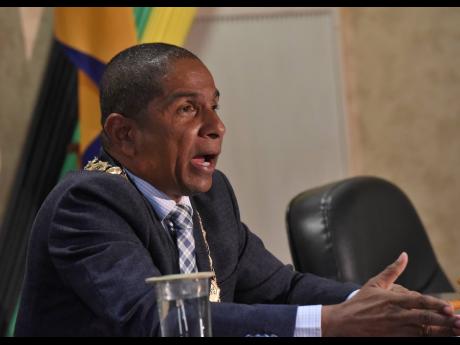
Announcing an internal probe of the Charlemont Avenue scandal – presumably to unearth how its building inspector(s) missed eye-popping deviations from approved building permits to the Barnetts – is the least the Kingston and St Andrew Municipal Corporation’s (KSAMC) could do.
But as the corporation’s investigators get on with the job of unravelling their latest mess, the KSAMC and its chairman, Kingston Mayor Delroy Williams, have unfinished business, on related issues, to attend to.
For example, Mr Williams should report on the outcome of the case of two senior members of the corporation’s building department who were, two years ago, in January 2022, interdicted and sent on leave by the Local Government Services Commission for unspecified concerns relating to construction oversight.
One of those officials, Shawn Martin, a field inspector and second in command of planning, was heavily criticised in a 2020 ruling by Georgiana Fraser for his part in approving a development on Birdsucker Drive in Kingston 6, which the court said breached the regulations. The National Environment and Planning Agency (NEPA) was also lambasted in that ruling.
The regulations require that multi-family dwellings should not be built on less than half an acre of land. The Birdsucker Drive developers were permitted to do so on a 0.38-acre property. The multi-storey complex of 12 one-bedroom apartments also contained several other breaches by the developer (including the height of the complex), which became issues only because the neighbours went to court.
“I would think that for the sake of transparency, a public servant who is exercising a statutory duty would reveal his thought process at all material times, and more specifically, reveal the link between the facts and his conclusions,” Justice Fraser said of Mr Martin, with respect to the absence of clear, documented explanations of his decision-making process.
AFTERMATH
In the aftermath of the judge’s scathing observations, Mayor Williams announced an overhaul of the regime for granting of building approvals, and for the inspection of construction sites. An internal audit of the KSAMC’s building approval system was also ordered, and Mr Williams said he had also requested that Prime Minister Andrew Holness order a similar process at other local government authorities which are responsible for building approvals.
“This is not the first that the (KSAMC’s) Building Committee will be put under scrutiny, but it will be the last time this happens without action, tangible action, being taken,” Mr Williams said at the time.
Whether anything substantial has happened is not clear.
What is known, though, is that Justice Fraser’s was only one of a recent raft of less-than-flattering observations by judges of how building and environmental regulators fulfilled their obligations. A year earlier, Justice Natalie Hart-Hines invoked Shakespeare’s Hamlet’s reflection on the moral failings of his duplicitous uncle, Claudius, in her critique of the ineptitude KSAMC and NEPA in approving a building permit for a multi-family home on another undersized plot, where construction started in breach of restrictive covenants.
Quoted the judge: “Tis an unweeded garden that grows to seed; things rank and gross in nature.”
Not only did the developer in that instance build more than twice as many habitable rooms (32 bedrooms rather than 15) at the Roseberry Drive, Kingston 8 property than their permit allowed, the violation was known because of the judge’s site visit during the hearing of a neighbour’s suit.
“Armed with these (building and environmental) permits, the applicants proceeded to commence construction, ostensibly unsupervised by the KSAMC,” the judge observed.
PERMIT VIOLATIONS
In instances where permit violations have been uncovered, it has mostly been because of court actions, or persistent advocacy, citizen groups or individual neighbours, rather than oversight by regulators.
Indeed, the current matter involving the power couple, Mark Barnett, the suspended CEO of the National Water Commission, and his lawyer wife, Annette Francis Barnett, is a result of an investigation by the Integrity Commission (IC), apparently on the basis of complaints by Charlemont Avenue, Kingston 6 neighbours.
The IC, the anti-corruption watchdog, concluded that the Barnetts, having received permits to build 12 one-bedroom apartments in two blocks, built six two-bedroom and six three-bedroom units. Additionally, the layout of the blocks was different than what was approved.
The breaches were noted and highlighted by a NEPA inspector only after his seventh visit to the project in December 2020. But days before the observations by the NEPA man, a senior KSAMC building inspector, David Clarke, gave the greenlight to the project.
While NEPA wrote to the Barnetts about the breaches, it did so more than two months after Mr Henry’s last inspection. In the event, the director of public prosecutions (DPP) has ruled that legal action by NEPA, the administrative agency for the Natural Resources and Conservation Act, was statute-barred because cases had to be brought within a year of the offence.
The DPP said that KSAMC could contemplate cases under the Building Act, but pointed to internal complexities in going that route.
Those complexities, no doubt, would include who is to be held accountable. While Mr Williams tries to figure this out, he can say what happened in the earlier instances.