
Editorial | Reading is priority
Published:Friday | November 8, 2024 | 12:06 AM
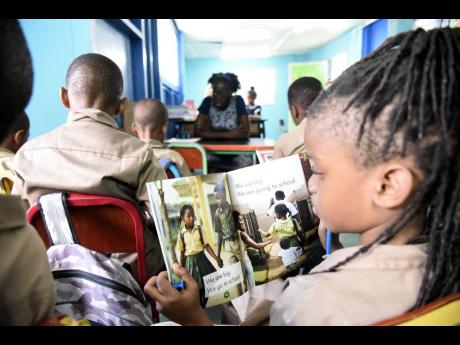
The new education minister, Dana Morris Dixon, signalled that tackling problems in the early childhood sector will be among her priorities for fixing Jamaica’s poor education outcomes.
She has also said that no child should leave school unable to read and without being proficient in mathematics.
Dr Morris Dixon is right on both counts.
Indeed, early childhood preparation is an important foundation for future learning by children. In Jamaica, that preparation is primarily via private community schools, which, as the Orlando Patterson Commission on the education transformation pointed out, are mostly understaffed with undertrained teachers and short of the play/stimulation materials that are essential to their efforts.
These so-called basic schools, as is the entire early childhood system, are underfunded. The Patterson Commission, in its 2021 report, proposed a rebalancing of sorts. Some of the over J$12 billion collected annually in a payroll tax by the skills training agency, HEART/NSTA Trust, it said, should be used to fund early childhood education.
The Government has shown any inclination to go that route. Neither has there been any advancement on the idea floated by the former education minister, Fayval Williams, of the absorption of the basic schools into the government’s early childhood/infant school system.
COMPLEX DECISIONS
Resolving the issues in the early childhood system will require relatively complex policy and funding decisions, which will also impact the economic interests of the owners of the community basic schools. They must be addressed with urgency.
While Dr Morris Dixon tackles these matters, she also faces an immediate and ongoing problem that holds grave consequences for Jamaica’s development: the educational outcomes from the island’s primary schools.
Each year, approximately one-third of Jamaican student’s complete primary school, at around age 12, unable to read and comprehend at their age and grade level.
These underperforming students need various levels of remediation to bring them to a level required to absorb high school education. On average, for seven per cent of these students the starting point for correction has to be at the beginner’s level.
In the case of mathematics, 40 per cent of the grade six students don’t meet the proficiency standards. Which, of course, is understandable. Children are unlikely to fully grasp the other subjects being taught if they can’t read or comprehend in the language in which they are being instructed, English.
The mother tongue of most students, which is what they use in their homes and communities, is Jamaican or patois. That may be interspersed with some standard Jamaican English.
The problem with reading and comprehension spills over to high schools and in secondary education results. Two years ago, an analysis of students at Denham Town High School in west Kingston’s inner-city community, found that over 96 per cent of its students read significantly below their age and grade levels. These deficiencies were significantly improved for students who were part of a special intervention, using the Lindamood-Bell method, which was developed by a pair of American educators over three-and-half decades ago.
NOT UNIQUE
The problem at Denham Town High is not unique to that school. It is replicated across the island, especially at schools in poor urban and rural communities, most of whose incoming students are those who failed to meet the proficiency levels at grade six.
The shortcomings aren’t overcome at the high school level. So nearly a quarter (23.6 per cent) of Jamaican students who took Caribbean Secondary Education Certificate (CSEC) exams this year failed. In mathematics the failure rate was nearly eight in 10 (77 per cent). And only 14 per cent of the Jamaican students who wrote CSEC exams, which are administered by the Caribbean Examination Council (CXC), passed five subjects, with maths and English among them. This combination is usually considered basic for matriculation to higher education or gaining good jobs.
Dr Morris Dixon can’t wait for corrections to the early childhood system to provide an organic fix to these problems.
This crisis demands immediate and aggressive intervention, including, as we have several times suggested, a mobilisation to reading and writing equivalent to that of the 1970s campaign for adult literacy. This time, though, the target must be the primary schools.
Put boldly, there must be a reorientation of the mission of the primary schools. Their first objective, whatever else they do, is ensuring that every child who leaves the system can read and comprehend and do sums at his or her grade level.
This will require dismantling the automatic escalator that each year promotes children from grade to grade, notwithstanding their (in)ability to read at their current grade levels.
This approach must be underpinned by law, written into education regulations, which is now being reviewed. It must also be given all necessary support mechanisms, including the training of instructors/teachers in new approaches to teaching reading as well as remediation techniques. If mobilising volunteers is required, that, too, must happen.
Dr Morris Dixon should go all in on this one.