
Elizabeth Morgan | CARICOM/USA relations – dodging a voracious eagle
Published:Monday | February 3, 2025 | 4:44 PM
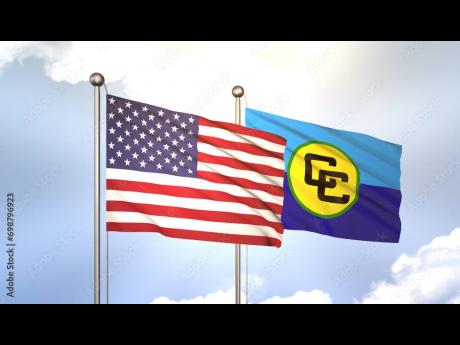
LAST WEEK, as President Donald Trump began his first week in office, this column’s focus was on the relationships and issues facing the countries of the Western Hemisphere. Articles addressing specifically the relationship between the countries of the Caribbean Community (CARICOM) and the USA seem to suggest that this region can adopt camouflage and manage to avoid incurring the wrath of the US Trump Administration. After all, in trade, the region has a trade deficit with the USA; bilateral aid is not significant; and immigration and deportation are customary concerns.
It is noted that the Community of Latin American and Caribbean Countries (CELAC) will be having an emergency meeting on Thursday, January 30, organised by Honduras. As indicated, CARICOM countries are members of CELAC and CARICOM is represented on the Bureau. This emergency meeting comes in the aftermath of US deportations to Central and South American countries on the weekend and the stand-off between Colombia and the USA. It is also reported that the US Secretary of State, Marco Rubio, will be visiting countries in Central and South America and the Caribbean (Dominican Republic) this week.
THE PRE-TRUMP REPUBLICAN PARTY
As a background reminder, on trade, recall that the free trade agreements between the USA and countries in the Western Hemisphere were initiated and/or negotiated and overwhelmingly supported by Republicans before the Trump advent in 2016. The Republican Party in 2001 championed the entry of China into the World Trade Organization (WTO). US businesses then favoured cheap labour. Presidents Ronald Reagan, George H.W. Bush, and George W. Bush were of the Republican Party which then favoured the interests of businesses, which included free trade, low national tariffs established in the WTO, globalisation, law and order, and family values. Ronald Reagan introduced the Caribbean Basin Initiative (CBI), benefiting countries in the Caribbean. It has been the view that the more conservative political parties in this region, such as the Jamaica Labour Party, were more aligned with the US Republican Party. However, the Republican Party that existed up to 2015 no longer exists. It is dead. In its place is Donald Trump’s MAGA Republican Party. On some issues, like trade and protectionism, this Trump party is looking more like Democrats. Are conservative parties of this CARICOM region now aligned with the MAGA Trump Republican Party?
THE TRUMP TRADE EXECUTIVE ORDER
On January 20, President Trump signed an executive order addressing his America First Trade Policy, which is intended to robustly invigorate investment and productivity, enhance industrial and technological advantages, defend economic and national security, and benefit American workers, manufacturers, farmers, entrepreneurs, and businesses. Using existing institutions and legal provisions, this executive order requires reports on unfair trade practices and the operation of trade agreements, among others, by April 1.
While calling for a review of revenue from tariffs, this executive order does not seem to focus explicitly on the application of punitive tariffs. President Trump, however, has threatened the use of high tariffs as punitive measures and to increase US revenues. These tariffs are most likely illegal in international trade law.
ISSUES OF CONCERN TO CARICOM
1. Immigration and deportation – In CARICOM/US relations, this is an issue always on the agenda. So, it can be expected that CARICOM nationals will be among those deported, and many will be from Jamaica and Haiti. The hope is that countries in CARICOM will not be coerced to take nationals which are not from their countries. It is reported that this was raised with some countries in the region.
2. Bilateral aid – Aid channelled through the USAID, while important, seems to be small. This aid goes mainly to Haiti, which is the only least developed country in the hemisphere. More significant development support to the region comes through the development banks, such as the World Bank, the Inter-American Development Bank, and the Caribbean Development Bank. The Trump administration has frozen all aid for 90 days to conduct a review to ensure that its aid benefits the USA. Thus, the results of this review could impact CARICOM countries.
3. Trade – The USA is the region’s major trade partner and, as pointed out in other articles, the USA has a trade surplus with this region. Trade is conducted under the non-reciprocal CBI, which is congressional legislation. It requires a WTO Most Favoured Nation waiver. The US Generalized System of Preferences, also used, may not be resurrected.
President Trump loves tariffs. He has said he intends to impose an across-the-board tariff of 10 per cent on all imports into the USA. CARICOM countries need to be on guard. They could be impacted by US tariffs on both exports and imports.
4. Multilateralism – The multilateral institutions are important to CARICOM members as small states. There, they have a voice. Much development support is channelled through these bodies. President Trump has already withdrawn the US from the World Health Organization and from the UN Paris Climate Change Accord. Other UN bodies could be in the president’s firing line. He could be looking to change the existing world order, which the USA was actively engaged in structuring in the post-World War II period. The WTO, which is not a UN body, is already facing challenges from the USA, which supported its creation. Developing countries have been calling for reform for decades, but Trump might actually bring some form of undesired change to the multilateral system.
DEPENDENCE
From all that has happened over the past weekend, it is quite evident that countries in this Western Hemisphere, including CARICOM, are too dependent on the USA, the eagle, as their primary market. Economies are too intertwined with that of the USA. Canada, during the first Trump term, had talked of diversifying their trade. CELAC was established, among other things, to promote intra-regional trade. The Association of Caribbean States should also have looked at promoting trade.
CARICOM has been in existence for over 50 years to promote regional integration and intra-regional trade. It has entered into trade agreements with countries in Latin America and the Caribbean. Yet, CARICOM has failed to fully implement the CARICOM Single Market and Economy and diversify its market. Is it time for commitment to lessening this US dependence?
Now, we are all wondering how to dodge a voracious, self-serving eagle. What is CARICOM doing? Can anything positive come from this week’s CELAC meeting? We can only hope.
Elizabeth Morgan is a specialist in international trade policy and international politics. Send feedback to columns@gleanerjm.com.