
Editorial | Destabilising South Africa
Published:Friday | March 28, 2025 | 12:06 AM
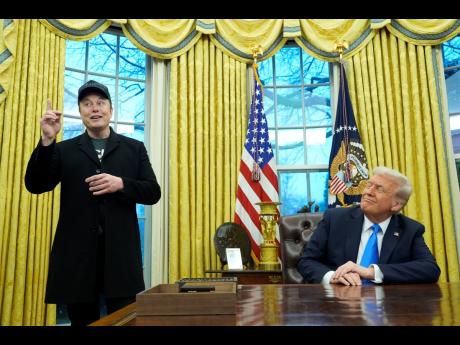
Jamaica and other countries in the Caribbean who contributed to the defeat of apartheid in South Africa can’t be indifferent to the recent insidious, and dangerous, narrative by Donald Trump and Elon Musk about that country. For, if left unchallenged, it could shape a revisionist history of South Africa and undermine its ongoing effort to build an equitable post-apartheid democracy.
Mr Trump, the American president, and Mr Musk, a white South Africa-born entrepreneur, who spent his formative years in the apartheid system, are casting Afrikaners, apartheid’s architects, as victims of current black rule. Indeed, Mr Musk, the world’s richest man and an advisor to Mr Trump, has preposterously tossed around the accusation of “white genocide”.
Mr Trump, partly driven by these allegations, has offered asylum to Afrikaners, descendants of South Africa’s Dutch settlers, the Boers, who he claimed are subject to “unjust racial discrimination”. He also mandated a cut of all American aid to South Africa. It is not clear whether the asylum policy is limited to Afrikaners or extended to all white South Africans.
IMMEDIATE TRIGGER
The immediate trigger of Mr Trump’s action is legislation that the South African president, Cyril Ramaphosa, signed into law in January, which allows the government to confiscate land without compensation, in some circumstances.
These circumstances, with respect to private ownership of the property, are “where the land is not being used and the owner’s main purpose is not to develop the land or use it to generate income, but to benefit from appreciation of its market value”.
There is a complex historical context to this law and South Africa’s land question.
Although apartheid, and the legal structure of white minority rule, was formalised in the late 1940s, its essential elements are hundreds of years old and are vividly reflected in land ownership. Early 20th century laws explicitly dispossessed blacks of land, a fact that was exacerbated by later anti-black resettlement policies.
White South Africans are only 7.3 per cent of a population of 62 million, but own 72 per cent of farmland and 49 per cent of urban holdings. Black people, who account for over 81 per cent (50.46 million people), own four per cent of the farmland and 30 per cent of urban holdings. Coloured (mixed race) South Africans control 15 per cent of rural land, and Indian/Asian, five per cent.
It is to South Africa’s credit that since the fall of apartheid in 1994, the country has avoided the kind of politically-motivated land grabs that characterised Zimbabwe, despite pressure on the African National Congress (ANC) for rebalancing.
Indeed, if anything, notwithstanding instances of corruption, as well as complaints by blacks that they have not made sufficient economic progress, South Africa deserves plaudits for cementing its multi-party, multi-ethnic democracy and maintaining the rule of law. To claim otherwise is to insult the post-apartheid effort at national reconciliation.
CYNICAL MISCHARACTERISATION
Indeed, the attempted inversion of South African history by President Trump and Mr Musk appears to be a cynical mischaracterisation of the fears of Afrikaners over a diminution of power and status, overlaid by global politics.
Like Jamaica, South Africa faces a crisis of crime, especially murders. An estimated 22,000 people were killed in 2024, for a homicide rate of around 35 per 100,000. The victims include white South Africans, farmers among them. Mr Musk has classified this as genocide against Afrikaners. He has also framed almost as official policy, the signing by a far-left political party, which is a harsh critic of the ANC, of an apartheid liberation song that refers to killing “the Boers”.
Further, Mr Trump is offended that South Africa referred Israel to the International Court of Justice (ICJ), alleging genocide and war crimes over its conduct of the war in Gaza, which has already killed over 50,000 Gazans. That war began in October 2023 when Hamas militants crossed the border into Israel and murdered 1,200 people, while taking 200 hostages.
Mr Musk, who has openly backed far-right, fascist-leaning movements in Europe, earning the ire of the continent’s mainstream leaders, has also been irritated by South African rules requiring foreign investors to open at least 30 per cent of South African enterprises to black ownership. The government, it has reported, declined to waive that rule (variations of which exist in several countries) for Mr Musk.
History is replete with instances of groups and people who victimised others, later casting themselves as victims. In South Africa’s case, on the basis of the evidence and the conclusion of most well-thinking people, this historical inversion is simply not true.
The danger of President Trump’s and Mr Musk’s distortions and perpetration of what President Ramaphosa called a “completely false narrative” is that it could lead to a hardening of positions, widen chasms that exist between white and black South Africans, and unravel the achievements of the post-apartheid truth and reconciliation project.
Instability in South Africa might give some people an immediate rush, but it is of no long-term value, geopolitical or otherwise, to anyone. Rather, it diminishes us.