
Patricia Green | Liability of the house of cards
Who is taking responsibility for unplanned developments?
Published:Sunday | June 12, 2022 | 12:07 AM
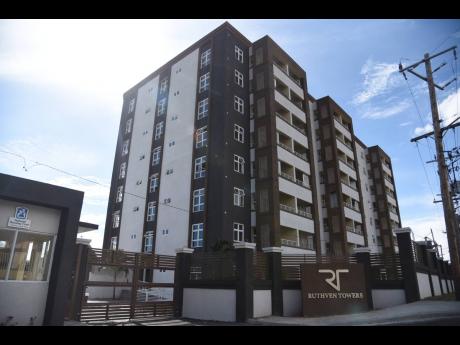
Kudos to the Jamaica Fire Brigade (JFB) for preventing the issuance of the clearance for the 86-unit National Housing Trust (NHT) Ruthven Towers. The Gleaner of May 29, ‘NHT Bungle: ‘Structural issues’ at upscale Ruthven Towers prevent owners from occupying apartments’ noted that “under the original design, the complex was slated to include 238 apartments, spread across four blocks, each rising six floors”, but the NHT redesigned the units into a single eight-floor building as Phase One.
In the 1990s, I attended a Benny Hinn Healing Crusade in Atlanta, Georgia, and witnessed a fire inspection at the Convention Centre relating to facilities and number of persons present. Curious, I tagged alongside the fire team, asking questions that they happily answered. Eventually they permitted me to enter, removing persons for a capacity of 3,000. Proceedings was delayed for over an hour.
In 2019, I witnessed again a fire inspection at the UNESCO Paris, France, headquarters before its director was permitted to commence the assembly each morning.
Ruthven Towers is an indicative scenario surrounding multi-family developments in the Kingston Metropolitan Region. The issue is about who holds responsibility, then critically, who may be issued with liability for this?
INDICATORS
First indicator: Have multifamily dwellings, especially those over two storeys, received a ‘Return to indicate completion of building works’? This is spelt out under Section 12 of the 2018 Building Act as “signed by the chief engineering officer, and certified by him that to the best of his knowledge and belief, all building work to which the return relates has been completed in all respects in accordance with this Act, the National Building Code [under the purview of the Jamaica Bureau of Standards] and any other regulations made under this Act and that they have been duly inspected by him and that information submitted under section 11(1) is true”.
Even if a land surveyor has issued certification for a finished apartment to facilitate mortgage acquisition, was any prior due diligence undertaken to ensure regulatory compliance and safety standard adherence of the development?
Under the Building Act, the KSAMC holds final responsibility over any building permit it has issued. The building must be declared satisfactorily completed for occupancy, including meeting all safety factors such as for fire. Liability also resides with others, hence the KSAMC is obliged to obtain prior certification from the various entities.
Following the June 14, 2017 fire at the 24-storey Grenfell apartment building that had housed up to 600 people, killing at least 79 in London, Time Magazine in ‘The Continuing Urgency of the Grenfell Tower Inferno,’ June 23, 2017 remarked, “the mounting evidence that the fire might have been prevented were it not for the negligence of authorities and regulators.”. Grenfell had no water sprinklers although it had been recently restored using aluminium cladding with a polyethylene core, “which the British media suggest could have been made fire-resistant for only $6,300”.
Another London highrise caught fire on March 7. Thankfully, there were no fatalities, starting on the 17th storey of the 21-storey relay housing development run by three different companies, reported The Guardian. Its wooden balconies were destroyed in the fire. The London Fire Brigade released that they mobilised around 125 firefighters and 25 engines including its 64-metre turntable ladder, the tallest firefighting ladder in Europe, that allowed them to get water onto the fire from outside the building. ITV News of March 7 spoke to a London borough commander who said the building was “…structurally sound…”.
A late for a prominent project manager Jamaican insurance company, chose only to use a certain architect for all their Jamaican development projects because that architect’s buildings never leaked and he had no liability issues to contend with.
Santiago Calatrava, a Spanish/Swiss architect, structural engineer, sculptor, and painter, is internationally known for his bridges and buildings designed like wings that move. Dezeen Newsletter of May 21, 2014 reported that “in June 2013, he [Calatrava] paid €3.3 million to settle a dispute after a conference centre he designed in the northern Spanish city of Oviedo suffered structural collapse … in Bilbao, his footbridge to the Guggenheim has caused controversy after the city had to pay compensation to pedestrians who slipped on its glass surface in wet weather”.
WHY THE SECRECY?
Second ind icator: Why the secrecy over development projects, including those undertaken by government using public funds? The Gleaner of May 30 reported that ‘NHT denies claims of ‘structural issues’ with upscale Ruthven Towers’ and said “public scrutiny because of its [Ruthven Towers] costs, which range from $27.7 million to $37.7 million”. An Access to Information request for their inspection document has been submitted to the JFB.
Third indicator: Which socio-economic target groups can afford the range of new highrise multi-family residential developments including Ruthven Towers constructed with public funds? The Gleaner May 31 article, ‘NHT denies structural issues at Ruthven Towers’, said members of the Jamaica Teachers’ Association, Nurses’ Association of Jamaica, and Jamaica Civil Service Association “…returned units allocated to them because their members cannot afford the mortgage payments … there are also issues about the maintenance fees…”.
Fourth indicator: Why are multi-family developments with basement breaches, as discussed in development judiciary reviews, being permitted with questionable designation as parking yet appearing as potential habitable spaces for additional apartment units? The Gleaner May 31 news story, ‘Ruthven Towers still unoccupied’, said that the JFB had “concerns about the fire doors, a staircase, and the access to the basement where residents are to park”.
Fifth indicator: Why are citizens excluded from an open and transparent planning process for the urban environment? This contravenes Jamaica’s signature to the United Nations 2018 ‘Regional Agreement on Access to Information, Public Participation and Justice in Environmental Matters In Latin America and the Caribbean’. The Gleaner editorial on June 2 titled, ‘What went wrong at Ruthven Road?’, speaks to “part of that process requires being honest and open when things go wrong and understanding why”.
Sixth indicator: What should be hurricane preparedness, question citizens, for residents and neighbours exposed to highrise glass balconies, plate-glass windows and doors? The Gleaner of June 6 ‘NHT takes step to fix issues at Ruthven Towers’ reports “the NHT continues to work on other minor finishes that will allow for more comfortable occupancy by the new homeowners”. However, where is the Ruthven Towers occupancy preparedness plan for fire, also for the June 1 commencement of the 2022 hurricane season?
Where is development preparedness to come from? From government, developers, managers, contractors, sub-contractors, professionals, practitioners, or all?
Allow the Jamaica Fire Brigade to perform unhindered their responsibility for public safety. By so doing, they should be relieved of any potential liability claims.
- Patricia Green, PhD, a registered architect and conservationist, is an independent scholar and advocate for the built and natural environment. Send feedback to patgreen2008@gmail.com.