
David Salmon | Jamaica’s biggest threat
Published:Sunday | March 23, 2025 | 10:02 PM
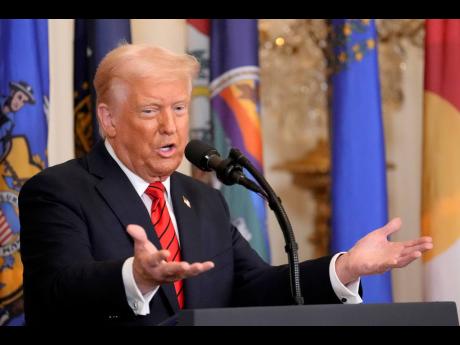
March 20 marked the second-month anniversary of the inauguration of President Donald Trump. These past two months have highlighted an inescapable truth: Jamaica cannot rely solely on the United States. We must secure our own interests by diversifying our economy and international partners.
The dismantling of USAID illustrates how the US government has no moral qualms about wielding a sledgehammer in a china shop. While we are not as reliant on USAID compared to other countries, nevertheless the organisation’s dismantling has increased our own vulnerabilities.
For example, USAID was a major funder for local HIV/AIDS treatment. The overnight elimination of this support compromises our healthcare system’s ability to respond to this disease. This should make any policymaker uncomfortable. Jamaica should not have to rely on the temperament of the average American taxpayer or its leader to satisfy its healthcare needs.
This example also highlights the arbitrary nature of decision making currently taking place in Washington. Foreign aid is 1.2 per cent of the US’ budget with USAID being 0.6 per cent of total federal spending. And yet this is touted as an example of government inefficiency.
The real problem is not necessarily the elimination of funding. The challenge is with the abruptness of this decision without any thought to its implications. With a friend like this, who needs enemies?
THREATS OVER CUBA
Now, the Trump administration is pressuring the Caribbean with regard to who we employ as healthcare workers. This month, it was reported that the US threatened Caribbean countries with visa restrictions for their decision to employ Cuban medical professionals.
Ironically, one reason why the region has had to employ Cuban professionals in the first place is due to the recruitment of our medical personnel by American recruiters. Many of these recruiters come to the region to lure professionals to work in the US. Consequently, historically, Cubans have filled the gaps.
For an administration so concerned with “America First,” they are awfully interested in meddling in the affairs of other countries. If removing financial assistance was not enough, the US has sought to tell us who we can or cannot employ as doctors and nurses. This is intolerable!
HISTORY OF THREATS
Let there be no mistake. The presidency of Donald Trump should not be seen as an isolated incident but a culmination of coercion that transcends administrations. This is not about regurgitating turgid accusations of foreign interference in the 1970s. Even “friendlier” administrations have utilised hand twisting against Jamaica.
In 1996, the Clinton administration threatened the country with financial sanctions and the withdrawing of aid because of what they perceived as Jamaica’s failure to combat drug trafficking although the Financial Gleaner reported on January 3, 1997, that “the real reason for the US government’s peeve was the Jamaican Government’s refusal to allow US crimefighters to chase and arrest suspected drug smugglers in Jamaica’s 12-mile territorial zone.” Jamaica further angered Washington “by calling on the US to impose greater control on the smuggling of guns from that country as a part of any agreement”.
In other words, in the exercise of sovereignty, the US threatened Jamaica with financial ruin. If you tell someone that they cannot enter your house and that person threatens to burn your house down, that person is not a friend.
CURRENT SENSE OF URGENCY
Even more recently, the Biden administration issued a travel advisory, which led to a fall in visitor arrivals. The reasons for this warning were never stated, but it makes little sense as it was issued while crimes were on a downward trend. What this emphasises is that Washington is willing to use any tool at its disposal to achieve its interests regardless of the consequences.
With uncertainty surrounding Trump’s imposition of tariffs, US consumer expenditure is currently down. Many Americans are avoiding new expenses and are saving for any uncertainty. Correspondingly, private-sector confidence has weakened and growth forecasts have been cut.
For Jamaica, this means fewer remittances as the diaspora saves in anticipation of a recession, and tourist arrivals will not be as buoyant. Remittances and tourism are our biggest sources of foreign exchange. With economic slowdown in the US, Jamaica will be adversely impacted.
WHAT CAN BE DONE?
The solution is not to repeat the same mistake by allying with any one country or block. For example, if Jamaica solely relied on the British, we would have been left exposed as last month, Prime Minister Keir Starmer announced cuts to Britain’s overseas assistance in order to expand military expenditure.
If we think that European countries are any better, we can just look at a speech made by French senator Claude Malhuret. In arguing for greater European collaboration considering Trump’s rapprochement with Russian President Valdimir Putin, Malhuret said, “The Global South is awaiting the outcome of this conflict to decide whether they should continue respecting Europe or whether they are now free to trample it.” Who is he referring to? This explicitly shows the contempt many policymakers even in Europe have towards non-European nations. In reality, Jamaica is alone.
That is why we must review all areas where the country relies on overseas assistance. Even agencies funded by more reliable partners such as the World Bank should be scrutinised with the goal of examining in the short to medium term how to absorb these bodies into the central budget. Public agencies that currently receive funding from international organisations include the Development Bank of Jamaica and the Jamaica Social Investment Fund. We should not take this assistance for granted as it will not always be there.
Additionally, our government cannot rely on the belief that it will be treated differently given that we previously had a better relationship with the Trump administration than other Caribbean countries. Europe thought that it was the exception, and yet, the continent is now reeling from this flawed assumption.
Ultimately, Jamaica must pursue rapid economic growth at all costs. This will require diversifying the economy away from tourism and remittances. Our economic survival depends on it. If there is one thing that should be appreciated about Donald Trump’s presidency it is that it has opened our eyes to the unreliability of the United States. It is up to Jamaica to decide whether we continue to rely on an “emperor with no clothes”.
David Salmon is a public commentator, development specialist ,and a Rhodes Scholar. Send feedback to davidsalmon@live.com or on X @DavidSalmonJA.