
Samuda touts ‘significant’ investments in drought mitigation
Published:Thursday | April 11, 2024 | 12:08 AMSashana Small/Staff Reporter
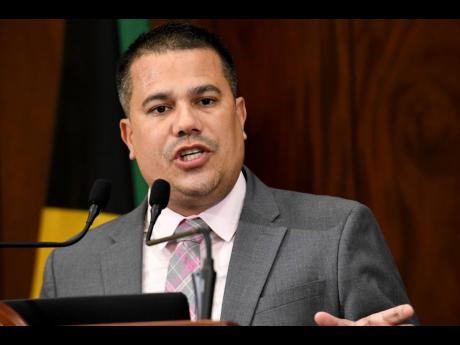
MINISTER WITHOUT Portfolio in the Ministry of Economic Growth and Job Creation, Matthew Samuda, says the Government has made significant infrastructure investments and honed its emergency response to minimise the impact of the drought season.
“It is important that citizens note that the Government did not allow drought to creep up on us in terms of its planning. Government, through the IWRMC, which is the Integrated Water Resource Management [Council], meets and also has a drought management committee that meets in and out of drought to examine the response and to fine-tune emergency response when we know this comes,” he said.
He was speaking during yesterday’s post-Cabinet press briefing, where he shared that the Government had made allocations of $450 million to the National Water Commission (NWC) for water trucking as well as approximately $102 million to the Ministry of Local Government.
Additionally, he said allocations were made to the Ministry of Economic Growth and Job Creation and stated that it also had “significant contingency funds” at the Ministry of Finance that it could access.
Evan Thompson, head of the Meteorological Service of Jamaica, explained that lower-than-normal rainfall in October last year and a further dip in rainfall in January gave rise to the current drought season.
To cushion the effect of future droughts, Samuda stated that the Government has $5 billion of capital works projects for potable water, $2.5 billion for infrastructure work sewage, and a further $1.6 billion to be spent through Rural Water Supply Limited.
“We’re well aware that our climate has changed and our weather patterns have shifted. The reality is some of these investments should have been made 30 years ago. However, it is this Government that is investing at an unprecedented rate to correct this investment in our water sector,” he said.
Samuda also highlighted the Government’s achievement in bringing non-revenue water in Kingston to 38 per cent.
Non-revenue water is water that has been produced and is “lost” either as real or physical losses (for example, through leaks and overflows) on one hand and as apparent or commercial losses (for example, through unauthorised use, theft, and metre under-registration), and authorised unbilled use such as water supplied to fire hydrants.
MORE WATER RESILIENT
“It means we have virtually cut leaks and theft in half, and what has that practically meant? In 2015, we needed 55,000 million gallons of water for the Corporate Area daily ... investments cut it down to 38 million gallons of water a day in the Corporate Area,” he said. “[Despite] increasing development and an increase in population, we are using less water. It means we are more water resilient in the Corporate Area.”
Further, he pointed to the public-private partnership arrangement that the Government has entered into for a water-treatment plant in Content, St Catherine, which he said would add 15 million gallons daily to the system.
“So we’re starting to see how the infrastructural investments will come together because if you were short 12.5 gallons in the worst of the worst drought and you’re adding 15 million gallons, you’ll see that you are better able to serve Spanish Town, Portmore, and Kingston and St Andrew,” he said.
Following the success of this non-revenue water programme in the Corporate Area, Samuda said the Government would be extending it islandwide at a cost of US$300 million, which is expected to last 10 years.
“Non-revenue water exercise does increase storage in areas of higher elevation. It does have (water) main replacement, it does install pressure monitors, and it does put in new measures at the household level by way of … digitising metres. So it changes the entire network, and we’re better able to manage your supply,” he said.
Additionally, Samuda shared a US$209 million water-development strategy for western parishes. He stated that it would involve the replacement of mains in St James and Negril and will commence this year.
This programme is expected to be executed over two years at a cost of US$70 million.