
Reading revival
Pembroke Hall High School reports remarkable turnaround less than year after implementing remedial literacy strategy
Published:Monday | February 16, 2026 | 12:09 AMKimone Francis/Senior Staff Reporter
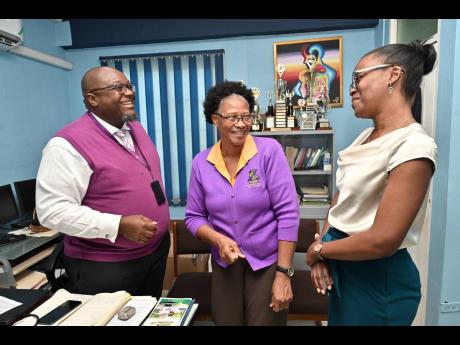
Less than a year after a literacy crisis at Pembroke Hall High School drew national attention, the institution has reported a landmark academic turnaround.
Internal assessments have shown that 76 per cent of grade-seven students have advanced by two or more grade levels in reading, a success attributed to reduced class sizes, a specialised Grade 7 Academy model, and intensive remedial collaboration, principal Reverend Claude Ellis said.
Of the 220-student cohort, who have since matriculated to grade eight, 105 students improved two grade levels and 63 moved three or more grade levels, internal assessments showed. At the same time, 25 students showed no improvement, while 27 were not tested.
“When we did our post-tests at the end of grade seven for them to move to grade eight, what we found was that a significant amount of them, almost all of them, would have moved several places in terms of their reading level. At least two or more levels above their starting point,” Ellis told The Gleaner during an interview at the school last Wednesday.
Diagnostic tests
In June last year, the principal disclosed that the majority of grade-seven students entered the school at least four grade levels behind in literacy. He said some were also unable to identify letters.
As a result, he said a series of diagnostic tests were administered to “augment” the Primary Exit Profile (PEP) results and reports sent from the education ministry.
“The ministry sends us a report for students of whether they are at the beginning, they’re at the developing, they’re at the proficient or highly proficient level, but we still do our own test just to make sure that we’re saying the same thing about the same students,” the principal said.
He said students were screened to identify those with learning disabilities, and several measures were implemented to engineer improvement.
“It’s not one thing that we have done, I believe, that has caused this positive change; but there are a number of things that are being done. We collaborated with Holy Trinity and implemented the Grade 7 Academy. One of the things that we saw them doing and were really strong on is the character development education, and so we have put that as a part of our curriculum,” said Ellis.
“It is something that we are moving strongly towards, because we believe that in developing their character … kindness, values, just basic things [are needed],” he added.
In September 2024, Holy Trinity High School, which also struggled with literacy, introduced its Grade 7 Academy, an overhaul of the traditional secondary model by prioritising foundational recovery through a double-block schedule, providing students with two daily 90-minute sessions dedicated exclusively to language arts and mathematics.
By scaling the curriculum from 13 subjects to seven core areas, the programme maximises time on task for literacy, supported by 40 minutes of daily technology-aided learning.
The intervention was further strengthened by capping class sizes at 20 students, creating small groups that allow for individualised attention.
Ellis said, with a similar programme now implemented, the school is anticipating even better results.
Additionally, he said results from a mandatory summer programme also caused the school to reduce class sizes and introduce individualised programmes for students having challenges.
“This worked better with some students who were struggling in the bigger classes. It was glaring at that time because, naturally, the classes were smaller. So we learnt from that, started an implementation in 2025, and coming into the 2025-2026 school term, we tried to do our best to ensure that our class sizes are as small as we can make them,” he said.
Further, he said the school has literacy and numeracy specialists, paid for by the education ministry, permanently on its roster. He said approval has been given for a second literacy specialist.
Ellis, who has served as principal since 2017, said the school has also mapped the institutions where the majority of its students matriculate from, and several meetings have been held with principals looking at ways to improve students’ results before they reach Pembroke Hall.
“We’re having conversations to say, ‘This is what we are seeing here at grade seven, which means they are coming from you. How can we work together to improve’,” he explained.
The principal said the school has also scheduled the hosting of its parent-teacher meetings in surrounding communities, to meet parents halfway and foster greater involvement.
“This programme that we’re on now and these several interventions that we’re doing, we’re going to be meeting with them to report the results. And so it’s out of this that we’re expecting more parents to come on board,” Vice-Principal of Human Resources and Operation Yvette Shields-Green added.
Meanwhile, Ellis wants outside support for the implementation of a breakfast programme for grade-seven students.
“I believe this will help them to be a lot more settled than they are now, and it will also enhance what it is we’re doing. You just know that a lot of them are struggling. They have the basic lunch money, but if we have something that we could do breakfast for them that would be excellent,” said Ellis.