
‘It’s American imperialism’ – Crowne raises issues with act used to investigate Okagbare case
Published:Sunday | October 3, 2021 | 12:07 AMAndre Lowe - Sports Editor
To access this article in full please login or register today
With the controversial Rodchenkov Anti-Doping Act now back in the headlines following the RJRGLEANER report that the legislation is being enacted to push investigations into the doping case involving Nigerian sprinter Blessing Okagbare,...
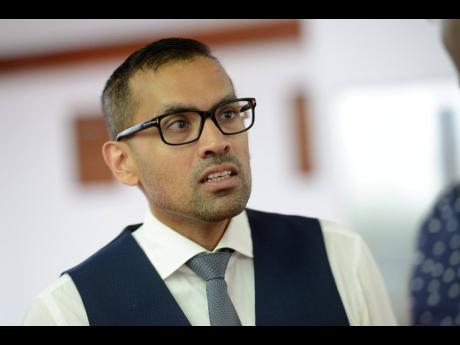
With the controversial Rodchenkov Anti-Doping Act now back in the headlines following the RJRGLEANER report that the legislation is being enacted to push investigations into the doping case involving Nigerian sprinter Blessing Okagbare, international sports attorney Dr Emir Crowne, is raising questions about the legitimacy of the regulation.
Crowne highlighted what he considers to be significant issues with the act, which he labelled as a gross over-reach and an undermining of the efforts and authority of the World Anti-Doping Agency (WADA).
The act, which was passed by the US government in December 2020, grants extraterritorial jurisdiction over major international doping fraud conspiracies and provides the framework for the prosecution of individuals involved in doping schemes at international sporting events.
Under the law, criminal prosecution cannot be brought against athletes who test positive for performance-enhancing substances, focusing instead on coaches, support personnel and other individuals.
This plus the act’s wide-reaching jurisdiction and its criminalisation of doping offences are the main points of contention for Crowne, who boasts among his clientèle in anti-doping matters individuals from every corner of the world.
“With respect to the Rodchenkov Anti-Doping Act, I think it is a highly problematic act,” Crowne told The Sunday Gleaner.
“I guess the first little note about the act is that it applies to everyone except athletes, so it says, it shall be unlawful for any person other than an athlete to carry out basically a doping conspiracy,” Crowne added. “So anyone other than the athlete that is involved in using or importing a prohibited substance or prohibited method is subject to the act.”
“Now that in itself may not be problematic, but the act goes further to say it shall have extraterritorial effect, which means somehow the US has criminal jurisdiction over people outside of the United States and they claim this jurisdiction on the basis that if those people are involved in a major international sport competition, then they the United States (US) have jurisdiction over them.”
WIDELY INTRUSIVE
“So here you have an act that criminalises doping conspiracies that applies extraterritorially, it applies to people beyond the United States – in my view its widely intrusive. It intrudes on what we call the comity of nations, that each nation sort of respects the boundaries of its own laws,” Crowne added.
“It’s criminalising doping, which takes it to a completely different scheme from what we all currently know because doping is currently a civil offence, the burden of proof is much lower and the sanctions are also much lower compared to a criminal scheme.”
The Rodchenkov Anti-Doping Act stipulates criminal penalties, including a prison sentence of up to 10 years and fine not exceeding US$250,000 for individuals, and up to US$1 million if the defendant is not an individual.
Okagbare was provisionally suspended by the Athletics Integrity Unit (AIU) on July 31, just before she was scheduled to contest the women’s 100m semi-finals at the Tokyo 2020 Olympic Games, after a July 19 out-of-competition test showed that she had used the anabolic steroid, Human Growth Hormone (HGH).
WADA rules surrounding the use of HGH call for a maximum four-year ban for first-time offenders.
“I know WADA has significant problems with it (act) and quite frankly, and perhaps a bit unusually, I agree with WADA this time that there are serious problems with the act and I am surprised that there hasn’t been more of a reaction to it, especially since the law was passed on December 4th of last year and the Olympics and so on were caught within it in theory,” said Crowne.
“Could you imagine if an act like this was passed outside the United States and then somehow a foreign country was criminalising US coaches or US support personnel? The US would laugh at that law. The US would say there is no way that law could apply to us, but yet the US feels perfectly entitled to enact their own law,” Crowne shared.
“It’s classic America imperialism because I guarantee you that America would have baulked if another country tried to pass a similar law which extraterritorially criminalises US citizens,” he added.
Crowne also takes issue with the act essentially establishing a US-grounded structure which operates independently of WADA.
“What is also interesting in the law is that it authorises USADA to share information in the possession of the Department of Justice, the FDA (US Food and Drug Administration) and the Department of Homeland Security. So several federal agencies are now involved in this information sharing, but, as we know, WADA is the supra-national body that is coordinating anti-doping efforts globally and now you have the US sort of sidetracking and taking a bit of the sting out of WADA’s efforts, in my view. Now they have their own system investigating and punishing doping conspiracies,” Crowne noted.