
Starved cops - Equipment shortage slows ballistics unit
Published:Friday | September 17, 2010 | 12:00 AM

Laura Redpath, Senior Gleaner Writer
A major shortage of some basic equipment is causing a massive backlog in cases at the ballistics unit within the Police Forensic Lab.
This has led to delays in the investigations of thousands of cases.
According to acting head of the ballistics unit, Deputy Superintendent Carlton Harrisingh, basic items in short supply include comparison microscopes, which are essential in any in-depth probe.
"It is only one microscope and we cannot move as fast," Harrisingh told The Gleaner.
"If somebody is using that microscope, everybody else will have to wait until that person is through," he added.
Harrisingh pointed out that one investigator working on a case could spend up to two days using the only available microscope.
A source within the police force said the forensic department is in the process of acquiring two more microscopes - each quoted at US$57,000 or approximately J$4.9 million plus shipping.
However, it is unclear whether the Government has ordered any of these equipment. Attempts to contact National Security Minister Dwight Nelson proved futile yesterday.
The forensic department has been allocated $145.6 million in this year's Budget, a slight decrease from the $149 million it received last year. Some $96 million of the allocation is to pay salaries, while $27 million is to purchase equipment.
Meanwhile, Harrisingh was unable to provide figures on the number of investigations back-logged in the system, although he admitted that the number is staggering.
"It's really a problem to get a true picture of what the backlog is because it's all manual," Harrisingh said.
He noted that individual files would have to be counted manually to determine the backlog.
"It's not that we can say from 1,000, (we have) 500 already finished so we can tell what the balance is. That's the real problem," Harrisingh said.
According to the deputy superintendent, since he took over the position last week, he has been trying to implement an electronic system to keep track of the cases going through the forensic lab.
"We don't have an electronic database. We just started to build one."
However, Harrisingh argued that despite the problems, the lab is handling priority cases where charges have been laid.
This is not the first time that the officials at the police forensic lab have pointed to a shortage of equipment as a problem.
The much-talked about Inte-grated Ballistic Identification System, which cost the country US$1.9 million and is designed to allow the police to develop an appropriate firearms database by matching bullets and spent shells to weapons, has gone through several problems and delays.
These include an almost one-year break in the use of the system becuase of contractual issues.
Assistant Commissioner of Police Les Green, who heads the Major Investigation Task Force (MIT), told The Gleaner that the unit is now up and running.
Green, who said there are no ballistics issues he is aware of that are affecting MIT investigations, acknowledged that the suspension in the use of the system created a backlog, which law-enforcement officials are now trying to clear.
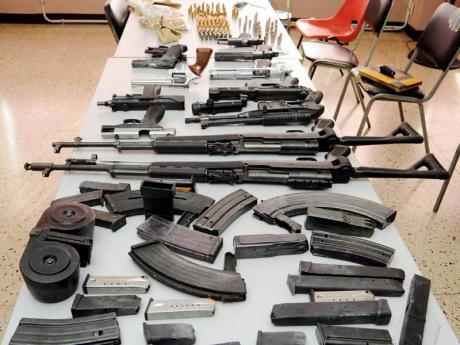
According to Green, up to a week ago, the police had seized 520 illegal firearms, most of which can be traced back to the United States.
"There's a whole multitude. It goes from handguns to automatic weapons. Certainly, some of the weapons are very high-powered automated weapons but the vast majority of weapons we see are handguns," Green said.
There were 793 gun murders and 1,054 shooting incidents recorded across the island as at September 12.