
Revolt met with wide support, censorship
Published:Sunday | February 13, 2011 | 12:00 AM

LONDON (AP):
From London to Gaza City to Seoul, the world was savouring the spectacular fall of Egypt's Hosni Mubarak, with demonstrators rallying in the thousands yesterday in cities across the world. But other authoritarian regimes weren't celebrating - and some were trying to censor the news.
In China, where the ruling Communist Party ruthlessly stamps out dissent, terse media reports downplayed the large-scale pro-democracy protests in Egypt that forced Mubarak from power and instead emphasised the country's disorder and lawlessness.
In oil-rich Equatorial Guinea, where coup leader Teodoro Obiang has been in power since 1979, state-controlled media was ordered to stop reporting about Egypt altogether, according to African news site afrol.com.
Nearly everywhere else, news-papers congratulated Egypt's revolution, with many headlines carrying the word: 'Finally'.
The headlines were matched with an outpouring of international support. Human-rights group Amnesty International organised dozens of rallies around the world, with events in New York, Chicago, Houston and cities in 15 other countries.
In London's Trafalgar Square, thousands gathered to see scenes from Tahrir Square beamed via video link on to a giant screen. Salil Shetty, Amnesty's secretary general, told the crowd that the rally was both a celebration of Mubarak's departure and a protest against the strongmen still holding sway over the region.
London-born Shariff el-Wardany, 33, whose family is from Cairo, said he was "still numb" that the Egyptian dictator had gone.
"We were told many years ago that we would never see this day," he said. "The elite could go anywhere, do anything, they could commit crimes and nobody could touch them. That's all changed now."
In the Middle East and Africa, politicians and activists were still struggling to find their footing as the shockwaves from Mubarak's resignation spread through the region. In Yemen and Algeria, violence erupted as protesters pressed their demands for democratic reforms. In Uganda and Zimbabwe - two countries ruled by long-serving strongmen - opposition figures invoked Mubarak's downfall as a warning to their current rulers.
In Gaza, a celebratory rally organised by the radical Islamist group Hamas - and the silence maintained by both the Western-backed Palestinian Authority and the Israeli government spoke to the possible repercussions of Mubarak's ouster for long-delayed peace process.
Hamas has had a tense, often angry relationship with the deposed Egyptian president who, along with Israel, has kept Hamas-ruled Gaza blockaded for the past four years. If Egypt's Islamist Muslim Brotherhood wins a role in any post-Mubarak government, it could help Hamas shore up its position.
Wider afield, the congratulations kept pouring in.
Australian Foreign Minister Kevin Rudd commended Egyptians on what he called a clear and courageous protest movement.
"My view is that the people of this most ancient civilisation truly deserve a most modern of demo-cracies," Rudd told the Australian Broadcasting Corp.
Japan and South Korea issued statements noting Mubarak's resignation, while India - which with Egypt was one of the founding members of the Non-Aligned Movement during the Cold War - said it welcomed Mubarak's decision to step down "in deference to the wishes of the people of Egypt".
In Indonesia and the Philippines, two countries whose own 'people-power' revolts toppled long-ruling dictators, the praise was more fulsome, although there were words of warning too.
Philippine President Benigno Aquino III, son of the late President Corazon Aquino - the country's democracy icon who was swept to power in a revolt that toppled the late dictator Ferdinand Marcos - welcomed the "relatively peaceful resolution" of the political crisis in Egypt, saying it showed that "aspirations for a more free and fair society are universal".
Indonesians - who chased long-time Washington ally General Suharto from power in 1998 - largely echoed the sentiment.
"Congrats, Egyptians," Luthfi Assyaukanie, leader of Indonesia's Liberal Islamic Network, wrote on the micro-blogging site Twitter. "I know how you feel today. I had the same feeling 13 years ago. The real struggle has just begun."
In Thailand, which has been rocked by demonstrations aimed at forcing the country's prime minister to step down, protest leader Thida Thavornseth said Egypt's experience had shown "that the power of the people is enormous and triumphant".
- Uncertain future for US policy
WASHINGTON (AP):
The United States faces an intensely uncertain future in Egypt, a stalwart ally for decades in the volatile Middle East, where key tenets of American foreign policy are now thrown into doubt.
Behind President Barack Obama's praise for Egypt's protesters and the outcome they achieved lie major unanswered questions about what will come next now that President Hosni Mubarak has been overthrown after 30 years of authoritarian rule. For many people in Egypt, they were years of oppression, corruption and poverty; but for the US, Mubarak was an anchor of stability at the helm of the world's largest Arab nation, enforcing a peace treaty with Israel and protecting vital US interests, including passage for oil through the Suez Canal.
For now, the military is in charge, but whether, when or how a transition will be made to the kind
of democratic society that meets the protesters' demands remains unknown. Speaking at the White House last Friday, Obama ack-nowledged difficult days ahead and unanswered questions but expressed confidence that the answers will be found.
OBAMA praises military
Most tellingly, as the US warily eyes the days ahead, Obama singled out the Egyptian military for praise in the restraint it showed through more than two weeks of largely peaceful protests. But the president emphasised the military's role as a 'caretaker' leading up to elections now set for September and said it must now "ensure a transition that is credible in the eyes of the Egyptian people".
He said that means lifting Egypt's hated 30-year-old emergency police powers laws, protecting the rights of citizens, revising the country's law and constitution "to make this change irreversible and laying out a clear path to elections that are fair and free".
But just as the US had limited influence during the uprising that seemed to spring almost out of nowhere to overtake Egypt, it has limited influence over what happens next. The US provides some US$1.5 billion a year in aid to Egypt, the vast majority of it to the military. The US has a good relationship with the Egyptian military, which often sends officers there for training. That doesn't guarantee a commanding US role.
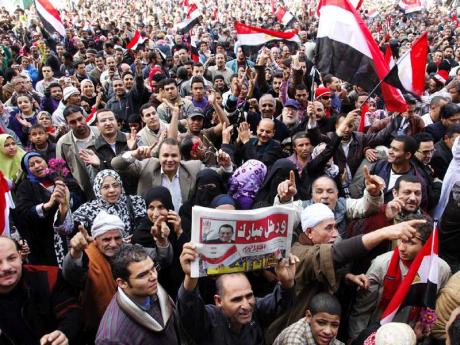
CAPTION: Egyptians celebrate as one of them holds up a newspaper fronted by a picture of former President Hosni Mubarak with a headline in Arabic reading 'Finally he steps down' at Tahrir Square in Cairo, Egypt, yesterday. Egypt exploded with joy, tears, and relief after pro-democracy protesters brought down President Hosni Mubarak with a momentous march on his palaces and state TV. Mubarak, who until the end seemed unable to grasp the depth of resentment over his three decades of authoritarian rule, finally resigned last Friday and handed power to the military. - AP