
Quickie IMF deal unlikely
Published:Wednesday | January 25, 2012 | 12:00 AM
Steven Jackson, Business Reporter
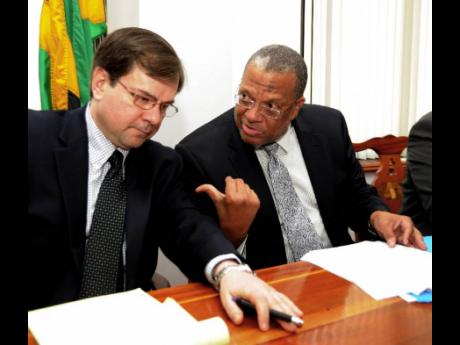
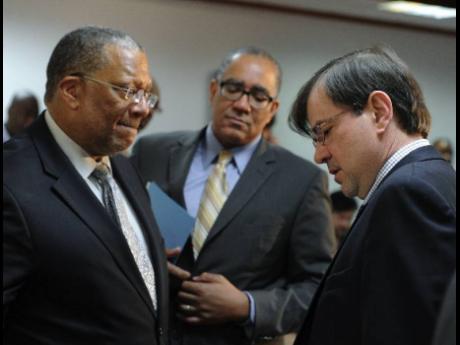
Negotiations for a new International Monetary Fund (IMF) programme would begin in February but will not involve new borrowing, Minister of Finance Dr Peter Phillips said Tuesday.
The timeline begins next week with the briefing of Cabinet at a retreat, followed by Phillips leading a team to meet the US-based fund in early February, and a return of the IMF mission team in late February.
Phillips avoided stating whether these negotiations would conclude in time for the new fiscal year on April 1.
And while he has previously said an Extended Fund Facility is preferable, he avoided confirming the type of deal Jamaica now hopes to negotiate.
"You can't go into a negotiation and determine the end point. That's why I am not telling you an end point except to say we are determined to use our best efforts, within the confines of good sense, to come to a conclusion," said Phillips at a press conference held at the Ministry of Finance in Kingston to report on the IMF team visit.
He said the details on the nature of the new programme remains undetermined.
"Much work remains to be done. It is not going to be possible to discuss technical details at this point," he said, but later told Wednesday Business at the close of the press conference that a new programme would not involve new borrowing.
"Not from the Fund," he affirmed. "There is no urgent balance-of-payment problem that we face. But obviously, we have to look for our financing for our fiscal going down the line. The scope for increasing the debt as measured by our debt to GDP is just not there."
Jamaica currently has US$1.9 billion in net reserves, falling consistently from US$2.6 billion last April.
Phillips last week stated that new negotiations with the IMF could result in the unlocking of some US$220 million of funds from the Inter-American Development Bank. These funds were stalled along with a portion of the disbursements under the IMF US$1.27 billion standby agreement inked under the previous administration in February 2010.
The IMF team led by Luis Breuer, IMF division chief, visited the island to meet the new political administration which won elections in December.
Joint agreement
The IMF and Phillips broadly agreed that the island faced mounting challenges and that a new programme was required to increase the island's competitiveness and growth trajectory.
"We have made significant progress in the sense that we have a common view — both the authorities and the IMF team — on the challenges faced by Jamaica, in particular, in the context of an international economy that is in a dangerous phase," said Breuer at the press conference. "There are indications that the world economy has slowed down."
Phillips stated that the new programme would continue to implement qualitative requirements under the existing agreement, including tax reform, reduction of government expenditure, pension reform and the elimination of duplication in the public sector.
He said any new programme would entail a growth component but avoided stating targets. The island's growth rate severely underperforms the region and world economy, such that it consistently ranks in the bottom 25 slowest-growing nations based on annual United Nations data.
"There is a growth component in this effort we are undertaking," he said. "We are owning this programme. The people require that there is an economic foundation in order for the people's aspirations to be achieved."
On Tuesday, the IMF revised down by 70 basis points its growth forecast for the world economy to 3.4 per cent for 2012. It said Europe could contract by 0.5 per cent. Phillips said a global slowdown could result in reduced foreign exchange earnings for Jamaica.
"It certainly can have an impact on payments account, exports could potentially be affected and also remittance flows. It would increase our vulnerability on both the fiscal and balance of payment accounts. That would significantly worsen the risk that the Jamaican economy faces," he said. "Ultimately, we have to make adjustments so that the economy can rebound when the world economy rebounds."
Phillips reiterated that the existing standby agreement has been derailed and suggests it is unsalvageable, citing the non-disbursement of additional funds and cessation of performance reviews "for about a year".
"My conclusion is that the targets outlined have been breached. It has been irrecoverably derailed," he added. "We are entering into discussions with a view to establishing a programme. You cannot revive something that is finished."