
Nonprofit reads newspapers for those who can't
Published:Sunday | February 12, 2012 | 12:00 AM
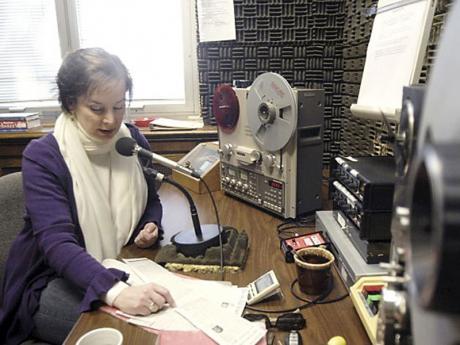
BISMARCK, N.D. (AP):Neatly tucked away on the second floor of the North Dakota State Library are two small recording studios. Volunteer announcer Joyce Sauer, a retired nurse, slips in about 10 minutes before she begins her 8:30 a.m. Thursday recording. She collects the newspaper clippings prepared for her and, in a tiny white booth, reads news from The Bismarck Tribune for the next 45 minutes.
Since she started in 2002, Sauer has volunteered nearly 400 hours for those who can't physically read the paper themselves or have impaired vision.
"It is a very important service," she said. "I love reading the newspaper. I do not have a computer. For me, I have to have a paper in my hand. I feel it's a good service to read for people who are unable to read the news or hold a newspaper."
The nonprofit Dakota Radio Information Service radio reading programme was founded in 1982 to provide access to newspapers through closed-circuit radio receivers. It first aired in March 1984, and has grown from 39 listeners to 295.
The radio service runs from the same office as the state Library Talking Books Program. It is subsidised with US$45,000 a year from the Legislature to allow the Talking Books programme staff to schedule readers and prepare the three-hour news tapes for broadcast. The Dakota Radio Information Service board members also seek grants and fundraise to support services and upgrade equipment, said Sue Hammer-Schneider, director of the state Talking Books Program.
news features
Abby Bardell arrives shortly before 9 a.m. on a recent Thursday. A library staffer hands her a hot cup of coffee. She jokes about "what a diva I am". Bardell reads the news features for the next half hour in a separate recording booth five feet away from Sauer.
Bardell has volunteered more than 600 hours since 1996 for the Dakota Radio Information Service programme.
"It's just such an easy thing to do," she said. "I think a lot of the patrons - their visual impairments give them some isolation, emotionally, physically. A lot them are isolated geographically as well. For them to hear a warm human voice is a really valuable human need."
Sauer and Bardell are among 61 volunteers reading local newspaper articles, grocery ads and feature columns for the programme. The studio equipment is simple. Reel-to-reels record their voices and the segments representing different parts of the state are aired together in three-hour increments on special receivers (radios). These receivers are set to frequencies based on where people live in the state. Dakota Radio Information Service wants to transition to a digital system before the end of the year, Hammer-Schneider said.
Papers read include the Minot Daily News, Williston Herald, The Dickinson Press, The Jamestown Sun, the Valley City Times-Record and The Bismarck Tribune.
Williston-Dickinson news and Jamestown-Valley City news are grouped regionally in the recordings. On the east side of the state, listeners hear programming from 'Minnesota Talking Book Radio' system, which airs 24-7. 'The North Dakota' news slots air from 2-5 p.m. and 6-9 p.m. weekdays. Prairie Public Radio is a partner in the project. The Dakota Radio Information Service also is supported by Lions clubs.
Dakota Radio Information Service listeners apply for the service.
"They could have physical conditions like Parkinson's disease or MS," Hammer-Schneider said. If it's a visual problem, it could be temporary - such as cataracts - or full-vision loss, she said.
Hammer-Schneider said volunteer candidates audition with a script of news articles and words that tests them for annunciation, knowledge of words, clarity and voice projection. The stories from the newspapers aren't edited, but obituaries are, for brevity, she said.
"Sometimes, I get emotional. I have difficulty sometimes reading a sad story, a heartwarming story. It's a wonderful program. There's good staff here - very supportive," Sauer said. "I love to read and I can't fathom having that taken away. As we age, more and more of our peers have become troubled with vision problems."
"The purpose is to get information out," Hammer-Schneider said. "We hear so many times that when people lose their eyesight or can't physically read the newspaper ... that they just miss reading the newspaper. This is one way to get the newspaper read to them. It is all local news."
mostly senior citizens
Before the Internet, programmes like these were the only way people could get local news without people reading them the newspaper, Hammer-Schneider said. Listeners consist of mostly senior citizens, and the audience keeps steady at about 300 people, she said.
Milta Zimmerman, 88, of Elgin, who suffers from macular degeneration, said she has been a Dakota Radio Information Service listener for at least five years.
"Mondays, I never miss, unless there's a medical appointment," Zimmerman said. "I used to get the Tribune, but when my eyes (went bad), I had to stop it. If I get the daily news, I keep up on the world. I like to know what everyone is talking about."