
Jamaican economy continues to recover
Published:Wednesday | February 22, 2012 | 12:00 AM
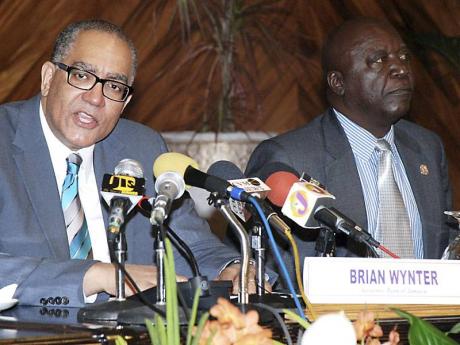
The Jamaican economy recorded its fourth consecutive quarter of real growth during the period ending December 2011, even as the country documented the lowest annual rate of general price increases for the last five years.
Economic recovery is estimated to have strengthened within the range of one per cent to two per cent during the quarter, compared with 0.6 per cent for the September quarter, the central bank reported on Tuesday.
That performance reflected strong expansion in agriculture, forestry and fishing, and mining and quarrying, said Bank of Jamaica Governor Brian Wynter during his quarterly press briefing on monetary policy and the economy.
According to the bank's quarterly monetary policy report, the performance of the economy partially reflected recovery over the December 2010 quarter following supply disruptions triggered by Tropical Storm Nicole on September 28, 2010.
In addition, domestic demand conditions continued to improve, influenced in part by sustained growth in remittance inflows to Jamaica since November 2010, as well as increases in real wages in the private sector for the first half of 2011.
The BOJ is projecting GDP growth in the range of one per cent to two per cent for the March 2012 quarter, predicated on expansions in electricity and water, hotels and restaurants, construction, as well as agriculture, and forestry and fishing sectors.
Wynter said that given the forecast for the quarter, real GDP growth for fiscal year 2011-12 is still expected to be in the range of one per cent to two per cent. The fiscal years runs from April to March.
"The forecast for growth in the March 2012 quarter and the fiscal year is supported by the relatively strong expansion in credit to the private sector from the commercial banks in the previous quarter," said the central bank governor.
He also revealed that private-sector credit increased by 6.2 per cent in the December quarter, the fastest rate of growth since the June 2008 review period.
"Of note, the growth in private-sector credit mainly reflected expansion of 7.3 per cent in loans to the business sector, a reversal of the earlier trend where increases in personal loans were dominating the marginal growth in credit," Wynter said.
The growth in credit was largely to the sectors being projected to record continued expansion for the rest of the fiscal year.
Headline inflation for the December quarter was 1.3 per cent, within the BOJ's forecast range of one to two per cent.
The out-turn also compared favourably with the 2.1 per cent recorded for the September 2011 quarter, as well as the average of 2.9 per cent for the previous five December quarters, Wynter said.
Inflation for calendar year 2011 was six per cent, 5.7 per cent lower than the 11.7 per cent recorded for calendar year 2010 and, according to Wynter, "the lowest annual rate of general price increases since 2006".
In addition, he said, all the bank's measures of underlying inflation were below the rates for 2010.
Wynter said the relatively low inflation out-turn for the review quarter reflected the dampening impact of increased supplies of some domestic agricultural commodities, reinforced by the protracted period of relative stability in the exchange rate, as well as the persistence of weak but improving domestic demand.
In that regard, he said, the inflationary impulses in the quarter emanated from higher prices for processed food and energy, associated with the increase in the cost of crude oil, in addition to seasonally higher demand during the Christmas holidays.
The BOJ is again projecting price increases to be in the range of one to two per cent for the March 2012 quarter, underpinned by the forecast for a decline in imported inflation, supported by relative stability in the exchange rate.
Given the projection for the March quarter, the BOJ has maintained its forecast for inflation in the range of six to eight per cent for fiscal year 2011-12.
Wynter said that the inflation rate for January, as reported by the Statistical Institute of Jamaica, was 0.4 per cent, similar to the rate in the previous two months.
According to the monetary policy report, during the quarter the bank sold US$254.2 million to the market, contributing to a decline in the net international reserves to US$1.96 billion at the end of 2011.
That resulted from intermittent demand pressures in the market, primarily influenced by the refinancing of the National Road Operating and Constructing Company's bond last November.
However, the gross revenues at the end of the year totalled US$2.82 billion, representing 19.4 weeks of imports, comfortably above the international benchmark of 12 weeks.
mcpherse.thompson@gleanerjm.com