
Shell's reputation hit by record North Sea oil spill
Published:Wednesday | August 17, 2011 | 12:00 AM
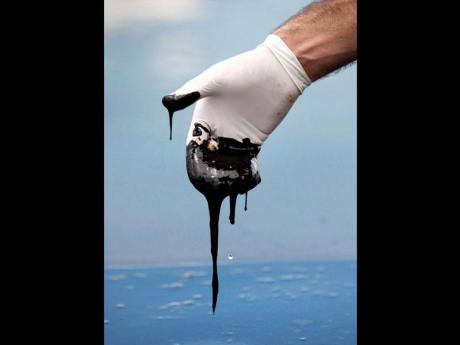
Royal Dutch Shell struggled to contain the worst North Sea oil spill in a decade as well as damage to its credibility Tuesday as a second leak was found in an oil line the company had said was "under control".
Although the amount of oil involved in the Shell spill off the coast of Scotland is an order of magnitude smaller than BP's 2010 Gulf of Mexico disaster - around 1,300 barrels, so far, compared to an estimated 4.9 million in the Gulf - the spill undercuts Shell's earlier suggestions that it was a safer company than BP.
The Gannet Alpha oil rig, 112 miles (180 kilometres) east of the Scottish city of Aberdeen, is operated by Shell and co-owned by Shell and Esso, a subsidiary of the US oil firm Exxon Mobil.
Shell shut down the main leak in a flow line at the rig by closing the well and isolating the reservoir, said Glen Cayley, technical director of Shell's European exploration and production activities. However, he acknowledged a second, smaller leak has proved more elusive to control.
"The residual small leak is in an awkward position to get to," he said. "This is complex sub-sea infrastructure, and really getting into it, among quite dense marine growth, is proving a challenge."
"It's taken our diving crews some time to establish exactly and precisely where that leak is coming from,"
The secondary spill is pumping about two barrels or 84 gallons into the cold water each day.
Saket Vemprala, an oil and gas analyst for Business Monitor International, said while any spill is problematic, the North Sea spill is much smaller than the Deepwater Horizon spill.
"The numbers are simply not comparable," he said.
While the BP leak was from the well's head, the Shell leak is from a flow line, so the company knows what to expect, he said. "There is a finite amount of oil in the flow," Vemprala said.
Still, the shallow-water disaster is an embarrassment for Shell as the company seeks its first licence for exploratory drilling off the coast of Alaska. Shell CEO Peter Voser has previously said the BP blowout could never have happened to Shell, due to Shell's different well design.
"The risk-management practices of some companies in the Gulf of Mexico do lag behind the standards set by other companies," Voser told analysts on a conference call in February. "We at Shell have been applying the best of the North Sea standards to our worldwide operations for many years."
Kenneth E. Arnold, a member of the US National Academy of Engineering who served as an adviser to the US Department of Interior during its probes into the Deepwater Horizon explosion, said he would classify a 1,300-barrel spill as "significant" but not catastrophic.
At its largest, the North Sea oil spill sheen covered an area 19 miles wide by 2.7 miles long (31 km by 4.3 km). Both Shell and the British government predict the oil will disperse naturally and not reach shore.
Cayley, in a statement, said the company "deeply regrets" the spill. He said the first leak was stopped Thursday but now "the oil found a second pathway to the sea."
Shell said it believes the oil is now leaking from a relief valve close to the original leak, and once it is certain of the source, it will stop the spill.
Shell informed UK government agencies of the spill last Wednesday, but did not make the news public until Friday. On Saturday it declared that the leak had been contained.
Britain has already beefed up its inspections of the 24 drilling rigs and 280 oil and gas installations in its part of the North Sea in the wake of the 2010 Gulf spill.
The last major spill in the North Sea was in 1993, when oil tanker MV Braer ran aground in the Shetland Islands, spilling around 620,000 barrels of crude into the sea.
- AP