
The life of a missionary
Published:Friday | April 11, 2014 | 12:00 AM


Laura Koch, Gleaner Intern
Many quotes in the Bible point out the duty of Christians to spread their religion all over the world. The most popular might be Matthew 28:19, as Jesus steps towards His disciples and proclaims: "Therefore, go and make disciples of all nations, baptising them in the name of the Father and of the Son and of the Holy Spirit."
Nevertheless, not every Christian would call him/herself a missionary.
The Oxford Dictionary defines a missionary as: "a person sent on a religious mission, especially one sent to promote Christianity in a foreign country".
It is estimated that around 400,000 missionaries are on duty worldwide. From Jamaica, only a few have been sent.
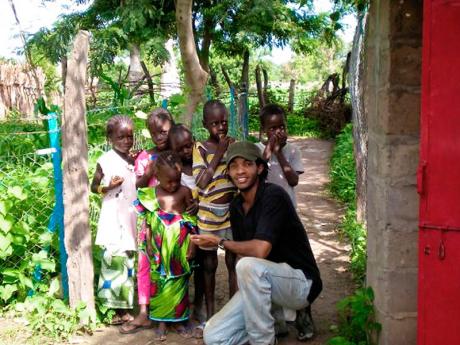
Teko Bailey is one of them. The 31-year-old already worked as a missionary in the Caribbean, West Africa and Australia. Like other missionaries, Bailey has basically two goals: he wants to help people in need and, through his actions, encourage people to become Christians.
Life can be rough
Recently in Hawaii, Bailey told The Gleaner in an email interview about his work, the life of a missionary can be very rough. Nevertheless, Bailey keeps on walking on his mission.
When he decided to become a missionary five years ago, Bailey's parents were not amused at all: "My parents sent me to school with the expectation that I'd be able to work, get a good-paying job, take care of myself, and support them later on in life." The work as a missionary is completely voluntary - at least with his organisation 'Youth With A Mission'. The non-profit Christian mission exists in some 190 countries.
Bailey and his colleagues completely depend on family, friends and other supporters. "Those who are impacted or interested in the vision or my passion for the vision, partner with me and help to further that journey," he said.
Sometimes, though, the young missionary said, he doesn't have much to eat and struggles. "There are times when I am drained and tired, but nobody is there to encourage me", Bailey admitted. "Missions are a lonely road and few travel it." To cover his basic needs, a budget of around $100,000 is required monthly, Bailey said.
In return, Bailey and his colleagues work for free, build homes, provide medical care or help to farm.
Missionary work
Most missionaries call regions where people are not Christians 'unreached'.
One of the so-called 'unreached' regions is the north of Sierra Leone in West Africa, where Bailey stayed for six months in 2008 and lived with the Susu people. According to the United Nations Refugee Agency, in Jamaica, 80 per cent are Christians, whereas in Sierra Leone, around 80 per cent of the people are Muslims and are deeply rooted in their religion - a difficult area to work for someone who would like to spread Christianity.
In an earlier contribution to The Gleaner, Bailey described his trip there.
"The Susus are known to be hardcore Muslims". He didn't hide why he was in this rural part of the country and told the people there: "Jesus loves you and He wants you to know who He is. That's the reason I'm here".
The leaders of the villages reacted positively. Bailey wrote, "The chiefs said that, for hundreds of years, they had followed the Islamic religion and had gained nothing and it was time they opened up to Christianity."
This phenomenon was already observed in the early 20th century and is described as 'Rice Christians'. As Craig Ott and Gene Wilson described it in their book Global Church Planting, "People often become Christians for the sake of what they will personally gain, be it a bowl of rice, an education, or a small business loan."
Bailey said he doesn't want Muslims to become "fully" Christians. Still, he explained: "We approach Muslims not with the ideas of making them Christians, but with the idea of bringing a Christian Biblical world view into the lifestyle of being a Muslim."
Way of life
The young missionary is convinced "these individuals are born as Muslims, they don't see it as a religion or a label they attribute to themselves, but as a way of life."
What other people would see as an insult, Bailey believes, he is doing rightful work.
Not everybody is happy about the missionaries coming to their communities. Some people are very suspicious and some "may be less grateful because they believe more should have been done for them", Bailey stated.
"What do I need to continue in missions? Bailey asked.
"I will need persons who are interested in walking alongside me as 'care supporters'. Those who don't just give, but walk alongside me and even help me raise the support I need for various projects as well as my primary need, among other things.
"To keep this email short, I would like to hear from you, how you would be interested in supporting me in the years to come as I continue serving."
To support the missionary's work, go to Bailey's website at - http://tekohintsa.org/ and click on the support page for various options on how to give.