
US House passes same-sex marriage bill in retort to high court
Published:Tuesday | July 19, 2022 | 7:26 PM
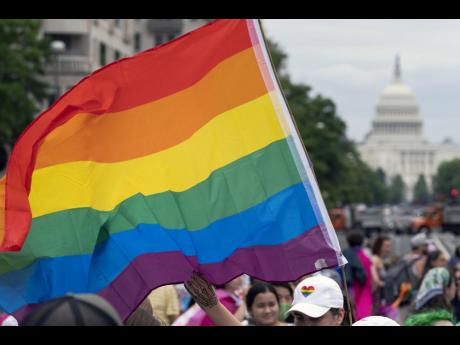
WASHINGTON (AP) — The US House overwhelmingly approved legislation Tuesday to protect same-sex and interracial marriages amid concerns that the Supreme Court ruling overturning Roe v. Wade abortion access could jeopardise other rights criticised by many conservatives.
In a robust but lopsided debate, Democrats argued intensely and often personally in favour of enshrining marriage equality in federal law, while Republicans steered clear of openly rejecting gay marriage. Instead leading Republicans portrayed the bill as unnecessary amid other issues facing the nation.
Tuesday's election-year roll call, 267-157, was partly political strategy, forcing all House members, Republicans and Democrats, to go on the record. It also reflected the legislative branch pushing back against an aggressive court that has raised questions about revisiting other apparently settled US laws.
Wary of political fallout, Republican (GOP) leaders did not press their members to hold the party line against the bill, aides said. In all, 47 Republicans joined all Democrats in voting for passage.
“For me, this is personal,” said Democrat Mondaire Jones, who said he was among the openly gay members of the House.
“Imagine telling the next generation of Americans, my generation, we no longer have the right to marry who we love,” he said. “Congress can't allow that to happen.”
While the Respect for Marriage Act easily passed the House with a Democratic majority, it is likely to stall in the evenly split Senate, where most Republicans would probably join a filibuster to block it. It's one of several bills, including those enshrining abortion access, that Democrats are proposing to confront the court's conservative majority. Another bill, guaranteeing access to contraceptive services, is set for a vote later this week.
House GOP leaders split over the issue, with Minority Leader Kevin McCarthy and Whip Rep. Steve Scalise voting against the marriage rights bill, but the No. 3 Republican Rep. Elise Stefanik of New York voting in favour.
In a notable silence, Senate Republican leader Mitch McConnell declined to express his view on the bill, leaving an open question over how strongly his party would fight it, if it should come up for a vote in the upper chamber.
Key Republicans in the House have shifted in recent years on the same-sex marriage issue, including Rep. Liz Cheney of Wyoming, who joined those voting in favour on Tuesday.
Said another Republican, Rep. Nancy Mace of South Carolina, in a statement about her yes vote: “If gay couples want to be as happily or miserably married as straight couples, more power to them.”
Polling shows a majority of Americans favour preserving rights to marry, regardless of sex, gender, race or ethnicity, a long-building shift in modern mores toward inclusion.
A Gallup poll in June showed broad and increasing support for same-sex marriage, with 70 per cent of U.S. adults saying they think such unions should be recognised by law as valid. The poll showed majority support among both Democrats (83 per cent) and Republicans (55 per cent).
Approval of interracial marriage in the U.S. hit a six-decade high at 94 per cent in September, according to Gallup.
Ahead of Tuesday's voting, a number of lawmakers joined protesters demonstrating against the abortion ruling outside the Supreme Court, which sits across from the Capitol and remains fenced off for security during tumultuous political times. Capitol Police said among those arrested were 16 members of Congress.
As several Democrats spoke of inequalities they said they or their loved ones had faced in same-sex marriages, the Republicans talked about rising gas prices, inflation and crime, including recent threats to justices in connection with the abortion ruling.
For Republicans in Congress the Trump-era confirmation of conservative justices to the Supreme Court has fulfilled a long-term GOP goal of revisiting many social, environmental and regulatory issues the party has been unable to tackle on its own by passing bills that could be signed into law.
The Respect for Marriage Act would repeal a law from the Clinton era that defines marriage as a heterogeneous relationship between a man and a woman. It would also provide legal protections for interracial marriages by prohibiting any state from denying out-of-state marriage licenses and benefits on the basis of sex, race, ethnicity or national origin.
The 1996 law, the Defense of Marriage Act, had basically been sidelined by Obama-era court rulings, including Obergefell v. Hodges, which established the rights of same-sex couples to marry nationwide, a landmark case for gay rights.
Follow The Gleaner on Twitter and Instagram @JamaicaGleaner and on Facebook @GleanerJamaica. Send us a message on WhatsApp at 1-876-499-0169 or email us @onlinefeedback@gleanerjm.com or editors@gleanerjm.com.