
Peter Espeut | Good things we have lost along the way
Published:Friday | January 8, 2021 | 12:05 AM
There were many things about Jamaica that I didn’t learn in school – like about the large number of animals and plants (fauna and flora) that used to flourish in Jamaica, but which have now gone extinct.
Did you know that there was a Jamaican monkey that roamed the trees in the forests that used to cover most of the island? Commonly seen in the time of the Spaniards, the Jamaican monkey ( Xenothrix mcgregori) may have survived into the 1700s. It is now extinct, probably due to overhunting; but bones have been found in caves all around the island. One theory about the origin of the name Moneague is that it is derived from Monesca Savannah meaning ‘Savannah of Monkeys’ in Spanish. These creatures were more Jamaican than you and I, and the nation is poorer, now that they are no more.
More recently, pods of Pedro seals ( Monachus tropicalis) used to frolic in the waters and bays of Jamaica, and our nearshore and offshore cays. I have read first-hand accounts of the killing of some of them in the 19th century. Bloody Bay in Hanover and Manteca Bay (Montego Bay) in St James are said to have got their names because of the many seals (and whales) slaughtered there for their blubber. These marine animals were also common on Seal Cay (South Cay) on the Pedro Bank, and at Seal Cove (Scott’s Cove) on the St Elizabeth-Westmoreland border.
Can you imagine the attraction they would be for Jamaicans and tourists alike if these playful animals were still around?
All the mongooses in Jamaica are descended from the nine animals imported to the island from India in 1872 to control the rodent population on Spring Garden Estate in Portland. This rodent has been linked with the extinction of five Jamaican endemic invertebrates: one lizard [the Giant Galliwasp ( Celestrus occiduus)], one snake [the Black Racer ( Alsophis ater)], two birds [the Jamaican Poor-Will ( Siphonorhis americanus) and the Jamaican Petrel ( Pterodroma caribbaea)], and one rodent [the Jamaican Rice Rat ( Oryzomys antillurum)]. The descendants of the planter that introduced that pest into Jamaica should spend their lives making up for that family mistake by becoming strong environmentalists and conservationists!
‘Osborn’s Key Mouse’ ( Clidomys osborni), also known as the ‘larger Jamaican giant hutia’, is a now extinct species of large rodent that once roamed this island. Remnants have been found in six caves in Jamaica, and likely went extinct before humans settled the island.
Fossil remains have been found of the extinct Jamaican flightless Ibis ( Xenicibis xympithecus).
THOUGHT TO BE EXTINCT
Some species not seen for many years are thought to be extinct: the endemic Jamaican stingless bees reported by early settlers have probably been pushed out by the introduced stinging European variety of bees; the endemic bird, the Jamaican Pauraque ( Siphonorhis americanus) was last seen more than 100 years ago; it and the endemic Jamaican sub-species of the Bahama mockingbird ( Mimus gundlachii hillii) are seen no more; the endemic bat species Phyllonycteris aphylla, which was known to roost in a cave in Manchester, is now possibly extinct.
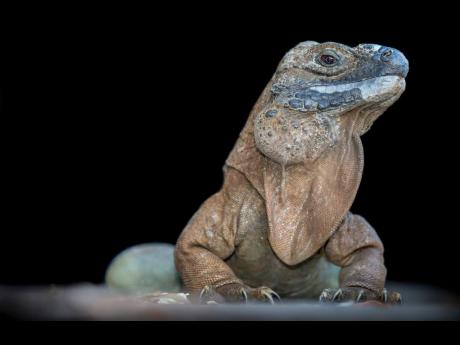
The Jamaican iguana ( Cyclura collei), Jamaica’s largest remaining native land animal, was believed to be extinct, but its continued presence in the Hellshire Hills was confirmed in 1990 when a hunter retrieved a live specimen and brought it to the Hope Zoo; since then, others bred in the Zoo have been released into the wild, but the Jamaican iguana remains the most endangered lizard in the world.
There are other species on the verge of extinction that need protection, otherwise we will lose them forever! And I won’t tell you where they survive, lest you (or others who like wild meat) seek to catch them and eat them.
The Indian Coney or Jamaican hutia ( Geocapromys brownii), Jamaica’s largest endemic land mammal, is now threatened with extinction. There is one known remaining stronghold of the Jamaican skink ( Mabuya mabouya), and one known colony of the fish-eating bat ( Noctilio leporinus). One forest is the last known habitat of the following found nowhere else in Jamaica or the world: the blind cave frog ( Eleutherodactylus cavernicola), two endemic Thunder snakes ( Trophidophis stullae and Trophidophis jamaicencis), and the Blue-Tailed Galliwasp ( Celestus duquesneyi).
As we begin the third decade of the 21st century, let us resolve to preserve our biodiversity and the habitats which support them, lest we lose more species and punch more holes in the web of life that is Jamaica.
Peter Espeut is an environmentalist and development scientist. Send feedback to columns@gleanerjm.com.