
Editorial | Police should stop dilly-dallying on body cams
Published:Monday | February 21, 2022 | 12:13 AM
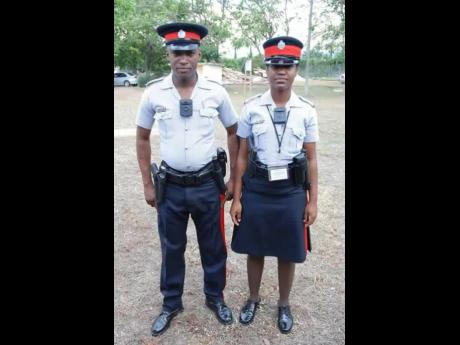
We can only conclude that the police, enabled by the Government, their declarations to the contrary notwithstanding, are resistant or deliberately slow with respect to the introduction and use of body-worn cameras.
This matter has been on the constabulary’s agenda for nearly eight years, since Peter Bunting, then the national security minister, promised that the police would be kitted out with body cams. His successors in the post, as well as the police chiefs since then, including the current one, Antony Anderson, have declared their commitment to the project. In 2016, the Americans financed a body-cam pilot project for the police, supplying 120 cameras.
However, as we were reminded last week by Hugh Faulkner, head of the Independent Commission of Investigations (INDECOM), the agency that monitors and investigates use-of-force complaints against the security forces, the constabulary does not seem to use body cameras – not even whatever few they may have. At least, in none of its investigations has INDECOM, according to Mr Faulkner, ever been provided with footage from body cams. And this is not because INDECOM’s investigators have not asked.
“We trust that body-worn cameras form a prominent feature of the activities, given that the initiatives seem to be about gangs, guns and gunmen,” Mr Faulkner said, in response to last week’s announcement of the establishment of a joint police-military anti-gang task force. “This, we believe, will assist in any investigative steps taken in the event of an incident.”
UNSTATED CONTEXT
The unstated context to Mr Faulkner’s observation is Jamaica’s high level of police homicides – 127 in 2021, an increase of 38 per cent over the previous year – and the often contentious aftermath to these killings. In most of the incidents, the police say that they were fired on by criminals and that they acted either in self-defence or to protect citizens.
It is not unusual, though, that people claiming to be eyewitnesses make counterclaims: that the victims were shot in cold blood or that the police used excessive force. Often, human-rights advocates say, the names of the same officers or police formations surface in police homicides.
It is against this background that Mr Bunting’s announcement of the planned body-cam initiative was widely welcomed. It would be one way to help establish truth and hold the police, when the circumstances require, accountable.
Robert Montague, Mr Bunting’s successor in changed administration, announced in 2016, not long after coming to office, the US-funded pilot project – the one with the 120 cameras. The result of that evaluation was never publicly disclosed. However, in 2020 the current minister, Horace Chang, said the police had “issues” with the cameras. He did not elaborate on what these issues were.
Dr Chang, however, did say that the police were gathering the specifications for the ordering of 1,200 cameras, presumably for another pilot project. Around the same time, the then head of the Jamaica Defence Force, Lieutenant General Rocky Meade, reported that the army was conducting its own tests of body cams and the feasibility of employing them during police-military patrols.
TESTING VARIOUS MODELS
Last June, Major General Anderson, the police commissioner, said that the constabulary was testing various models of cameras “to evaluate things like how rugged they are, whether the clips will break or not, and are they suitable for our circumstances”. Support servers were already bought but not yet commissioned. It is unclear whether this was intended to be a full roll-out of the body-worn cameras or another pilot. No one has spoken straight or disclosed a specific plan. There have been no timelines.
We appreciate that testing body cams to determine which is best for the JCF is necessary. But that is not rocket science; and it should not be made to seem that way.
In any event, many police forces around the world, including several in Jamaica’s partner countries, use body-worn cameras. Their experience, if the JCF asked, should help speed up its own evaluation, notwithstanding Major General Anderson’s warning that the JCF could not afford to get it wrong.
We understand, too, Major General Anderson’s concern about the size of the JCF – over 11,000 members – and therefore the amount of cameras that would have to be bought to kit out the constabulary. The fiscal constraint is known.
However, the administration often boasts about the money it has spent in recent years on national security – mostly on outward-facing technology. A notable absence in the security reform project is a robust inward look on the JCF, an institution that is perceived to be corrupt and enjoys low public trust. Initiatives to hold it accountable can only serve to heighten public confidence in the organisation. Which is why Mr Faulkner’s observation should be taken to heart by the Government – and Major General Anderson.