
Editorial | Clarify fiscal numbers
Published:Friday | March 25, 2022 | 12:06 AM
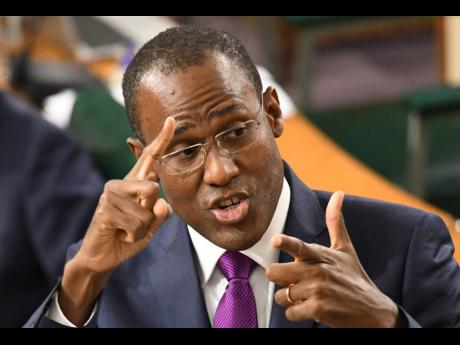
This newspaper supports Finance Minister Dr Nigel Clarke’s declared commitment to fiscal prudence and his insistence that demands that Government spend more on social programmes be accompanied by clear explanations of how bills will be paid and the value and/ or consequences of these expenditures.
This position reflects our appreciation that all policy formulation, including macroeconomics, involves making choices, whose efficacy in a liberal democracy may be subject to vigorous debate – as has been the case this past week between Dr Clarke and the parliamentary opposition, especially its leader, Mark Golding. But, for such debates to enjoy clarity, and for citizens to make informed judgements on the proffered choices, they must be based on credible and consistent data.
That is why, their initial explanation notwithstanding, Dr Clarke or the technocrats at the finance ministry are obliged to offer a fuller explanation for some of the data published by the ministry with respect to the revenue side of the Government’s $912 billion budget for the fiscal year that begins on April 1. This is important given that the divergent figures in separate documents were tabled in Parliament at the same time.
Last week, in his response to Dr Clarke’s budget, Mr Golding, the leader of the People’s National Party, argued that the finance minister was too stingy with his cushion for Jamaican families still reeling from the economic shocks caused by the COVID-19 pandemic. Mr Golding proposed that Dr Clarke spend an additional two per cent of gross domestic product (GDP) – around $40 billion – on social support, as well as called for the Government to cap the ad valorem tax on imported oil at a price of US$67.50 per barrel – the rate on which the budget was initially cast. Any tax earned on a price above that rate, Mr Golding argued, would represent a windfall to the Government. The Opposition leader predicated his call for greater social spending, in part, on an assumption that the Government was projecting to earn $99 billion, or over 17 per cent more in taxes in 2022-23 fiscal year than it did in 2021-22.
BREACH OF THE LAWS
However, Dr Clarke, in his closing rebuttal on Tuesday, not only claimed that spending more would wantonly undermine the fiscal stability, but would likely cause a breach of the laws calling for policies consistent with Jamaica bringing its debt to 60 per cent of GDP (a target it projects to reach by 2028) from the current 96.3 per cent. Further, the finance minister accused Mr Golding of overstating the effect of the ad valorem tax on petrol, while insisting that inflation in the economy didn’t necessarily mean a tax windfall for the Government. Given that the Government is the economy’s largest purchaser of goods and services, much of what it earns from inflation-boosted taxes is offset by the higher prices it pays for the things that it buys.
But more dramatic was Dr Clarke’s ridicule of the Opposition’s leader’s assumptions about projected size of the increased tax earnings over the next fiscal year. The projected 3.5 per cent real growth in the economy in 2022-23 would yield an additional $65 billion in new taxes, or $34 billion less than the $99 billion he told Parliament would be the case.
“He made a $34-billion error, or a $34-billion misrepresentation, which shows you the attention to detail he employed when going about your business,” Dr Clarke said of the Opposition leader.
The figures showing the $65-million tax growth, Dr Clarke explained, were contained in the Government’s Fiscal Policy Paper for 2022-23. This is a document that sets out the administration’s fiscal assumptions for the year, as is required by the fiscal policy rules. The Fiscal Policy Paper is subject to review by the auditor general, which, in effect, makes it the primary policy statement on the Government’s fiscal plans.
This raises the question of the source of the figures used by Mr Golding in his calculation. Well, they can come from another widely used and circulated government document – its Revenue Estimates for 2022-23. That, too, was tabled in Parliament at the same time as the Fiscal Policy Paper.
Both documents project the Government’s tax earnings for 2022-23 at $671.536 billion. When non-tax and capital revenue are added, the documents agree on total revenue of approximately $771 billion.
PROBLEM
There is, however, a problem when the revenues for the fiscal year now ending are compared across the documents. According to Revenue Estimates, at the end of March, when the 2021-22 fiscal year ends, the Government should have collected roughly $572.5 billion in taxes. This figure, subtracted from the $671,53 billion in taxes the Government projects for the next fiscal year, leaves Mr Golding’s $99 billion.
However, in the Fiscal Policy Paper, the Government estimates its tax revenue for 2021-22 will be $606.23 billion, or $65 billion less than the $671.53 billion in the coming fiscal year. The difference between those two numbers is in sync with the $34 billion Dr Clarke highlighted.
Notably, too, in the Fiscal Policy Paper, total Revenue and Grants for 2021-22 is approximately $717.43 billion. This figure, significantly, includes $97 billion in ‘non-tax revenue’, compared to $61 billion for the same line item in the Revenue Estimates for the same period. It is not clear what accounts for this $36 billion, or 59 per cent difference, in the two publications.
Errors and omissions will cause differences in numbers in documents, as well as the time when various versions are published. We are nonetheless still surprised at the wide difference in some of the figures in the Fiscal Policy Paper and the Revenue Estimates – both of which are produced in support of the Government’s budgetary and fiscal process and relied on to help in people’s understanding of the administration’s policy.
Dr Clarke is right about not going off on fiscal frolics. But there must be confidence in the numbers used to analyse these things.