
Elizabeth Morgan | Haiti’s trials and tribulations cannot be ignored
Published:Wednesday | February 15, 2023 | 12:54 AM
To access this article in full please login or register today
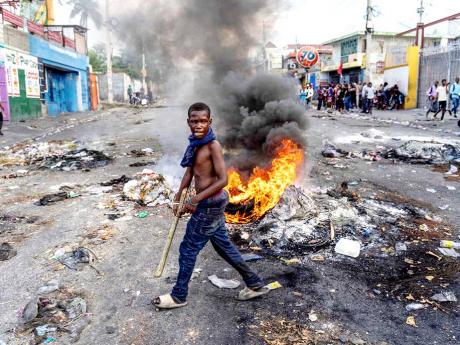
Jamaica is joining the USA and Canada in observing February as Black History Month and I am addressing Haiti again. As usual, we will talk about the Haitian Revolution, 1791-1804, making it the first black independent republic, and we will...
Jamaica is joining the USA and Canada in observing February as Black History Month and I am addressing Haiti again. As usual, we will talk about the Haitian Revolution, 1791-1804, making it the first black independent republic, and we will celebrate Dutty Boukman, enslaved in Jamaica, who fought in the Haitian Revolution in its early years. As I have said before, we really know little of Haiti’s history or its political, economic and social woes, preferring that they remain at a distance, thinking that we have enough problems of our own.
In January, when Prime Minister Andrew Holness mentioned that Jamaica would be willing to participate in an international security mission in Haiti, some here were not supportive of this proposal.
Haiti will be an important item on the agenda of the 44th CARICOM Heads of Government Conference in The Bahamas commencing on Wednesday, February 15.
In 2021, Haiti’s population was 11.5 million and its gross domestic product US$21 billion, with its per capita income US$1,830. Haiti’s main exports in 2021 were valued at US$1.3 billion going mainly to the USA, Canada, Mexico, France, and India, and consisting of textiles and clothing, scrap metal, vegetable oils, dates and cocoa. Haiti’s imports in 2021 were valued US$6.27 billion, which were mainly for food items, textiles, motor vehicles, fuel and iron and steel, and coming mainly from the Dominican Republic, USA, Netherland Antilles and China. Remittances accounted for 20 per cent of GDP in 2021, down from 24 per cent in 2020. Haiti’s external debt is given as US$2.6 billion.
Haiti is a CARICOM member. I would say that its membership to CARICOM has been incomplete due in part to its tariff regime which sees it having very low import tariffs of 0-5 per cent. Haitians, as we know, need visas to travel within the CARICOM region, and access is through Miami, Florida. Trade and investments from within CARICOM are limited.
HAITI’S DISADVANTAGES
Haiti has had 219 years of continuous political and economic turmoil. Their independence came at a time when most of their neighbours were still slave territories and colonies. This could be considered their first disadvantage. Allies were few, if any. During the revolution, the agriculture and infrastructure of Saint Domingue (Haiti) were destroyed; a second disadvantage. The economy was in shambles and the new country was politically divided. A third disadvantage was the level of migration of the upper and middle classes to the USA (Louisiana with its French influences), Quebec in Canada, and to France. As I pointed out before, many came to British Jamaica helping to develop the coffee industry, bolstering agriculture generally and the business sector. Haiti, through the years, continued to lose its people to migration making remittances extremely important to the economy. Currently, Jamaica, Haiti, and Guyana are ranked as having among the highest levels of brain drain in the world, in the top 10.
A fourth persisting disadvantage is its strained relationship with its neighbour, the Dominican Republic. From 1822-1844, under Haitian President Jean-Pierre Boyer, the island of Hispaniola was unified. That was unsuccessful and in a war of independence, Santo Domingo gained its independence from Haiti becoming the Dominican Republic.
The fifth disadvantage has been poor, unstable leadership. Jamaica became a refuge for deposed Haitian heads of state. These included Charles Riviéré Hérard, Faustin Soulouque, Fabre Geffrard and Boyer. From 1804 to the present time, Haiti has had about 50 heads of state, including a couple of emperors. Five were assassinated and about 20 overthrown.
The sixth disadvantage would be payment of reparations to France. In 1825, France recognised Haiti’s independence in exchange for reparation payments of 150 million French francs (about US$20 billion today), reduced in 1838. Haiti concluded the repayment of loans to pay this amount in 1947.
Following one particular period of conflict, the USA, to protect its interests, occupied Haiti from 1915 to 1934.
More disadvantages have come from natural disasters, catastrophic earthquakes, floods and hurricanes further devastating the economy through the years. Add deforestation and other environmental challenges.
The longest-serving head of state was dictator Dr Francois Duvallier, 1954-1971, who declared himself president for life, and his son, Jean Claude, who was deposed in a popular uprising in 1986. Since then, the trials and tribulations have been unrelenting with the rise and demise of about 20 governments, including of Henri Namphy, Leslie Manigat, Jean Bertrand Aristide, Rene Preval, Michel Martelly, and Jovenel Moïse . Moïse was assassinated on July 7, 2021 heralding a near slide into anarchy. I do not think there is any reliable assessment of the impact of the COVID-19 pandemic in Haiti.
The United Nations has been in Haiti with limited success. CARICOM has issued statements, made appeals and offered help to no avail.
Haiti is a tremendously tough case, but in The Bahamas, CARICOM member states have to make another attempt, with partners in the hemisphere, to help Haitians help themselves. It is a problem we cannot ignore. It has serious implications for all of us.
Elizabeth Morgan is a specialist in international trade policy and international politics. Send feedback to columns@gleanerjm.com