
Editorial | Why the Privy Council must go
Published:Friday | May 12, 2023 | 12:14 AM
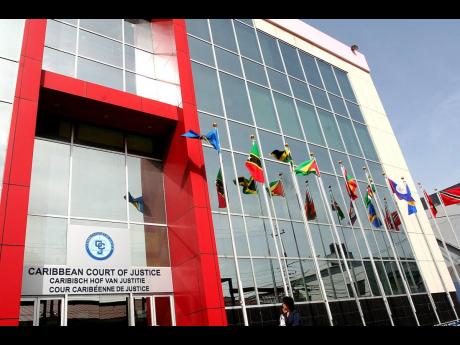
This week’s accession by St Lucia to the criminal and civil jurisdiction of the Caribbean Court of Justice (CCJ) will widen access to justice for that country’s citizens.
It is also a timely reminder to Jamaicans of their limited access to their highest court, given the review Jamaica is undertaking of its constitutional arrangements, the proposed sequencing of which the government is getting badly wrong.
The Holness administration’s idea is to decouple first from the British monarchy as Jamaica’s head of state, and then consider all other matters, including what should be Jamaica’s final court at a later stage. Which, if the government continues along its stated course, would mean resolving the issue of the final court perhaps a year or two down the road, after the hurly-burly of referendum to remove the king and establish Jamaica as a republic.
This newspaper supports dethroning the king and having a symbol of Jamaica’s sovereignty, a figure with whom citizens can readily identify. However, removing the Privy Council as Jamaica’s court of last resort carries as much symbolic weight, and is of even greater practical value, than becoming a republic. Therefore, logic suggests that Jamaica should immediately proceed with leaving the Privy Council and accede to the CCJ, while simultaneously getting on with the more complex business of divorcing the monarchy.
Few people believe that Prime Minister Holness and his senior ministers harbour any serious philosophical antipathy, or real antagonism to the CCJ, the regional court that Jamaica helped to establish and in which it participates in the court’s original jurisdiction as final arbiter of the Revised Treaty of Chaguaramas, which governs the Caribbean Community.
LOCKED POLITICALLY
The governing Jamaica Labour Party was locked politically in the anti-CCJ by its former leader, Edward Seaga. But having now championed the cause of “moving on” from the monarchy, Mr Holness need only consider the process for doing that and what it implied when the few Jamaicans with the ability to do so actually take cases to the Privy Council to appreciate the urgency of leaving that UK-based court. He must also look at the numbers.
First, when Jamaicans appeal to the Privy Council, it’s a prayer to the sovereign for justice, administered through one of the king’s committees, a king who has little in common culturally with his subject and resides in a country to which it is expensive to travel and requires an expensive visa for them to enter.
Transitioning to a republic requires that the relevant bills sit on the table of the Parliament for three months before debate, and for a similar period after debate before being voted on. They have to be passed by two-thirds majorities in both houses of Parliament, before being finally approved in a referendum.
As was the case in St Lucia, decoupling from the Privy Council requires a procedure similar to establishing a republic, but without the potentially fraught process of a referendum. It could be accomplished in six months.
Moreover, the practical return of acceding to the CCJ would likely be immediate.
In a statement welcoming St Lucia to the fold, the CCJ’s president, Adrian Saunders, noted that countries that acceded to its appellate jurisdiction at least double the number of cases that reach their final court, “thereby contributing to the dynamism of the country’s jurisprudence and considerably expanding access to justice for its citizenry”.
NOT MUCH HAS CHANGED
The point was underlined by the CCJ’s former president, Dennis Byron, in a speech in Jamaica a decade ago.
Between 2008 and 2011, Sir Dennis pointed out at the time, the Jamaican Court of Appeal issued an average of 105 judgments per year, but on average the Privy Council delivered on six judgments a year on cases from Jamaica.
Over the same period Barbados’ Court of Appeal averaged around 16 judgments a year, but the CCJ issued four judgments a year on cases from Bridgetown.
“These figures suggest that over 25 per cent of litigants in Barbados are now able to appeal to the CCJ, whereas only 5.5 per cent of the parties from Jamaica have the benefit of a second or final appeal,” Sir Dennis said.
Not much has changed with respect to Jamaica.
In the decade up to 2022, according to this newspaper’s tabulation, the Privy Council issued 37 judgments on Jamaican cases, or fewer than four (3.7) a year on average. The Jamaican judgments were approximately eight per cent of all judgments issued by the Privy Council.
Significantly, too, most of the cases from Jamaica were either appeals against murder convictions, which British lawyers handled pro bono, or disputes involving big corporations or wealthy individuals. Indeed, in the outlier year, 2017, when eight Jamaican cases were decided, two involved a dispute involving the GraceKennedy Group and Paymaster Ltd; one involved the mobile phone company Digicel and the Fair Trading Commission; another was a ruling on whether Jamaica Public Service Company could enjoy monopoly rights to electricity distribution; and one between the University of Technology and the Industrial Dispute Tribunal (IDT) over an IDT ruling.
That these companies and institutions can access the country’s highest court is good. The final court, however, should be similarly available to ordinary citizens.