
Editorial | NHT must explain
Published:Thursday | February 1, 2024 | 12:07 AM
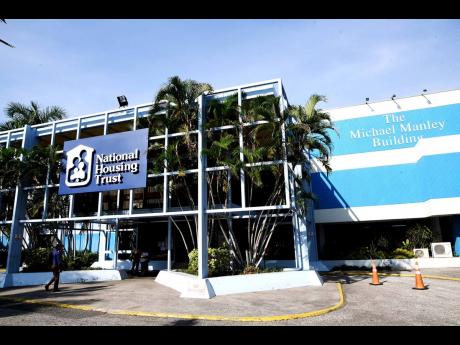
The larger question for the National Housing Trust (NHT) is not about the non-disclosure agreement (NDA) on its settlement with Dexim Limited, from which it is attempting to recoup J$650 million. Neither is it of the NHT’s scramble to undo the NDA.
What the Trust must urgently answer is what, in the first place, possessed it to enter the Dexim deal, and whether the contract was sanctioned by its board. It has already said that the Office of the Prime Minister, and Prime Minister Andrew Holness himself, were not aware of the arrangement.
For while there may be good and compelling reasons for the deal, they are not, at least from the perspective of business orthodoxy, immediately apparent to ordinary folk. Hence the need for the explanation.
The NHT is an important, successful and, in some respects, unique institution in Jamaica. Its primary function is to expand shelter for citizens.
It does this mainly through the provision of below-market-rate mortgages to its beneficiaries, which they may mix with borrowings from private institutions to buy homes. The NHT sometimes agrees to the pre-construction purchase of homes from developers, which allows it an inventory of properties for its borrowers, thus easing their need to tussle in the more competitive open market.
The NHT gets most of its cash from a five per cent payroll tax – three per cent paid by employers and two per cent by employees, who get back one year’s payment every seven years, with a nominal interest. In the financial year ending March 2022, the NHT spent J$46.5 billion on its housing programmes, or J$5 billion more that it collected from contributors that year.
That same year, the institution, which was established in 1976, gave $9.2 billion worth of mortgages, lifting its loan receivables to J$256.7 billion. It recorded net profit of J$20.5 billion on income of over J$35 billion.
In its 46 years of operation up to 2022, the Trust issued over 221,000 individual mortgages, benefiting nearly 233,000 people. Its assets, at the time of the review, was J$328.3 billion.
SWEETENED THE DEAL
By any measure, the NHT is a large and sophisticated organisation. And that is the context in which its 2019 arrangement with Dexim – which, at the time, was about to embark on the construction of 374 houses in the parish of St Ann, on Jamaica’s north shore – is being examined.
The NHT agreed in the contract to buy 200, or 53 per cent of the houses, at J$12.5 million each. That suggests that Dexim was assured of J$2.5 billion in revenue from the NHT. The houses were to be delivered in batches.
Contracts of this nature, backed by an organisation of the institutional pedigree and financial strength of the NHT, are usually the types that banks tend to line up to lend against. They signal the viability of projects.
For reasons that have not been so far explained, NHT appeared to have sweetened the deal by agreeing to upfront payments to Dexim. In November 2019, the Trust paid the company J$500 million. Two months later, Dexim was handed another J$150 million, to make the total advance J$650 million, or 26 per cent of the value of the deal.
OPPORTUNITY COST
In November 2019, government’s nine-month Treasury Bills were being offered at around 1.58 per cent, which would mean that on its first J$500 million the NHT might have grossed over J$8.6 million, if it had chosen to invest its money in that manner. The rates were a bit higher on the private markets.
Although T-Bills rate slipped in the following months, until they started to climb again in the second half of 2021 (they are now over eight per cent) the NHT, if it had invested on similar terms, could have collected just shy of another J$2.6 million on the additional J$150 million.
At current rates, on the total J$650 million it would, without the compounding, be collecting over J$56 million a year in interest. It could not make that investment because it did not have the money, so it could n0t earn the interest. That is the opportunity cost of money. And the impact is over more than four years.
But it is not only interest that the NHT did not collect. Neither did it get the homes. Dexim did not deliver.
In September 2022, the NHT sued the developers to recover its money. Dexim claimed force majeure, citing the effects COVID-19 pandemic and the disruption of supply chains, among other issues.
Last November, the parties agreed to settle – an arrangement that scrapped the deal. Dexim, it seems, would refund the NHT its J$650 million, plus another J$20 million in “full and final settlement”. That, if it is indeed the full extent of the agreement, would mean that the NHT would gross around three per cent interest on its money over four years.
The settlement, however, is governed by a non-disclosure agreement. Three per cent over four years.
In 2019, at the time of the scandal at the state oil company, Petrojam, over allegations of nepotism, cronyism and other forms of corruption, Prime Minister Holness railed against the use of an NDA with respect to a settlement with one of the casualties of the affair. He intended to end them, which the NHT should have known.
Is this the outcome of the PM’s effort?