
Byron Blake and Ohene Blake | Need for root and branch change in agriculture policy and financing
Published:Monday | February 3, 2025 | 5:11 PM
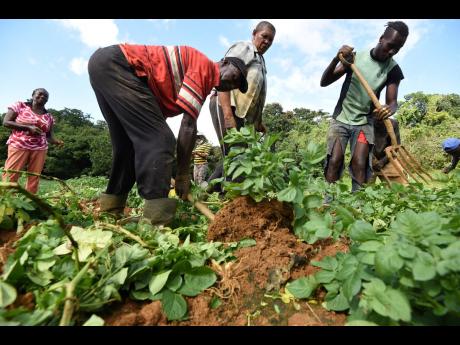


Food, like water, is vital for life. There are no substitutes. Both are sensitive to climate change and global warming and their manifestations such as prolonged droughts, severe floods, strong hurricanes, uncontrollable fires, and heat waves, counterbalanced by severe winters with blistering snow and hailstorms. These are by no stretch of the imagination ideal conditions for agriculture, in particular weather-dependent agricultural production.
The last 10 years have been progressively the hottest in recorded history. Scientists confidently project this trend to continue as average ambient global temperatures increase. Two of the most extensive and expensive wildfires with historical floods in between have hit California, US, within the last 12 months. In Jamaica, the agricultural parishes of St Elizabeth, Manchester, Clarendon, and St Catherine have experienced severe droughts and massive flooding in the same period. These catastrophic events have been occurring across the globe – in multiple countries on all continents. These are not ideal conditions for trade in agricultural produce.
Jamaica existed for the better part of 400 years as a supplier of certain tropical agricultural produce, mainly in their raw form, to a ‘market’ with vested interests and desirous of those products. Jamaica was a net exporter of agricultural produce. Those ‘favourable’ market conditions changed about 30 years ago. The necessary production side adjustments have been slow for a variety of reasons. One reason has been that the best lands for agricultural transformation have historically, and by policy, been denied or withheld from the large number of farmers willing to engage in new forms of agricultural production. A second was that at the same time, the major developed countries in Europe and North America, because of various internal policies, found themselves with large surpluses of sub-tropical agricultural produce which they could dump into the markets of developing countries like Jamaica. With the heavy hand of the multilateral financial institutions which they control, they demanded that countries like Jamaica, enact policies that favour the cheap imports. This translated into greater profits for much less effort for the local private sector. Many established agricultural and agro businesses shifted all or part of their operations to the lucrative import trade.
Some local policymakers bought into the narrative of the Washington Consensus while others were pressed into submission. But for whatever reason, the policies, organisational and institutional arrangements, and facilities like large-scale land leases, production cooperatives, and publicly organised marketing and processing facilities, as well as trade policies favourable to local agricultural products that were implemented in the 1970s to transform the agricultural sector, were jettisoned. One result, local farm production and exports stagnated while imports increased significantly. According to Jamaica Country Commercial Guide published in February 2024 total agricultural exports increased from US$239 million in 2020 to US$269 million 2021 and US$273 million in 2022 while total agricultural imports moved from US$933 in 2020 to US$1122 in 2021 and US$1402 in 2022. An unsustainable adverse movement with the larger (imports) growing at a faster rate than the smaller (exports).
VORTEX OF A PERFECT STORM
Jamaica is now at the point where:
1. Climatic conditions and climate-related disastrous events are strangling agricultural output. Six months after Hurricane Beryl and the severe drought a few months earlier, many local agricultural products are still in short supply. The chairman of the Egg Farmers Association has said on radio that he could not say when egg production would recover fully. And, even with vendors selling fresh imported produce, some prices are still 50 per cent to 100 per cent above pre-Beryl levels. It is chilling to note that we are only five months away from the next hurricane season.
2. On the import side there have been three significant developments. One, the massive subsidies and other legal and illegal support measures by developed country governments in North America and Europe which made the large surplus supplies of the 1980s and 1990s possible have disappeared. Two, the human (labour), and environmentally destructive industrial production systems that made the surplus pork, poultry, beef, corn, wheat, soy, and milk products available are under threat. Three, and most ominous, the climate-driven natural disastrous events discussed earlier, which will only increase, will result in rich countries and corporations buying up whatever produce comes to market. Countries might even begin to limit exports to feed their people first.
Speak about inflation and starvation: those are Jamaica’s oncoming realities. Only radical changes, ‘root and branch’ changes in mindset, policies, and resource allocation – land, human, and financial, will begin to avert those realities.
Financial resources are and will be elephant in the room, which will be needed at a level and in a predictable and timely manner to which we are strangers. It will be needed to, among others:
1. Attract and retain the quality and level of human capacity and provide the technological facilities to undertake research into production systems and crop varieties suited for the new and emerging climatic and environmental conditions.
2. Facilitate access to the land, training, and other inputs that would attract new, and retain existing farmers, particularly young persons, in the agricultural sector.
3. Establish, refurbish, and maintain infrastructures such as roads, irrigation and energy, agro-processing, storage, and markets vital for modern and technologically driven or supported agriculture.
4. Provide for the preemptive and timely recovery actions by farmers, farming groups, and communities.
Given the vagaries of climate-related occurrences, it is not possible to calculate the amount of funds needed annually. And, if it were correctly calculated it would be unlikely to be funded. We cannot until the disaster and then we can. Recall the post-disaster outlays last year. A more practical strategy is to change our mindset from post disaster funding to pre-disaster provisioning and build up funds while praying that there are no calls in the early years. A natural disaster agriculture sector preparatory and recovery fund should established for those purposes. Resources for this fund can be provided by:
1. A provision from the national Budget of, say, 20 per cent of the outlay for natural disaster-related expenditures in the previous financial year.
2. The reduction of only 50 per cent of any request for relief in the Common External Tariff (CET) on agricultural products and directing the amount collected to the fund. This imposition or retention should not affect inflation. The rationale underlying the CET is that it brings the import price in line with domestic production cost, thereby levelling the playing field. Removing the CET increases the profit of the trader since the lived experience is that in times of shortage the price of the imported substitute tracts the local prices. Inflation arises when, as has been the experience of the last six months, domestic production has not recovered.
3. Encourage philanthropists and others to contribute systematically to this type of recovery/development fund in preference to the ad hoc post-disaster contributions.
4. Encourage government to negotiate funds from the several global climate change-related facilities (adaptation or mitigation) to contribute.
5. The facility, once operational, to explore other sources. This facility will need to be well-managed, administratively lean, non-political, and transparent including through the publishing of timely quarterly and audited annual reports. It is the way out of our present dilemma.
Ambassador Byron Blake is former deputy permanent representative of Jamaica to the United Nations and former assistant secretary general of CARICOM. Ohene Blake is former deputy CEO of Trade Board Limited, and former board director of Jamaica Tourist Board. Send feedback to columns@gleanerjm.com