
Trevor Munroe | ‘We naah ease up’ against gender-based violence and to strengthen democracy
Published:Sunday | May 23, 2021 | 12:13 AM
My colleague and friend, Prof. Rosalea Hamilton, wrote an excellent article published in The Gleaner on May 20: ‘(W)right time to rethink representation’. Rosalea pointed out that “the people’s voice has been expressed on the infamous, brutal beating captured on video and allegations of Member of Parliament George Wright’s involvement”. As of now, the eve of Labour Day, when eighty-plus years ago our workers stood up for rights and justice, the expression of the people’s voice has had some impact but still a long way to go: A motion in Parliament not yet discussed, a bill to provide for impeachment not yet debated, a suspension of Wright from the Jamaica Labour Party (JLP) with no reason given and leave from Parliament with no explanation provided. Clearly, the people need to continue to speak out to achieve more meaningful impact.
The people’s voice was also expressed quite successfully on Black Thursday May 13, the day of protest against gender-based violence, organised by the University of the West Indies’ Institute of Gender and Development Studies and the Jamaica Council of Churches. The relative inaction by parliament and party, despite the people’s voice, highlighted in Rosalea’s view, “flaws in our democracy”. I fully concur.
Further, I agree with Prof. Hamilton’s proposals, some of which I have written about, to strengthen mechanisms to make the voice of the people more impactful on their parliamentary representatives and to reduce the dominance of the executive over parliamentarians in Parliament.
Rosalea’s has highlighted some of what is to be done. The additional question is how is it to be done? How do we the people, get our leaders, our members of parliament and policymakers to implement proposals to overcome flaws in our democracy? Repeatedly, our political leaders over many decades have discussed, debated, agreed and most of all, promised to implement proposals identical to Rosalea’s and to sum up my own.
TWO PROPOSALS
Two proposals from Rosalea’s article will suffice:
1. Rethink the size of the non-executive legislators relative to the executive legislators to strengthen legislative control of parliament.
2. Consider restructuring the Senate as an additional representative voice (rather than the voice of the parties) that could strengthen the representative voice of the people.
Let us remind ourselves of 30 years of our leaders’ agreement on similar proposals, their promises made and promises yet to be kept.
• 1992 – Constitutional Commission established by Prime Minister Patterson; eight representatives each of the PNP and the JLP (including then Leader of the Opposition Edward Seaga), also including two representatives of the Jamaican Bar Association, the Press Association of Jamaica, the University of the West Indies (one of whose representative was Delroy Chuck), the teachers’ organisations, women’s organisations, the PSOJ, Jamaican Agricultural Society, Jamaica Youth Council, the Jamaica Council of Churches and the Jamaican Evangelical Association. Recommendation: Senate to be expanded. Ten non-party members to be appointed by the head of state on his own discretion after consultation with the prime minister and the leader of the Opposition; 25 party members (15 appointed by the prime minister and 10 by the leader of the Opposition).
• 1995 – Joint select committee on constitutional and electoral reform (both JLP and PNP representatives). Recommendation: Fix the percentage of ministers that the prime minister can appoint from Parliament.
• 2007 – JLP Manifesto – increase membership of the Senate to include representatives of civil society chosen by the head of state.
• 2011 – JLP Manifesto – greater representation of civil society; increased membership of the Senate to include three independent representatives chosen by the governor general.
• 2016 – JLP Manifesto – greater representation for civil society and the diaspora, including three independent representatives in the Senate.
• 2016 – JLP Manifesto – establish a core of ministries with a limit on additional ministries.
• 2016 – PNP Manifesto – constitutional reform initiatives agreed by both sides will be pursued including amending the Constitution to replace the Queen with a Jamaican president symbolising unity of the nation.
• 2020 – JLP and PNP Manifestos – introduction of civics in secondary schools.
• 2020 – PNP Manifesto – establish a comprehensive code of ethics, conduct and performance for parliamentarians bolstered by a system of sanctions.
• 2020 – Consensus between the PNP, JLP and Civil Society on Combating Crime and Corruption- including passage of regulations to the Public Bodies Management and Accountability Act by December 2020.
UNFULFILLED PROMISES
So much for proposals and promises made, promises yet to be kept : no independent, non-party element in the Senate; no limit of how many parliamentarians that the prime minister can appoint from the House to the Cabinet!
This is not to say that no promises made have been kept and that no reforms have been implemented. To be fair some have. Most important amongst these has been the new Charter of Fundamental Rights and Freedoms fulfilling a commitment by both sides in 2011. Since that time, Jamaican people enjoy new rights such as to a productive environment and new protection of their previous rights enforced by the courts.
Why not have more promises been kept? How do we ensure that more proposals and agreements are implemented to strengthen our democracy?
One factor accounting for the shortfall is identified in an important study done by CAPRI in June 2011 Towards Public Sector Reform in Jamaica. The study concludes “The cases reviewed here all demonstrate that the quality and durability of reforms are dependent on the quality of leadership not only… on the quality of managers … but importantly that of the political leadership”.
The quality of political leadership has been at best inconsistent, sometimes in the same leader, and at best poor. This is not a recent development. The August 1991 Survey of Political Climate in Jamaica conducted by my late colleague, Prof Carl Stone, found that 60 per cent of Jamaicans then agreed with the statement “our two major politics parties… have let down the people of Jamaica and have not provided the right kind of leadership”.
That may be true, but shouldn’t we the people share a part of the blame? Have we not been accomplices, too often allowing too many critical issues to be “nine day wonders”? Maybe for good reason – having to spend most of our time to make two ends meet; buying into the illusion that “nutt’n caan change” and giving in to fear of victimisation. Continue to surrender to these and as sure as night follows day, more promises will be made and not kept; more infamous brutal beatings will be captured on video and allegations of prominent persons’ involvement shall go without punishment and the flaws in our democracy shall remain.
The truth is that to make a wrong right, the people’s voice has to be sustained beyond nine days. “We naah ease up” must continue to be the resolve of opponents of gender-based violence. It must also be the resolve of all of us – starting with the leadership of the private sector, church, trade unions, professions, the youth – to correct the flaws in our democracy.
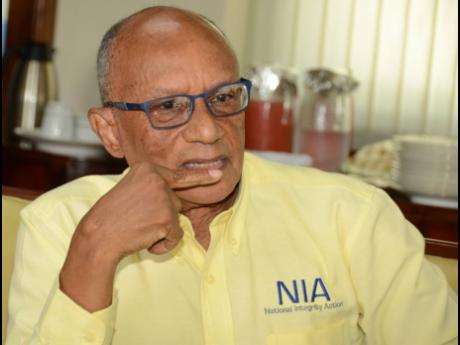
- Professor Trevor Munroe is principal director, National Integrity Action. Send feedback to info.niajamaica.org or columns@gleanerjm.com.