
Gordon Robinson | Protecting freedom of speech
Published:Saturday | August 21, 2021 | 12:05 AM
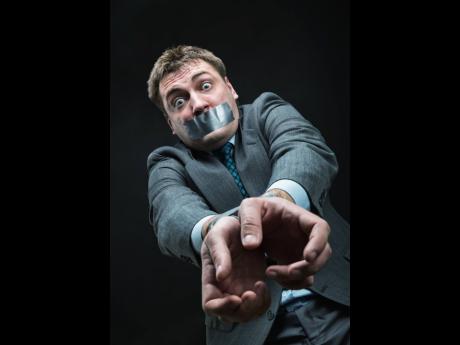
Recently, “freedom of speech” has become a hot-button topic.
Police arrested at least three persons in circumstances suggesting the “crime” was telling PM to jump off (using more indelicate and less biblical language). One was famously forced to “apologise” to PM in a widely broadcast video recorded inside a police station. In a related issue, lawyers have been subject to sanction by General Legal Council for “vulgar, sensational or too frequent” advertising.
So what’s “Freedom of Speech”? Like every constitutional freedom, it was constructed as protection against excessive governmental interference and is simply defined as the right to express opinions without government restraint.
But it’s more than that. It’s a democratic ideal dating back to ancient Greece where “free speech” was pioneered as inherent to democracy. The ancient Greek word “parrhesia” means “free speech” or “to speak candidly”. The term first appeared in Greek literature circa 500 B.C. Athenians were free to openly discuss politics or religion and to criticise government.
By the time Christ became adult, parrhesia had caught on and he was free to spread his teachings until they became a threat to Rome’s power over Judaea, at which point his “free speech” became “treason” and Pontius Police stepped in.
The first “free speech” example in modern constitutions came within USA’s first amendment (Bill of Rights) to its independence Constitution.
It reads (in part):
“Congress shall make no law …. prohibiting the free exercise thereof; or abridging the freedom of speech, or of the press...”
Jamaica’s Charter of Rights provides:
“(a) the state has an obligation to promote universal respect for and observance of human rights and freedoms;
(b) all persons in Jamaica are entitled to preserve for themselves and future generations the fundamental rights and freedoms to which they are entitled;
(c) all persons are under a responsibility to respect and uphold the rights of others”
See the difference? USA protection of free speech is against government. In Jamaica, the protection of free speech is against government and, following the Canadian example, each other.
Jamaica’s “rights” include: “the right to freedom of expression”
USA’s Bill of Rights doesn’t define “free speech”. So courts decided what is and what isn’t protected. Generally, First Amendment guarantees the right to express ideas, information and opinion (however unpopular or unsavoury) without fear of government censorship. USA Supreme Court has held that even flag burning was protected when Gregory Lee Johnson, a youth communist, burned a flag during the 1984 Republican National Convention to protest the Reagan administration.
Jamaica’s Constitution is more explicit, so specifies: “the right to seek, receive, distribute or disseminate information, opinions and ideas through any media”
But, even in USA, freedom of speech has limits. Forms of speech that aren’t protected include:
• Obscene material such as child pornography
• Plagiarism of copyrighted material
• Defamation (libel and slander)
• True threats
Speech inciting illegal actions isn’t protected. Congress passed the Espionage Act 1917, after USA entered World War I, prohibiting interference in military operations or recruitment. Socialist Party activist Charles Schenck was convicted after distributing fliers urging young men to dodge the draft. USA Supreme Court upheld his conviction by creating the “clear and present danger” standard for government to limit free speech. It viewed draft resistance as dangerous to national security.
NON-STARTER
Jamaica’s Constitution expressly provides rights can be limited if “demonstrably justified in a free and democratic society”.
So the idea that “free speech” is absolutely free is a non-starter. Freedom of speech, like every constitutional right, is an individual right subject to the collective good (and rights of others).
Jamaican Constitution provides:
“The following provisions … shall have effect for the purpose of affording protection to the rights and freedoms of persons ... to the extent that those rights and freedoms do not prejudice rights and freedoms of others.”
Jamaican freedom of speech also can’t be used to libel, plagiarise, threaten, disseminate obscene material, incite crime or threaten national security.
Yet, in Jamaica, we get everything as backwards. Government panders to “vaccine hesitancy” by begging and pleading instead of mandating, despite the clear and present danger to public health that renders any restriction of anti-vaxxers’ rights (including to “free” speech) demonstrably justified.
Media encourages false equivalency by giving excessive time to lunatic fringe apostles who tell us, for example, “It’s not a vaccine; it’s an injection” and suggest that, because vaccines obtained only “emergency approval”, evidence of hundreds of millions safely inoculated (with rare exceptions) means nothing. But citizens publicly using profanity to criticise PM are treated as if they’ve overstepped freedom’s limits and are purveyors of obscenity.
Are they really? Jamaica’s Obscene Publications Act 1927 (sheesh!) limits “obscene publications” to items in the category “writings, drawings, prints, paintings, printed matter, pictures, posters, emblems, photographs, cinematograph films”. And the Cybercrimes Act 2015 makes using “a computer to send to another person any data that is obscene” an offence.
“Obscene” isn’t defined in either statute but, in 1868, in an English case, Cockburn C.J opined: “The test of obscenity is this, whether the tendency of the matter charged as obscenity is to deprave and corrupt those whose minds are open to such immoral influences, and into whose hands a publication of this sort may fall.”
BREACH OF PEACE?
Let’s not forget the Town and Communities Act, imposed by colonial masters in 1843 and STILL on our books 59 years after “independence”. It prohibits feeding or foddering any horse on any town thoroughfare or the highway; negligence in driving cattle; driving a horse-drawn carriage without holding the reins; and, oh yes I almost forgot, using “any threatening, or abusive and calumnious language to any other person publicly, as shall tend to provoke a breach of the peace”.
Breach of peace? What peace? Whose peace? There’s nothing abusive, calumnious, obscene or peace endangering about a citizen’s exercise of free speech by criticising government/PM using the only vocabulary available to him after government’s failure to educate him. Similarly, lawyers’ advertisements cannot be restricted because a statutory authority replete with competitors in the legal marketplace considers them “vulgar”; “sensational”; or “affecting the profession’s standing”. That’s a recipe for unfair competition, arbitrary standards and a holier-than-thou attitude.
GLC chairman Allan Wood’s assertion in a recent Gleaner article that “attorneys are officers of the court and this places them in a distinct category from other providers of goods and services” is unnecessarily bigheaded and discloses an attitude of superiority that defies Jesus’ teachings of equality. In my opinion, lawyers telling other lawyers what they can or can’t say; how they can or can’t advertise is a clear breach of freedom of speech.
Regarding constitutional rights, I concur with Batts J’s judgment in Gary Hemans v Attorney General (2009). A driver was abused in front of family by armed, bulletproof-vested policemen (during a “stop and search”) who then charged him with assault and the last refuge of every delinquent policeman, indecent language.
Batts J. wrote (paragraph six of his judgment):
‘The above quoted [constitutional] rights aren’t trappings which necessarily go with statehood. They are the product of over 400 years of conflict, struggle and sacrifice. Beginning in the 15th century the forefathers of the majority of persons in this nation we now call Jamaica were brought here in chains. They were forcibly taken from the country of their birth. Families were separated and humans enslaved to serve firstly Spanish colonizers and then later English economic interests. The system of enslavement continued until it was abolished by an Imperial Act of the British Parliament in 1833. Abolition came after two maroon wars, hundreds of violent slave revolts and agitation by human rights activists called at the time “Abolitionists”. The planters were financially compensated after abolition for the loss of their “property”. The newly freed men received no compensation. In Jamaica civil strife and further rebellion resulted in the free men attaining the right to vote on a basis of Universal Adult Suffrage in 1944. Another 20 years passed before the British lowered the Union Jack and Jamaicans assumed full responsibility for their economic, social, political and international affairs. Central to its position as an independent nation is the Constitution. That document among other things guarantees inalienable rights to Jamaicans. Its ultimate form and content was influenced by developments internationally not least of which were the creation of the United Nations and the Universal Declaration of Human Rights. It’s the duty of this Court to protect and uphold the rights guaranteed by the Constitution.’
We must protect these rights by any means necessary unless a clear and present danger makes a restriction demonstrably justified. We mustn’t surrender to colonially inspired myth that all are created equal but police, politicians and lawyers are more equal than others.
Peace and Love!
Gordon Robinson is an attorney-at-law. Email feedback to columns@gleanerjm.com