
Mark Wignall | Puzzling love affair with British royalty
Published:Sunday | March 27, 2022 | 12:06 AM
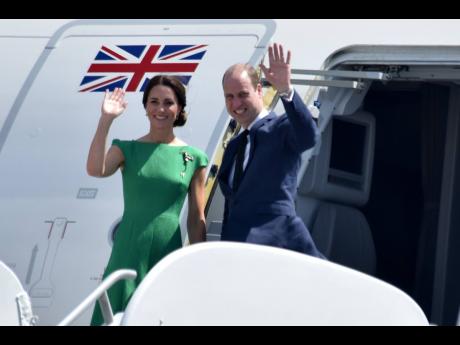
Jamaica’s love affair with the British royalty puzzles me. I hold no fascination for royalty of any kind. Specifically because it is a made up descriptor arranged by families who through the centuries acquired power through thuggery and ownership of large tracts of land.
Somehow or through the application of a special kind of psychology, a handful of people with pomp and pageant and brutal armies at their disposal were able to convince entire populations that their blood was royal. Because of this royalty it would follow that all others were of low birth and to be dubbed commoners. A great hoax that is unshakeable.
In 1983 Queen Elizabeth visited Jamaica. As the entourage slowly made its way on one arc of the roundabout and Harbour View, many men, women and children gathered to embrace them with loud cheers and wild movement of the hands.
I watched it and felt embarrassed. Against that background and the arrival of Prince William and his wife in Jamaica being regaled by the same people who had signalled that they were bottom feeders in the feudalist arrangement seemingly set in concrete for centuries a few of us met, a journalist, a lawyer, a Rasta elder and a strong pan-Africanist.
Not surprisingly, the lawyer spoke first. “I have been trying hard to work out how the visit has any benefits to Jamaica. I know it is costing us a lot of money. Security arrangements, deploying police and soldiers to close roads or redirect traffic and provide security. Preparation of lavish food and special accommodations.
“Space for support personnel, the expense of government vehicles and resources being used in support of the visit, and of course the interruption to the economy. The ‘Royals’ get a huge benefit, they are seen as in tune, connected and human. So the benefit to the ‘Royals’ is very clear.”
MERE WORDS
The veteran journalist said: “Prince William’s statement on slavery are mere words, nothing more. England has had many decades to make things right and has not done so. It would seem to be that Mr Holness and his Government are under some kind of ‘Royal’ spell. They are all enchanted with meeting the ‘Royals’, interacting with them and pandering to them.”
The pan-Africanist was blunt and strident. “England’s behaviour towards Jamaica has not been good. It has always been one-sided. It has been a relationship of exploitation. England got free labour in the form of slavery, which is horrid, evil, cruel, and worse, predatory. After slavery, England looted Jamaica of its natural resources as it saw fit. Where in that relationship is there any balance? It is all in England’s favour.”
The lawyer ended our discussion with a new search for a socio-biological explanation.
“I am at a loss what makes the Queen and her family ‘Royal’. They are quite mortal and subject to indiscretions and inappropriate behaviour, like the rest of us. In fact, they are quite a dysfunctional bunch. Charles and Diana, Andrew, Harry and his flirting with Nazi ideology, The Queen getting Parliament to shield the public from any information on her finances. It goes on and on. The hard fact is the publicity the visit will generate for Jamaica is not worth the cost and aggravation.”
The Rasta elder said as we prepared to leave, “A wonder if is that the people are too programmed into loving white people, especially those divine royals. Dem feel uncomfortable occupying the black skin dem have. It remind dem of pure tribulation.”
BAD MESSAGE TO POLICE FORCE
He is a former member of the Jamaica Constabulary Force (JCF) with a substantive rank. He called before emailing me because he wanted to make sure I read it.
“I read in today’s (March 18) online Gleaner the [Jamaica Defence Force] JDF will be establishing a base in or near Wareika Hills. According to Mr Holness, it will be the first of many. That caught my attention. It seems that the JDF is taking on an ever-increasing role in the fight against crime. I am starting to get the impression that the ‘plan’ is to let the JDF become a second police force.”
When we spoke again, I asked if he was coming straight with me. He was convinced that his assessment was correct.
The rest of the email said, ‘The base that should be established is a police base or station, not an army base or post. ‘The first of many’. How many, at what cost? Why not upgrade police stations and/or establish new ones? Ultimately for Jamaica to have a balanced and peaceful society, the police must be the main crime-fighting and crime-prevention force. That is not a ‘plan’ for success.
“As an ex-policeman, I am ashamed to say that successive governments have never really bought into the idea of bringing police stations to full modernity. I am in support of a well-equipped and well-trained JDF to help in times of national emergency, such as hurricanes, floods and in cases of national emergency.
“Mark, I do not think Jamaica is an invasion target by any foreign nation or power. The JDF can also play a positive role in providing skills and morals to young men and women. But the very heavy reliance on the JDF to fight crime and quell crime as a long-term strategy not just flawed but suspect in its reasons.”
A few weeks ago, the 16-year-old student of a top-ranking rural school told me that she was expelled because of a tattoo on her lower leg. I recently got the chance to speak to her mother. She was not the most gentle of people, or it could be that I was no longer in tune with inner-city pockets.
“Mi tell di principal say mi daughter body belong to har and she can tattoo it if she want,” the mother said.
“And you insisted that she had that right as a student in high school?” I asked.
“A wonda if di principal know sey wi box dat dung,” she said.
- Mark Wignall is a political and public affairs analyst. Email feedback to columns@gleanerjm.com and mawigsr@gmail.com.