
Cash over claims
Businesses urged to prepare beyond insurance for immediate recovery efforts after disasters
Published:Saturday | April 4, 2026 | 12:24 AMAlbert Ferguson/Gleaner Writer
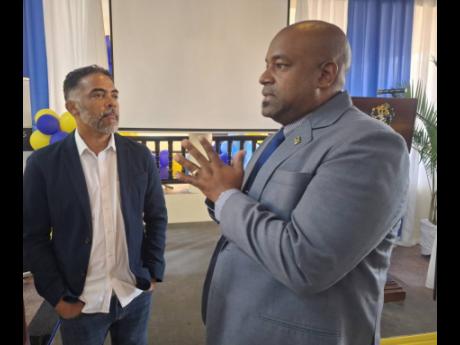
WESTERN BUREAU:
Warning that insurance alone is not enough to safeguard businesses from disaster, Montego Bay Chamber of Commerce and Industry President Jason Russell is urging entrepreneurs to strengthen their financial preparedness and build resilience to withstand unexpected shocks.
Russell made the call while addressing final-year business students at the University of Technology, Jamaica (UTech) Western Campus Business Seminar held recently at the Sea Gardens Beach Resort.
Speaking candidly about the realities entrepreneurs face, he stressed that businesses must plan beyond insurance coverage and be ready for financial shocks caused by hurricanes, pandemics and other disruptions.
“In recent times, we’ve been hearing the back and forth about insurance,” Russell said. “The word deductible is being thrown up and average clauses, and what we’re seeing in the market right now is insurance not providing that comfort that people expect.”
He noted that many business owners mistakenly assume insurance will provide immediate relief following a disaster, when in reality the process can take months – a gap exposed after Hurricane Melissa devastated large parts of Jamaica late last year.
The Category 5 storm caused widespread structural damage to tens of thousands of homes and businesses across the island, triggering prolonged reconstruction efforts and highlighting weaknesses in disaster-recovery coverage for many enterprises.
“We as business owners have to put what we call a little cash under the mattress,” he said. “Because even when something might happen, we cannot sit down waiting on insurance because insurance does not open everything tomorrow. It’s a long process a lot of the time.”
Russell warned that businesses which fail to plan financially often struggle to reopen after major disruptions.
“It can be any catastrophe,” he said. “It can be with your family, it can be with you personally. But if you don’t prepare financially, when something happens, the business may not recover.”
The Montego Bay entrepreneur pointed to financial preparedness as a key pillar of business resilience, alongside staffing, customer loyalty and passion.
MAINTAINING FINANCIAL BUFFERS
For Russell, who owns and manages the Pier One Restaurant on the Montego Bay waterfront, maintaining financial buffers is critical to ensuring operations can continue during periods of uncertainty.
“You work hard and you make money, but instead of just spending it, you must invest the money and keep something aside to help the business survive,” he said, urging the UTech students to adopt this approach.
He also cautioned against operating outside formal financial systems, stressing that proper record-keeping and transparency are essential for long-term growth.
“Some people hide the real numbers in their business, but when you go to the bank, they ask what happened to the last 10 years of your business,” Russell said. “If you say you make $1 million but the bank account only shows $10,000, the bank is going to ask where the money is.”
He noted that such practices often limit a company’s ability to access financing or expand internationally.
“What they do in the short term affects their growth in the long term,” he said. “A business built on ‘runnings’ is limited in where it can go and who it can do business with.”
Businesses that maintain transparent records and meet their tax obligations, he added, are better positioned to access financing and withstand economic shocks.
“At Pier One, we pride ourselves on paying all the taxes and being straight,” Russell said. “I can walk into any bank.”
Russell also underscored the shift in business priorities, noting that resilience now outweighs the singular pursuit of profit.
“Back in the day when I started business, the word was profits,” he said. “Now it’s about how do I survive the next Category 6 hurricane, the next pandemic? How do I keep my staff happy and maintain the business?”
His message to students was clear: successful entrepreneurs must prepare for uncertainty and structure their businesses to withstand crises.
“You have to be ready for anything,” he added.
Hurricane Melissa’s Aftermath: Impact on Business and Insurance in Jamaica
Hurricane Melissa, which struck Jamaica on October 28, 2025, made landfall as a powerful Category 5 storm, tying with historical Atlantic hurricanes for intensity and leaving widespread destruction across the island.
Estimates show that around 150,000 structures were damaged or destroyed, including homes, schools, health facilities and commercial buildings, with thousands left without secure shelter or basic services.
The hurricane also dealt a significant blow to the economy. Government and financial analysts reported that the storm’s damage was equivalent to roughly 30 per cent of Jamaica’s gross domestic product (GDP), posing immediate challenges to economic output, infrastructure and financial stability.
Tourism and small businesses suffered acute losses in the hurricane’s wake. Many small and medium‑sized enterprises (SMEs) in Montego Bay and other western parishes struggled to recover stock, repair facilities and resume normal operations after the storm, with reported sales down sharply and slow restoration of power and logistics complicating recovery.
While some formal insurance payouts have been made, they tell a mixed story for business continuity:
The Caribbean Catastrophe Risk Insurance Facility (CCRIF) triggered fast, parametric insurance payouts totalling nearly US $92 million shortly after the storm — one of the largest such disbursements in its history — helping the
Government of Jamaica with immediate liquidity for emergency response and early recovery efforts.
For specific sectors, such as agriculture, insurance coverage has provided targeted relief: farmers affected by the hurricane received payouts under weather protection programmes, although amounts have been limited compared with overall losses.
However, business insurance challenges remain acute for many private enterprises. Traditional insurance policies typically require detailed damage assessments and claims processing, which can take months to conclude — a delay that can stall reopening, repairs and staff rehiring. This aligns with warnings from local business leaders that insurance alone is insufficient for continuity planning.
Economists and financial institutions note that insurance does not cover all losses, especially where low insurance penetration among SMEs leaves many operators underinsured or uninsured entirely. Combined with
infrastructure damage and disrupted cash flow, this has prolonged recovery for smaller businesses despite broader economic resilience efforts.
Overall, Hurricane Melissa’s impact has underscored the importance of integrated disaster planning, including financial buffers, formal risk‑transfer mechanisms and long‑term resilience measures, to reduce economic vulnerabilities and support sustainable business continuity in the face of intensifying climate hazards.