
PAKISTAN
Sharif sworn in as new PM after week of drama
Published:Tuesday | April 12, 2022 | 12:09 AM
ISLAMABAD (AP):
Pakistan’s parliament on Monday elected opposition lawmaker Shahbaz Sharif as the new prime minister, following a week of political turmoil that led to the weekend ouster of Premier Imran Khan.
Sharif took the oath of office inside the stately, white marble palace known as the Presidency in a brief ceremony.
But his elevation won’t guarantee a peaceful path forward or solve the country’s many economic problems, including high inflation and a soaring energy crisis.
Sharif, the brother of disgraced former Prime Minister Nawaz Sharif, won with 174 votes after more than 100 lawmakers from Khan’s Pakistan Tehreek-e-Insaf, or Pakistan Justice Party, resigned and walked out of the National Assembly in protest.
Those 174 votes – two more than the required simple majority – are enough to pass laws in the 342-seat assembly. If Khan’s followers take to the streets, as he has vowed, it could create more pressure on lawmakers and deepen the crisis.
Khan, a former cricket star whose conservative Islamist ideology and dogged independence characterised his three years and eight months in office, was ousted early Sunday. He lost a no-confidence vote after being deserted by his party allies and a key coalition partner.
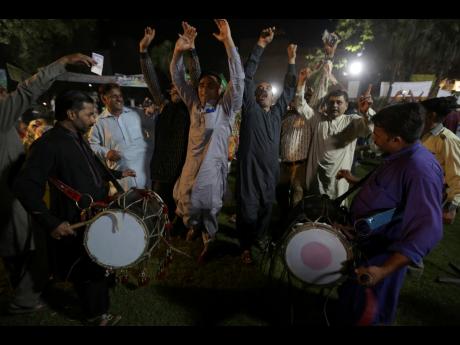
In a show of strength and a precursor to the political uncertainty ahead, Khan rallied hundreds of thousands of supporters in protests on Sunday night, describing the new leadership as an “imposed government” that colluded with the US to oust him. His backers marched in cities across Pakistan, waving large party flags and shouted slogans promising to return him to power. The crowds were dominated by youths , who make up the backbone of Khan’s supporters.
The political drama began on April 3 when Khan sidestepped an initial no-confidence vote demanded by the opposition by dissolving parliament and calling early elections. The opposition, which accuses Khan of economic mismanagement, appealed to the Supreme Court. After four days of deliberations, the court said Khan’s move was illegal and the no-confidence vote went ahead, leading to his ouster.
Khan has demanded early elections – the balloting is not due before August 2023. He has tapped into anti-American sentiment in Pakistan, accusing Washington of conspiring with his opponents to topple him. That conspiracy theory resonates with his youthful base, which often sees the US war on terrorism after 9/11 as unfairly targeting Pakistan.
Khan claims Washington opposes him because of his independent foreign policy favouring China and Russia. He was criticised for a visit he made on February 24 to Moscow, where he met with President Vladimir Putin as Russian tanks rolled into Ukraine.
The US State Department has denied any involvement in Pakistan’s internal politics.
China, which is Pakistan’s key ally and investor, said on Monday it would support any government.
“As Pakistan’s close neighbour and iron-clad friend, we sincerely hope that all factions in Pakistan will remain united and work together for national stability and development,” Foreign Ministry spokesperson Zhao Lijian said at a briefing. “I would like to emphasise that no matter how the political situation changes in Pakistan, China will unswervingly adhere to its friendly policy towards Pakistan.”