
God, people, party
Published:Sunday | October 3, 2010 | 12:00 AM
Robert Buddan, POLITICS OF OUR TIME
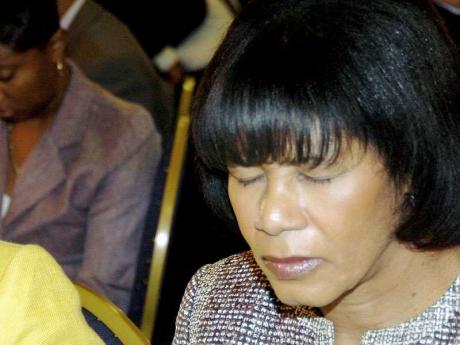
Portia Simpson Miller says she believes in God, people, and party, in that order. She was telling her interviewer, Lambert Brown, on 'Evening Edition' last week that she was not so tribal as to put party first. This is why she said in her conference speech that her party founders put "people" in the name of the party. The party belonged to the people, not to any leader.
There was no other time over the past 70 years that the people needed to be brought back into politics than now. This is true the world over. This is evident in the two takes on the present global economic crisis. One is that the solutions are known. The elite know what the solutions are. In Jamaica's case, International Monetary Fund (IMF)-Government of Jamaica (GOJ) cuts are part of the solution. Stimulus packages, bailouts and tax incentives for the people in big business is the solution. It is just a matter of which party can demonstrate that it has the will to go as far as is necessary.
The other take is that the solutions are not known, certainly not by the elite. After all, they got us into this mess in the first place. The solutions are not known because there is such a profound failure of the old society and politics of the post-war period that societies need to go back to asking some fundamental questions. They need to provide answers as a people, not an elite. The crisis, in this view, is a failure in the way we live. We must find better, more humane ways.
The right-wing pro-business parties that have dominated western societies think they know the answer. They represent the entrenched elite who take the top-down view, being at the top. They believe that their way is fundamentally sound. All we have to do is allow business and market full sway. The left-wing social democratic parties and grassroots movements see things from the bottom up. There is such deep malaise in the lives of these people on the ground that they are disillusioned with the old way but they see no blueprint for the future. Social democratic parties believe that societies need an honest and open dialogue to re-think the roadmap to progress.
NEW DISCOURSE
This, for example, is happening in Cuba where profound changes will take place under a new plan. This is coming after more than a year of widespread debate among the people. It is not happening in Haiti because the grassroots movements and the foreign and domestic elite are not in the same dialogue. In Europe, the social democrats want a fresh and profoundly new discourse on society, its values and ways of living. In the United States, the modern representatives of progressivism want the same. Barack Obama had started that conversation there. That's why he won the presidential election. Portia Simpson Miller's invitation to Jamaicans to dialogue towards a progressive agenda is the best Jamaican example.
Achieving a new discourse is not easy in any of these cases. The old forces don't want to change anything. They have got richer. They've even got richer off the crisis. They are sure they have the answer. But they have been sure before and they have been wrong before too. What is worse is how ideological and propagandistic they are. In the United States, they are painting Obama as an alien who was really born in Kenya, not Hawaii, and who forged his birth certificate. They say he is a closet Muslim. They say he is a socialist. These are all bad words in American politics. As much as a third of the American population believes these lies. There are outright lies being told about the grassroots movement in Haiti, the Castros in Cuba, the social democrats in Europe and Portia Simpson Miller in Jamaica. The lies are an old tool. But they work.
What is also hard about achieving the discourse is that the changes of our epoch are so profound that many of us are confused. Capitalism is changing radically and we don't know what to regulate, how, and how much. Family structures are changing. Values are changing. Technology is changing how we work, play, study and think. Politics is not responding nearly fast enough. In 2004, scholars of democracy presented the Council of Europe with a 28-point green paper for amending democracy in Europe. Little has been done.
Old Coalitions
The old coalitions of the left have been deconstructed anyway. Unions, grass-roots movements, environmental ones, those representing women, youth, intellectuals, Christian socialists, minority races, immigrants, and so on, have organised themselves around more group-specific agendas as social movements, new parties and civil society organisations. Left-wing parties agree on what has gone wrong. Capitalism's irresponsible and reckless manipulation of the market for greed and globalisation's extension of all this around the world with little regulation, is the problem. But they admit that they are still groping for an alternative model. What they agree on is that the most vulnerable must be protected.
It is in this state of deconstruction, change, flux, confusion and desperation that people in America, Europe, Latin America, and the Caribbean are asking of the left, 'what is your alternative?' The right-wing chides the left for not being ready as if the state of things lends anyone to being ready. The left can only hope for a regrouping of the forces of progressive change. But to get this it needs national conversations with the people.
The People's National Party (PNP) is in the best position to lead this dialogue in Jamaica. The Jamaica Labour Party has lost credibility and lost its opportunity. Other groups are too limited. Indeed, the PNP's annual conference was the best attended ever. People seem to want to listen. It is being compared to the 1976 conference which had to be moved to the National Stadium. The PNP said more people were outside the National Arena than inside and the crowd could have almost filled the National Stadium much as the Reggae Boyz have. It says more people were left back in the constituencies because the party had not expected so many to have wanted to attend.The people inside the Arena listened to the party leader and the people outside wanted the party to put on mini-conferences in their regions so they can hear her speak directly to them.
opportunity for pnp
This is the opportunity that the PNP needs to organise Jamaicans to join in a progressive dialogue. The PNP intends to break out its preliminary progressive agenda in this dialogue and build on it through the mini-conferences.
What are other people talking about? They are talking about new taxation systems, new pension systems, new generation politics, saving agri-biodiversity, entitlements, and mending broken economies. They are offering a critique of contemporary society and its soulless individualism and are talking about developing a future social democracy for the good of society. They are talking about a social Europe and, yes, even a social America (USA).
The Social Democratic Party just lost elections in Sweden, but the British Labour Party elected a new leader from the left last week. Somewhere in all of this social democratic revival is the search for a moral basis for politics, for trusting governments, for restoring the hope for a just society and a role for God, people and party.
Robert Buddan lectures in the Department of Government, University of the West Indies, Mona. Email: Robert.Buddan@uwimona.edu.jm.