
Black history lessons
Published:Tuesday | February 22, 2011 | 12:00 AM
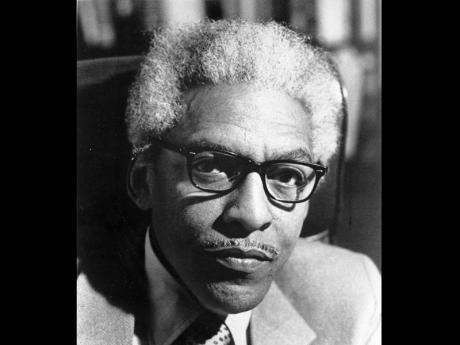
Some genius picked the year's shortest month to celebrate black history. Every February, Martin Luther King Jr is revered worldwide. Very few persons ever hear the name Bayard Rustin.
Who was Bayard Rustin? He was a black American civil-rights activist who introduced King to Gandhian principles of non-violence. History buffs should remember that King was a reluctant leader, and even when he was thrust into leadership, his early vision was limited to the Montgomery Bus Boycott. That protest, sparked by criminal charges laid against Rosa Parks for refusing to give up her seat on the bus to a white man, wasn't expected to extend beyond the desegregation of the Montgomery transport system.
By then, Rustin, born in 1912, already had extensive experience in non-violent protest, having travelled to India in 1948 to learn those techniques from Gandhian leaders. Back in America, he co-founded a school that taught non-violence. In the 1930s, he contributed to successful efforts to save the 'Scottsboro Boys': nine black youths accused of raping a white woman in Alabama. They were convicted several times on patently fabricated evidence. The majority were sentenced to death.
During World War II, he joined with A. Philip Randolph and A.J. Muste to plan a march on Washington to protest racial discrimination in the armed forces. The march was cancelled after an executive order by President Roosevelt banned discrimination in defence industries and federal agencies. In 1942, Rustin co-founded the Congress of Racial Equality as a pacifist organisation based on Henry David Thoreau's writings and modelled off Gandhi's non-violent resistance against British rule.
By the time Rustin learned of the efforts of this hitherto unknown preacher to desegregate Montgomery's transport system, he was a seasoned civil-rights activist steeped in the principles of non-violence. He saw possibilities for this fledgling movement to achieve national reach beyond even King's expectations. So convinced was he of this simple bus boycott's limitless potential that he travelled from New York to Montgomery to try to meet King. He arrived, unannounced, late one evening, at King's home. He was stopped by a phalanx of armed security guards hired to protect King, who had been the target of vicious death threats. Rustin was allowed entrance only by King's personal intervention when, attracted by the commotion, he came to the door and decided to invite the stranger in.
Bayard Rustin became King's right-hand man. The very first issue he took with King was the contradictory message sent by the armed guards. He brought Gandhi's teachings to King and convinced him that success and national impact could only be founded on non-violence. King immediately dispensed with the use of armed guards or weapons of any kind and began the personal and spiritual growth and development that is revered today.
Greatest moment
Remembering his old plans of the 1940s, it was Rustin that organised King's famous march on Washington where he made his legendary 'I have a dream' speech. But this, Rustin and King's greatest moment, was also to be the beginning of the end for Bayard Rustin in the civil-rights movement. The movement suddenly became more visible. Its members came under scrutiny. Rustin, a lifelong homosexual (at a time when homosexuality was illegal everywhere in the USA) who didn't hide his sexual orientation, had also joined the Young Communist League (an affiliate of the Communist Party USA) in 1936. In the beginning, the Communist Party supported the civil-rights movement, but when Germany invaded the Soviet Union, Stalin ordered the party to abandon that work and focus on lobbying the US to enter the war. Rustin moved on to join other anti-communist socialists like Randolph and Muste, but his past as a young communist haunted him as King's profile grew. After the Washington march, Senator Strom Thurmond denounced Rustin as a "communist, draft-dodger and homosexual". He produced an FBI photograph of Rustin talking to King while King was bathing, implying a same-sex relationship between them. Not wanting to cause damage to the movement, Rustin withdrew.
So, it took a homosexual communist to teach the great Martin Luther King that men of God don't need guns. Who'll teach Reverend Al? The argument about protection of life and property is putrid twaddle. Didn't Christ teach death as the ultimate victory and property an obstacle to entering the Kingdom of Heaven? Was something said about camels and needles? Why do preachers pass the plate religiously on the promise of Heaven but few seem anxious to get there?
Peace and love.
Gordon Robinson is an attorney-at-law. Email feedback to columns@gleanerjm.com.