
The very best of sports
Published:Sunday | July 24, 2011 | 12:00 AM
Tony Becca, ON THE BOUNDARY
I have been blessed with watching sports all over the world, every day I thank God for the opportunity given me, and the more I see, even on television, the more I love sports. I love it for the beauty that it is - all forms of it.
I love sports also for the drama, excitement, and entertainment that it provides, both in competition and relaxation, and for its part in bringing people together; people of different nationalities, race, colour, and creed.
Sports is one of the few things in life that sees no difference in man, whether he is black or white or in between, rich or poor, and Christian or not. A man is a man and victory depends entirely upon who is better at the moment of reckoning - who hits the tape first, who scores the most runs, or who shoots the most goals, etcetera, etcetera.
My faith in sports, my love for sports, grew some more, if that was possible, last weekend while I sat at home watching television and lamenting the fact there was no live cricket to watch, no live Jamaica Cricket Association club match being played anywhere in Jamaica on a lovely sun-baked weekend in July in Kingston, or for that matter, anywhere in Jamaica.
On Saturday evening, I saw, on ESPN, a rebroadcast of Friday Night Fights from the previous night and, believe me, it was one of the most exciting, action-packed fights I have ever seen.
The fighters were not Rocky Marciano and Ezzard Charles, they were not Sugar Ray Leonard and Thomas Hearns, and they were not Muhammad Ali and Joe Frazier.
They were two relatively unknowns, one was a Puerto Rican, Delvin Rodriquez, and one was a Pole, Pawol Wolak, living in the United States of America. The Puerto Rican was an orthodox boxer, the Pole, shaven-headed, was a brawler, and standing in front of each other with the Pole moving forward for every second of the fight, they threw bombs at each other for every second of the 10 rounds.
It was as if they were two machines and somebody had wound them up and set them at each other.
The Puerto Rican looked untouched at the end of the fight, the Pole's right eye was swollen and resembled a balloon, he could not see out of it, and the fight was declared a draw.
The fighters stood hand in hand, there was applause around the arena for an exhibition of their skills, they both praised each other, and both vowed to do it again, and quickly at that.
After taking the best punch, brutal punches, from each other for so many rounds, after each man had hurt each other so much, they still found time to respect each other and to say to the other, "well done" and to promise another bout at another time to a cheering gathering.
fourth round
On Sunday, it was the fourth round of the British Open in Kent, England, and Darren Clarke of Northern Ireland at five under par won it by three strokes at 275 from Phil Mickelson and David Johnson at 278.
The beauty of that event was not that Clarke was a 42-year-old winner, not that he was winning his first Major in 54 attempts, or that he looked somewhat overweight, certainly in comparison to when he was a young man. The beauty of it was the way in which he played the game.
Starting the day at one under par in search of arguably the biggest title in golf, Clarke went around the course in and out of the rain and wind, smiling and talking, and playing exquisite golf in between.
Although, but for his fiancée and himself, hardly anyone, including one of his sponsors who offered him an extra £2.1 million if he won the title, gave him a chance, he played as if he knew he was destined to win.
Mickelson, even par and five behind Clarke at the start of the day, with three birdies and an eagle in seven holes, caught Clarke at the seventh hole.
Clarke did not flinch. Instead, he eagled immediately to go ahead, and when Mickelson birdied the 10th to go one behind, he kept going until Mickelson blew himself up and dropped out of the race.
"I went out there to do my best. That's what I did and, on this occasion, my best was good enough."
Maybe he believed in his friends, who kept telling him to "get out there and practise and keep going", or he believed that after Rory McIroy, a fellow Irishman at age 22 and living in Australia, had won the last US Open title, it was his time.
Maybe it was because when he turned up before the start on Wednesday evening he saw that he was given the locker room which was used by Greg Norman in 1993 when he won the championship, or maybe it was because his friend, the incomparable Tiger Woods, had called him on Saturday night and wished him well.
Whatever it was, and even though he looked chubby and overweight, Darren Clarke was one of the people's favourites to win the British Open; and they were as delighted as he was in the winning.
He was congratulated by almost every one of his opponents, and I enjoyed watching him play.
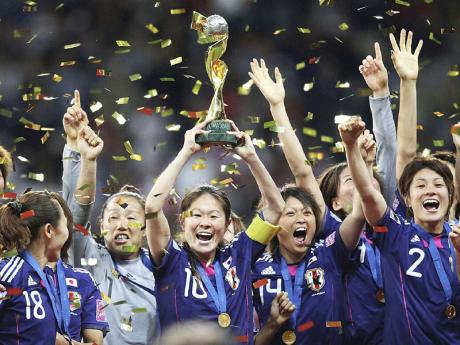
Later that Sunday evening, a few minutes after Clarke's brilliance, Japan rose to the occasion and defeated the USA to crown themselves queens of FIFA's Women's World Cup football in Germany.
Although it was not surprising that they won the title, even though they may have suffered from a height disadvantage, they did so with a charm, with a smile, that suggested that is how sports, even professional sports, should be played, always and forever.
technically good
They were technically good, they passed the ball around well, they enjoyed short-passing, they ran into spaces, and they were quick to shoot.
Twice they were down, and twice, late in normal time and late in extra-time, they came back until, in the penalty shoot-out, they won it 3-1.
I was happy for the Japanese, but I was also sorry for the Americans. They deserved to win, they dominated the game in the first 20 minutes and, in that time, it could easily have been 3-0 or 4-0 for the USA.
Why did USA not win? I do not know, although it could have been a bit of arrogance on their part.
While the USA media were busy finding excuses for the loss, criticising the way the match ended and condemning the penalty-kick system of deciding matches, the same penalty kicks by which they won the 1999 World Cup, the same penalty kicks by which they defeated Brazil at this year's championship, the American ladies were wonderful.
Amid their disappointment, they found time to congratulate the Japanese and to commend them for their brilliance, especially in set plays.
The Americans were good, but the Japanese were better, at least when it comes to passing the ball and running into spaces.
And all three, Darren Clarke, the boxers, and the World Cup finalists, were magnificent. They played sports the way sports, professional or amateur, win, lose, or draw, was meant to be played.