
Four things to celebrate
Published:Sunday | September 18, 2011 | 12:00 AM
Tony Becca, Contributor
In the past two weeks or so, some interesting things have occurred in sports, including the ICC's about-turn on the number of teams for the World Cup, the announcement of the ICC's top players of the year, and the debate concerning the IAAF's false-start rule.
The ICC changes stance on World Cup
At its recent meeting in London, the ICC accepted the report of its development committee, chaired by West Indian Clive Lloyd, to change the format for the 2015 World Cup and every cricket team, from the four corners of the world who is an ICC full member, or affiliate member, or associate member, is ecstatic, and especially because of the way the committee decided to do it.
The Lloyd committee has decided to open the tournament to all teams, to increase the number from 10 to 14 participants, to have two qualifying tournaments among all its affiliate and associate members to get the additional four teams. Each tournament will be played on a league basis, and everyone, including giant killers Ireland, is happy.
In fact, and in contrast to the original situation, with the process calling for two tournaments, one with the top-six teams from the World Cricket League and the top two from the World Cricket League Division Two with the top two joining the 10 for the World Cup, and one involving the remaining six plus the third and the fourth teams from the World Cricket League Division Two, some teams will have two bites of the cherry.
All is well that ends well, and we hope that once and for all the format, as far as the number of teams and the way they get there is concerned, has been finally resolved and that the future of the World Cup will be safe from politicking, once and for all.
Stafanie Taylor, Devendra Bishoo on top
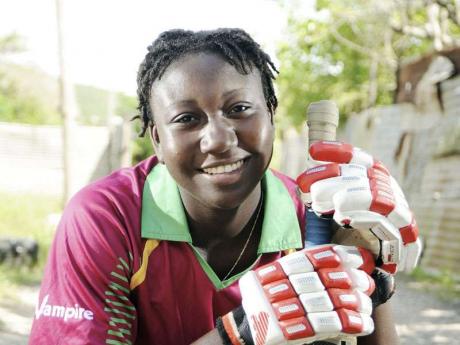
On Monday night, cricket had its annual banquet in London where it honoured its outstanding performers of the year and right there among Jonathon Trott, Alistair Cook, and Kumar Sangakkara, who won the player-of-the-year, Test player-of-the-year, and ODI player-of-the-year awards, were two West Indians, Stafanie Taylor and Devendra Bishoo.
Taylor won the women's player-of-the-year award and Bishoo the emerging player-of-the-year award, and quite rightly so.
Taylor is unquestionably the West Indies' finest batsman of the day, and probably their best all-rounder, and Bishoo is, undoubtedly, one of the West Indies' brightest prospects.
As a Jamaican cricketer, as a West Indian cricketer, Taylor is not as good as her male counterparts. As a batsman, however, as a female batsman, she is the best to have come out of the islands, better than anyone before her, including the likes of Jamaicans Molly and Polly Coombs, Jean Cardogan, Evelyn Bogle, Rita Scott, and Marlene Needham, Barbadian Gloria Gill and Trinidadian Louise Brown.
A right-arm leg-spinner with a useful googly, a brilliant fielder and a plucky tail-end batsman, Bishoo promises to be an integral part of the expected West Indies fight back to the top of world cricket.
M. S. Dhoni, the Indian captain, was not present at the function, nor were any members of the Indian team, and the question was: were they snubbing it?
Probably the answer was yes; probably they were embarrassed to receive the spirit of cricket award for calling back Ian Bell after he was run-out in the second Test match.
Usain Bolt, Glen Mills on the right track
Jamaica's world-record holder in the men's 100 and 200 metres by some distance, the Olympic champion in both disciplines, the two-time defending world champion in the 200, and the former world champion in the 100 blotted his copybook recently when he false-started in the final of the 100 metres at the World Championships in Daegu, South Korea, and dropped out of the race.
To his everlasting credit, however, while his countrymen, and a few others, were busy criticising the IAAF, the rule, and everybody contacted with it, Bolt simply dismissed it as one of those things and went ahead with his preparations for the 200 metres.
Bolt, who had said he had no problem with the rule when it was changed in 2010, recognised he made a mistake, moved to put it behind him and come back another day.
Maybe it was because he was so fast that he knew he could, for now, beat the field anytime he wants to; maybe it was because he knew that athletes try to beat the gun all the time, may be it was because he knew that the officials had tried many things to stop it in the past without success; maybe it was because he knew that the rule was there for everyone, and maybe it was because he knew that the only fair rule is one false start for each athlete and that that would be time-consuming why he made no fuss about it.
Bolt and his coach Glen Mills understand that the rules cannot be made for one man, regardless of who he is. His mother, Jennifer Bolt, appreciates that fact also, and you can bet your bottom dollar that regardless of the Jamaican pressure, the IAAF will stick to their guns.
Jamaica, the favourite
Once upon a time, in the days of Garry Sobers and Roan Kanhai, Wes Hall and Lance Gibbs, and then Viv Richards and Clive Lloyd, Andy Roberts and Michael Holding, the West Indies were so good that to many people around the world, to cricket fans, the West Indies were their second favourite team.
In other words, while their favourite team was their own, the second favourite team, to all of them, were the West Indies.
Today, certainly in track and field, the second favourite team to everybody is Jamaica, the land of athletes such as Veronica Campbell-Brown, Shelly-Ann Fraser-Pryce, Kerron Stewart, Sherone Simpson, Brigitte Foster-Hylton, Melaine Walker, Asafa Powell, Yohan Blake and, of course, Usain Bolt.
Just recently, during the World Athletic Championships in Daegu, I saw a little French girl in the stands happily waving her national flag, and on her cheek, her right cheek, was a Jamaican flag in all its colours, for all to see.
That was my proudest moment, as a Jamaican, throughout the meet.