
Portia understands mandate
Published:Sunday | January 8, 2012 | 12:00 AM
Ian Boyne, Contributor
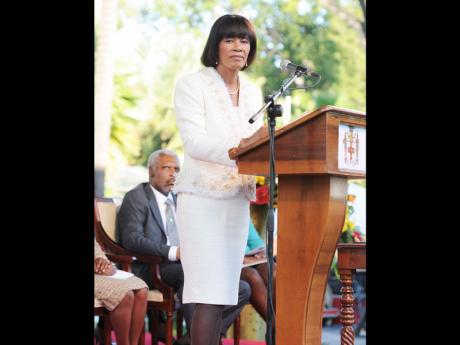
"It is shining time again," Prime Minister Portia Simpson Miller announced at her inauguration last Thursday, and she certainly shone in that well-constructed, highly strategic, conciliatory and inclusive inaugural address.
Yes, we have heard nice, flowery, high-sounding words before at inaugurals. And, yes, reality and performance have not kept pace with the eloquence. But don't use that experience to take away from Mrs Simpson Miller's excellent and on-point address, delivered with confidence and poise. And we were just reminded in October when Andrew Holness was sworn in that an inaugural speech can turn flat, off-key and off-mark. (Incidentally, I was on leave and did not get to review that speech.)
It was absolutely clear from listening to the prime minister last Thursday that she deeply understands her mandate and the message the people of Jamaica sent her on November 29. I get the impression that Portia Simpson Miller, with "so much cloud of witnesses" before her, to use a biblical phrase, is determined not to squander this mandate she has been given. She had better not. For our people's patience has run out.
"The Jamaican people have sent a clear message. They want a more accountable and transparent Government which consults them ... . My administration will be marked by respect and responsibility. By greater openness in Government." She touched on all the right themes. You might say these are just words and the 'right things to say', but we have had enough bitter experience with our politicians to know that often they find it extremely difficult to choose the right words.
So let us not be so eager to dismiss right words and carefulness of expression. One of the things many people are saying why the Jamaica Labour Party (JLP) was booted out of office is that its representatives did not know how to speak to us and did not use the right words. So, yes, rhetoric is not all, but the light words are very important.
Action time!
It is up to us to ensure that actions match words. Portia said she has not only been tested but "tempered", a subtle rejoinder to G2K's question: "Has Simpson Miller changed?" And she had her own charge to her generation: Complete the mission of Independence in this our 50th year by abolishing the monarchy. So she implied, contrary to the young and the restless who deemed her generation "done", that there is work yet to be accomplished, and she intends to do it.
The prime minister also sounded the right balance in economic philosophy when she underscored: "Let me say emphatically to our business community, at home and overseas: We will pursue a tight fiscal policy, reduce our debt-to-GDP ratio, maintain the key macroeconomic fundamentals and be very careful and prudent in our debt management."
She went on to say, "Our policies are based on the principle that the private sector is a major participant in shaping the economy of our country."
Many have charged the People's National Party (PNP) with fiscal recklessness and populism. As I pointed out last week, one of the major factors which enabled the party to win is that it convinced the private sector and the moneyed classes that the PNP was no threat to their interests and that it is committed to the same fiscal discipline which the JLP has preached.
But, as a voice crying out in the wilderness against neoliberalism and for Keynesian economics, I was very pleased to hear Mrs Simpson Miller say that while her Government accepts the pivotal role of the private sector, "in a time of crisis Government must act to stimulate growth". She also said the mandate Jamaicans gave her on December 29 was a "call to action", including a call to "ease the burdens and pressures of increasing poverty, joblessness and a deteriorating standard of living".
I was happy to hear her vigorously commit to "a tight fiscal policy" and the reduction of the debt, but just as vigorously to "do all this while seeking to improve the social conditions of our people, including a serious reduction in the chronic state of unemployment in this country". Now I can hear the neoliberals: "Now here is the typical politician speaking out of two sides of her mouth: On the one hand, pledging to have a tight fiscal policy and reduce the debt, while pledging to increase spending to create jobs and alleviate poverty! We are going back down that same 'run wid it' Omar Davies road again with a different driver, Dr Peter Phillips!"
balancing books, lives
And this is where the conversation has to go: How do we balance the books while trying to balance people's lives? Can we attempt both, or one cancels out the other inevitably? Do we have any space at all to do anything about poverty and unemployment now, or should we apply even more stringent austerity measures, more bitter medicine, which will get the patient in a condition to take in some food? This is the challenge the PNP will face as influential voices in the private sector and civil society - including the media which are dominated by neoliberal voices - press the Government to back-pedal on its promises to the people.
These people are genuinely convinced that a programme like JEEP will set us back. And my own question is, what if the Government is not able to convince the Chinese to agree to the reallocation of their funding for the Jamaica Development Infrastructure Programme? Will the Government abandon JEEP in the showroom or use state funds to fuel it and get it on the road? Dr Davies has been emphasising that no new resources will be used to fund any project mentioned in its manifesto. So the Government is walking a very fine tightrope between fiscal responsibility and social responsibility, and it is the degree of trust it will be able to engender with the people which will determine whether it trips up.
International Monetary Fund (IMF) boss Christine Lagarde has already said no nation will be immune from the effects of the Eurozone crisis and the Fund's chief economist, Olivier Blanchard, in its year-end review and 2012 projections, said the financial crisis of 2012 may turn out to be even worse than that of 2008. That first-rate scholar, Professor Anne-Marie Slaughter, former Obama administration official now teaching at Princeton, wrote in the Financial Times last Tuesday that austerity and the resulting poverty are likely to provoke revolts in sub-Saharan Africa, Central Asia and South America.
"In European countries ... protests are also likely to turn into coordinated civil disobedience ... . Expect a very turbulent year."
It is this year in which Portia Simpson Miller has been inaugurated to fulfil some high expectations and conflicting demands. A survey of 83 economists polled by the Financial Times found that in the opinions of the experts, 2012 will rival 2009 in terms of economic weakness. Two of the developing world's most noted economics writers, C.P. Chandrasekhar and Jayati Ghosh, in their essay Prospects for the World Economy 2012, say, "There is a palpable sense of gloom and impending doom in most discussions of the world economy today." Jamaica is not insulated from these pressures.
The global economy weighs heavily on the Jamaican economy. That is why it is foolhardy for us to simply wait for foreign investors to come to save us or to expect that our local private sector, by itself, can produce the stimulus needed to kick-start economic growth. The State should do something. Interestingly, the JLP manifesto says it accepts the Planning Institute of Jamaica's (PIOJ) Growth Inducement Strategy, but I wonder whether the manifesto writers have really read that document, which is diametrically opposed to the JLP's market fundamentalism.
The Growth Inducement Strategy says Government needs to provide a stimulus to aggregate demand in the short term and "improve the social inclusiveness of economic policies, which would include arresting and reversing the upward trend in poverty". This is precisely what Portia was saying in her speech. Did the JLP manifesto authors read the following statement? "While the country has passed IMF tests based on prudent fiscal management so far, the PIOJ is foreseeing potential danger to the socio-economic environment on the horizon if Jamaica continues with the current pace of fiscal consolidation."
The PNP is on solid ground to go for an economic model which uses a mix of private-sector and state-led activities to drive economic growth. And progressive people outside the party, including those in academia, must enter the public square and challenge the intellectual hegemony of neoliberalism which permeates the Jamaican media, especially its editorials. They must bring scholarship and empirical data from country experiences to confound neoliberal orthodoxy believed as theological dogma.
Foreign Affairs faux pas
Incidentally, a major weakness of the PM's speech was its total neglect of international affairs. The PM spoke of CARICOM and the Caribbean Court of Justice, but there should have been a clear call, with the world listening, for the resumption of the Doha Development Round, reforms to multilateral institutions to make them operate more in the interests of developing and emerging countries, and for greater coordination at the global level to mitigate the effects of the global economic crisis.
Foreign affairs is one area where this Government must pay far more attention. Foreign affairs is more than simply getting more countries to buy from us and getting foreign investors here. We must get away from that myopic view.
I am not too concerned about Cabinet make-up, except to say that Foreign Affairs needed Tony Hylton, (he was given investment, industry and commerce) and that Delano Franklyn deserved a key role at the Office of the Prime Minister, perhaps information minister (that has gone to Sandrea Falconer). Information is crucial. For information, the Government needs someone who is not arrogant or abrasive and who is likeable and credible. That person is the literal face of the Government and will be in our face every week at post-Cabinet press conferences and other occasions. I hope she has made the right choice. If not, a lot of what she said in her speech might be vitiated. But for now, she has made an excellent start.
Ian Boyne, a veteran journalist, is winner of the 2010-11 Morris Cargill Award for Opinion Journalism. Email feedback to columns@gleanerjm.com and ianboyne1@yahoo.com.