
Sam Sharpe: Greatest Jamaican
Published:Thursday | July 26, 2012 | 12:00 AM
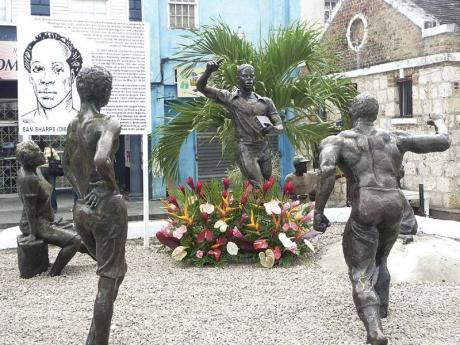
By Devon Dick
INSPIRED BY fellow author, Kevin O'Brien Chang, I will select, in this jubilee year, the greatest Jamaican.
Sam Sharpe, unlike his fellow national heroes, Paul Bogle and Marcus Garvey, is not revered in music, but based on what he did and the impact he made and the obstacles overcame, he is the greatest.
Sharpe was way ahead of his time. He wanted freedom for the enslaved, but he eschewed violence as a means to get it. While some of his leaders of the protest wanted to use arms, because they rightly believed that the colonial authorities would not give them freedom without a fight, he was against using force, and only agreed that force could be used in self-defence as a concession. Sharpe was an advocate of non-violent protest long before Mahatma Gandhi and Martin Luther King. His march to freedom took a different road from the Maroons, who used force as a means of attaining liberation.
Sharpe, in planning industrial action, was way ahead of his time. He and his followers were demanding wages for labour. Furthermore, he wanted better working conditions. The slave owners wanted to give two days holiday and Sharpe was demanding three consecutive days off. This must have been preposterous in 1831.
Master organiser
Furthermore, Sam Sharpe was a master organiser to involve approximately 60,000 persons in a cause at a time of no cellular telephone. He was able to get so many persons to buy into his ideals. He was a leader extraordinaire. What he managed to achieve was an almost islandwide protest. He was able to inspire so many enslaved persons from diverse backgrounds to maintain the secrecy of the plan until near the time. He inspired trust and confidence in the enslaved.
Additionally, Sharpe, though a deacon of the Thomas Burchell English Baptist Church, was independent enough and wise enough and confident enough to interpret the Bible differently, and he understood God differently from what he was taught. He would not compromise on freedom. He maintained that it was "not one minister said such a word. Not one, sir. But me read it in my Bible". Not to mention that Sharpe was prepared to be a martyr for the cause of freedom. Henry Bleby said of Sharpe, "It was not his purpose to wade through blood to freedom, although he was himself prepared to die rather than remain a slave."
Sharpe accomplished this feat while he was enslaved and considered to be property with no political rights, no economic rights, no civil rights and no human rights. He who was considered a 'nobody' challenged the status quo and was successful. He was a freedom fighter, labour leader, manager and skilled interpreter of the Bible.
Sharpe had a sharp mind and could be classified as a philosopher. Sharpe was a believer in equality, a value in which not even the admirable organisation, the Anti-Slavery Society, believed. Sharpe's position was that "the whites had no more right to hold black people in slavery than the black people had to make white people slaves".
Sharpe can be credited with engaging in a widespread protest that was a catalyst to emancipation. Amazingly, Sharpe accomplished all this when he was no more than 25 or 26 years old, according to Henry Bleby, a missionary who knew him well and visited him while he was in prison. He was young, gifted and eloquent.
He now stands as a symbol of hope for all, including young people.
We have outstanding national heroes, but based on the significance, the magnitude of his accomplishments and the degree of difficulty encountered and over which he triumphed, the prize goes to Samuel 'Daddy' Sharpe.
Devon Dick is pastor of the Boulevard Baptist Church in St Andrew. Send comments to columns@gleanerjm.com