
First quarter deaths up
Published:Sunday | May 4, 2014 | 12:00 AM


Sheldon Williams, Gleaner Writer
More Jamaicans died on the nation's roads in the first quarter of this calendar year than during the corresponding periods in 2013 and 2012.
Eighty-two lives were lost in traffic fatalities up to the end of March, compared to 64 in 2013 and 61 in 2012. As the second quarter began, there were 23 fatalities in April, compared to 28 last year and 18 in 2012.
The National Road Safety Council (NRSC)
is concerned about the high number of road fatalities, which, if the
trend continues, will exceed the organisation's target in its Below 240
campaign.
Crash statistics from the NRSC show that
there were 97 fatal road crashes from January 1 to April 28 this year.
Twenty-two persons were killed in crashes in January; 24 in February;
and 36 in March.
Ninety-two persons were killed in 84
fatal crashes over the corresponding period last year, while there were
79 fatalities from 66 crashes during that time frame in
2012.
Despite the hike, Victor Anderson, coordinator
for the Below 240 programme, expressed optimism that by 2016, the target
would be within reach.
"Bear in mind that the target
was for 2016, and that is what we are working towards. It is kind of
like a mid-way point between what happened in 2012 and where we want to
be in 2020. So the target of 240 is really, strictly speaking, one we
want to arrive at in 2016," he said.
Still, he
conceded that "we would have hoped, having got to 260 in 2012, we would
have been well on the way towards 240. If you look at the number of road
deaths over the years, the numbers fluctuate quite widely. But if you
look at the trend line, we are still trending down, and, hopefully, we
will get to 240 by 2016."
Anderson also said road
safety stakeholders do not believe they have been unsuccessful, but have
accepted that it is work in progress. "I don't think we have failed. If
you plot the statistical trend line, the road deaths have been going
down steadily. The deaths fluctuate around that trend line. I don't
accept that road-safety advocates - ourselves as well as other
road-safety stakeholders - have failed. I don't accept that at all," he
said.
"What you are seeing from year to year is
fluctuation that is normal, but we continue to fight, and we haven't
given up on getting to 240 by 2016. If we get there sooner, so much the
better," Anderson said.
Road Traffic
Act
Anderson said the impending revised Road Traffic
Act would inevitably contribute to the reduction of road carnage. Under
consideration, among other things, are the granting of autonomy to the
Island Traffic Authority (ITA) to suspend driver's licences and target
the use of mobile phones while driving.
Driving
schools and instructors will be required to be certified by the ITA and
adhere to a prescribed curriculum.
"We are hoping the
act will be passed by Parliament at the end of this fiscal year and then
will be implemented shortly afterwards. The bill has gone to the
legislation committee of Cabinet, and the next step is for it to be
approved by Cabinet and then go to Parliament. We are hoping it will be
debated in Parliament soon and passed," Anderson
said.
Specifying some especially important aspects of
the proposed revised Road Traffic Act, Anderson said, "Right now, a tyre
is deemed to be adequate for road use once the breaker strip is not
showing. The new legislation is going to introduce a limit, which, if it
goes below that, you can be prosecuted for using unsafe tyres. There is
a proposal for persons who do not pay their traffic tickets not be able
to renew their driver's licence and vehicle licence without paying -
and it is not just a revenue issue."
Cell-phone
use
Cell-phone use also comes in for special
attention. "Drivers will not be allowed to use a cell phone while
operating a vehicle unless it is in hands-free mode. Ideally, we would
have wanted a total ban on cell-phone use, but that was not favoured by
most of the parties who participated in the drafting," Anderson
said.
All speeding will not be penalised equally if
the legislation is passed as is. "School zones and construction work
zones are going to be established in the legislation, where speeding in
these zones will attract much higher fines than they do at the moment,"
Anderson said.
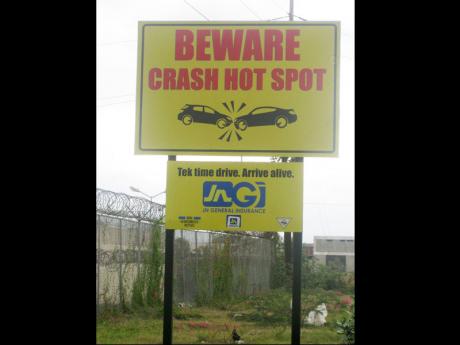
He said crash hot spots are determined
by the police, who continue to monitor those areas, using different
strategies. "In 2012, the number of hot spots was completely different.
One of the reasons we think 2012 was so successful is that the
police-on-the-ground presence focused on specific hot spots, but in
2013, what they realised is that the crashes moved. So if they are out
on a particular corridor and preventing people driving fast, people will
behave themselves until the police are gone. And where there are no
police, they will carry on badly, so the hot spots continue to change,"
Anderson said.
The causes of crashes and their
relative contribution to fatalities remain the same as in previous
years. "Although the numbers change, it is pretty much the same
proportion attributed to each. We have immediate records that go back to
2000, and looking at those, it is the same," Anderson
said.