
Dennis Minott | Killing in God’s name: A Lenten reckoning
Published:Saturday | April 4, 2026 | 11:09 PM

In the reflective hush of Lent, Christians are called to examine themselves with uncommon honesty. It is a season that strips away pretence, confronts us with the cost of discipleship, and insists that we reckon with the distance between what we profess and how we act.
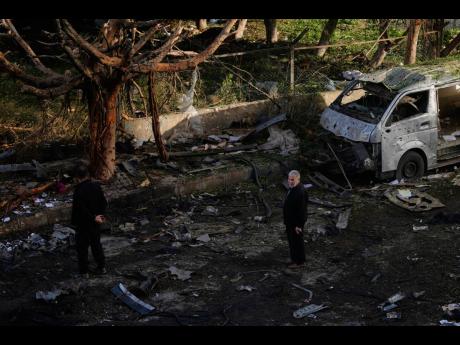
Yet, as this Lenten season unfolds in 2026, an unsettling contradiction presses itself upon the conscience of the faithful: the persistent invocation of God to justify the killing of others, shegging-up Iranians and peoples across the Middle East.
This contradiction is neither subtle nor new. It is, however, particularly jarring when framed against the central affirmations of the Christian faith. The God revealed in the Gospel is not one who delights in destruction or one who authorises violence for convenience. Scripture reminds us that He “is not willing that any should perish”, and the life of Christ embodies a radically different paradigm – one in which power is relinquished, suffering is embraced, and redemption is offered even to those who inflict harm.
How, then, do we reconcile this with the spectacle of self-identified Christian leaders and societies invoking divine sanction while supporting or prosecuting actions that result in widespread death? The answer lies in the long-standing human tendency to conscript religion into the service of power. The language of faith, with its moral authority and emotional resonance, becomes a convenient instrument through which policies driven by strategic, economic, or political interests can be presented as righteous necessity. In such moments, God is not worshipped; He is mockingly deployed.
For us Jamaicans, this global dissonance is not a distant murmur. As we stand in the wake of Hurricane Melissa’s devastation, our national focus is understandably on the “ROOFS Programme” and the immense fiscal effort to rebuild our communities. We are a people intimately acquainted with the fragility of life and the necessity of genuine international solidarity. Yet, even as we navigate our own recovery and the economic ripples of West Asian instability – felt at every petrol pump from Savanna-la-Mar to Morant Bay – we must not lose our moral compass in the pursuit of pragmatism.
LOVING GOD
When the name of a loving God is attached to acts that result in the loss of innocent life, a distortion occurs in the moral imagination of societies. The faithful are invited to accept that such contradictions are either unavoidable or justified. Over time, the dissonance dulls. What should provoke outrage becomes normalised; what should be interrogated is instead repeated. This is the covert erosion of moral clarity.
As a small island state, Jamaica has often found its strength in moral leadership rather than military might. Our history is marked by reliance on partnerships grounded not in coercion but in mutual respect. We understand the difference between assistance offered in good faith and influence exerted for advantage. It is, therefore, incumbent upon us to resist the uncritical adoption of narratives that originate in centres of power but do not withstand ethical examination. This demands that we maintain a disciplined distinction between necessity and justification, between explanation and endorsement.
The present moment, particularly the escalating tensions involving Iran, illustrates this tension starkly. Assertions of threat are advanced with urgency, and the language of deterrence is deployed with confidence. Yet, when such actions are accompanied by overt or implicit appeals to divine sanction, the line between political decision and theological claim is crossed. At that point, scrutiny must intensify.
For the Christian, the standard is found in the fixed witness of the Gospel. A Saviour who instructs His followers to love their enemies and rebukes the use of the sword cannot be easily reconciled with narratives that justify the taking of life in His name. This establishes clear moral boundaries: the name of God must not be used to sanctify actions that contradict His character. When it is, the responsibility of the faithful is to expose the contradiction.
Another boundary concerns our own posture. It is tempting to adopt a tone of moral superiority, yet Lent cautions against such reflexes. The same capacity for self-justification we critique in others resides within us – in our own community violence and our selective outrages. The call is to a dual movement: outward, in naming injustice, and inward, in examining our own complicity.
JUDGEMENT AND HOPE
Easter, which lies just beyond Lent, offers both judgement and hope. It judges the pretensions of power by revealing their ultimate impotence in the face of sacrificial love. At the same time, it offers the possibility of renewal – a recovery of integrity and a recommitment to truth. The question is whether we are willing to confront the ways in which the invocation of God has been distorted. When the language of salvation is used to justify destruction, something has gone profoundly wrong. To name that wrong is not an act of disloyalty. It is an act of faith.
A Prayerful Reflection for Easter Season 2026
Gracious and Merciful Lord,
We come before You in a time of deep unease, seeking light where there is confusion and truth where there is noise.
You have taught us that You are not willing that any should perish and that Your love for the world was made manifest in the giving of Your only begotten Sonv—vnot to condemn but to save.
Yet we look upon our world and tremble.
How is it, O Lord, that men who claim Your name can initiate war?
How has the language of faith been bent to justify destruction, domination, and the pursuit of earthly gain?
How has Your holy name been invoked in conflicts driven by power, resources, and fear?
In this solemn season of Lent, as we reflect on sacrifice, humility, and redemption, we are confronted by the dissonance between Your Gospel of love and the actions carried out in Your name.
Lord, grant us the courage to rebuke hypocrisy — first within ourselves and then within the systems and leaders we observe.
Guard us against self-righteousness even as we seek justice.
Deliver us from the temptation to mirror the very pride and hardness of heart we lament.
We pray for all peoples — those in lands of conflict, those who suffer unseen, and even those who wield power — that hearts may be softened and wisdom may prevail over impulse.
Teach us to be instruments of Your peace, to speak truth without hatred, to seek justice without vengeance, and to remember always that every life is precious in Your sight.
May this Easter not merely commemorate resurrection but awaken in us a renewed commitment to compassion, humility, and truth.
Through Christ our Lord, Amen.
Dennis A. Minott, PhD, is a physicist, green energy consultant, and long-time college counsellor. He is the CEO of A-QuEST. Send feedback to columns@gleanerjm.com.