
From classroom to coastline
How COVID-19 steered Sashae Shaw into Jamaica’s thriving fisheries industry
Published:Thursday | April 23, 2026 | 10:54 AMGarfield Angus/Contributor
To access this article in full please login or register today


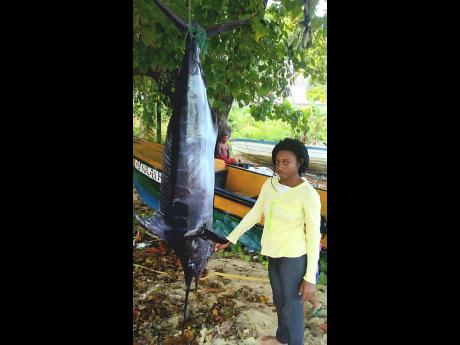
When the world ground almost to a halt at the onset of the COVID-19 pandemic in 2020, millions were forced to reimagine their futures overnight. For Sashae Shaw, a young woman from Portland pursuing an associate degree in psychology at Excelsior...
When the world ground almost to a halt at the onset of the COVID-19 pandemic in 2020, millions were forced to reimagine their futures overnight. For Sashae Shaw, a young woman from Portland pursuing an associate degree in psychology at Excelsior Community College (ECC), the disruption was more than an inconvenience – it was a turning point that reshaped her life’s trajectory.
Today, at 30, Shaw stands not only as a fisherwoman, but as a symbol of resilience, adaptability, and the growing role of women in Jamaica’s fisheries sector.
Long before the pandemic altered her plans, the sea had already claimed a place in Shaw’s heart. Raised in a family with deep ties to fishing, her earliest memories are intertwined with the rhythm of waves and the thrill of the catch. From a tender age, she accompanied her father on fishing trips, learning the trade firsthand – checking fish pots, baiting hooks, and hauling in the day’s catch. What began as bonding time evolved into a genuine passion.
“I loved seeing the fishes coming up from out of the water into the boat,” she recalled, capturing the wonder that first drew her to the ocean. Fishing was never foreign to her – it was heritage. Still, for years, it remained a part-time pursuit, secondary to her academic ambitions.
That balance shifted dramatically in early 2020. As fear surrounding the virus intensified, institutions across Jamaica shut their doors. Shaw remembers being informed via a class group that in-person classes were suspended indefinitely.
ECONOMIC STRAIN
Faced with uncertainty, she made a swift decision to leave Kingston and return home. Like many students, she transitioned to online learning, but the economic strain soon became evident. With limited resources and mounting responsibilities, she turned to the one skill she could rely on – fishing.
Using her savings, she began constructing her own fish pots, transforming what had been a supplementary activity into a primary source of income.
“It was really about taking care of our financial needs,” she explained. “From that day on, my parents and I became serious about being fisherfolk.”
Fishing, Shaw emphasises, is more than survival – it is a viable and often lucrative business.
“You can earn enough money in one day that can fund your livelihood for up to a month,” she said, underscoring the industry’s economic potential.
Demand for fresh fish remains high, with customers often placing orders before boats even return to shore. Popular varieties like snapper and ‘butter hymns’ sell almost instantly, while others may require storage and gradual sale. Timing is critical – early mornings yield the best results, as fish are more active and feeding, while evening catches tend to dwindle.
Yet, despite its rewards, fishing is far from easy.
“The scariest part of fishing is when the weather changes suddenly,” Shaw shared. “The sea can get rough – big waves, wind, rain, thunder, lightning.”
She also recalls a harrowing encounter while fishing for cardinal snapper in deep waters. As she hauled in a trap filled with fish, a massive shark – nearly the size of the boat – appeared and devoured the entire catch.
“I just stood there in shock,” she said. “I had never seen a shark that big.”
Moments like these have tested her resolve, but each time, she has chosen to persevere.
A key factor in overcoming fear has been training and support from the National Fisheries Authority (NFA) and the Ministry of Agriculture, Fisheries and Mining. Through workshops conducted in collaboration with the Caribbean Maritime University (CMU), fisherfolk have received life vests, radios, and emergency response training.
“These gears helped me overcome my fear,” Shaw explained. “Knowing that I can contact the coast guard in an emergency makes a big difference.”
Such interventions highlight the importance of structured support in sustaining the fishing industry, particularly for small-scale and artisanal fishers.
Globally, women have long played vital – though often underrecognised – roles in fisheries. Increasingly, however, women like Shaw are stepping beyond traditional roles to participate directly in the catch.
In Jamaica, the NFA has been actively encouraging this shift through training, outreach, and community engagement.
As a member of the Lower Brands Bay Fishing Group, Shaw is part of a growing network of women redefining what it means to be a fisher.
For her, fishing is more than a profession – it is a lifeline.
PRIMARY CONCERN
As a mother, her primary concern is providing for her daughter. The income generated from fishing supports everything from food and bills to school expenses, uniforms, and books. It also helped finance her own education at ECC.
“It is a good business to be engaged in,” she said. “It provides for the entire family.”
Her experience challenges outdated perceptions of fishing as unstable or marginal, instead presenting it as a sustainable and empowering livelihood.
“Anyone can become a fisherfolk,” she added. The process begins with obtaining a licence and identification card from the NFA. Even shoreline fishing requires proper authorisation, reinforcing the importance of regulation in protecting marine resources.
For beginners, starting small is entirely feasible – using simple hooks and lines from land before transitioning to boat-based fishing.
Shaw is especially passionate about encouraging youth participation.
“Bring them out, let them experience what it is like,” she urged. “Even when you’re not catching any fish, being out there is a really nice feeling.”
She describes the ocean as a form of natural therapy – a place of calm and reflection.
Still, she is keenly aware of the need for sustainability. Practices such as dynamite fishing or operating in protected sanctuaries can cause irreparable damage to marine ecosystems.
“These sanctuaries are like nurseries,” she explained. “If we protect the small fish, they will grow and multiply.”
Overfishing juvenile fish, she warned, threatens the industry’s future. Compliance with regulations is not just a legal obligation, but a moral one.
The NFA plays a central role in balancing economic development with environmental conservation through research, monitoring, enforcement, and training. Through its Marine Capture and Aquaculture branches, it works to ensure that Jamaica’s fisheries resources are used sustainably while maximising social and economic benefits.
For communities like Shaw’s, this support has been transformative – providing not only tools and training, but also a sense of empowerment.
Although fishing remains her primary source of income, Shaw remains open to exploring other opportunities. Her background in psychology reflects a broader curiosity and ambition.
Still, she is clear about one thing: fishing will always be part of her life.
Her journey from college student to full-time fisherwoman illustrates the power of adaptability in the face of adversity – a story shaped by necessity, strengthened by tradition, and sustained by determination.
In the wake of a global crisis, Shaw did more than survive – she carved out a path that honours her heritage while embracing the future.
TESTAMENT OF RESILIENCE
And as she sets out to sea each morning, she carries not just nets and lines, but a quiet testament to resilience – proof that even in the most uncertain times, new beginnings can emerge from the depths.
Jamaica’s fishing industry, meanwhile, is undergoing a quiet but powerful transformation.
Shellene Berry, senior director at the NFA, noted a significant shift: more women are becoming boat owners and entrepreneurs. Where women once dominated fish vending, many are now investing in vessels and leading operations in coastal communities such as Old Harbour Bay, Rocky Point, and Alligator Pond.
“The shift comes at a critical time,” she said, noting that many older male fishers are exiting the industry, while fewer young people are entering.
To address this gap, the Ministry of Agriculture, Fisheries and Mining has moved to lower barriers to entry, particularly the high cost of equipment.
Through programmes introduced during the COVID-19 period, young people aged 18 to 35 have been receiving grants of $200,000 to start or expand fisheries businesses. Selected participants are also being equipped with 28-foot boats and 40-horsepower engines – tools once out of reach for many.
But the transformation goes beyond traditional fishing.
Increasingly, Jamaicans are exploring aquaculture and value-added products, including oyster and sea moss production. Training initiatives, supported by institutions such as CMU, are equipping fishers with critical skills in safety at sea, scuba diving, and sustainable practices.
Safety remains a priority, with programmes aimed at reducing incidents of fishers being lost at sea through proper equipment use and preparedness.
At the same time, sustainability remains central – encouraging compliance with regulations, protection of marine species, and environmental stewardship.
As innovation, inclusion, and training converge, Jamaica’s fishing industry is evolving into a more resilient and dynamic sector – one where opportunity now stretches far beyond the shoreline.