
Visiting Marrakech
Published:Sunday | June 13, 2010 | 12:00 AM


LETTER FROM LAURA TANNA
For years I've yearned to visit the 11th-century city of Marrakech, once capital of an empire reaching from West Africa to Spain, whose fortunes varied with the ancient caravan routes and power struggles, alternating as a capital with ancient Fez.
Since hearing that Sir Winston Churchill would retreat from the stress of World War II to paint the gardens of La Mamounia, a palace in Marrakech transformed into a renowned hotel, so alluring was his description that I've wanted to stay at La Mamounia myself.
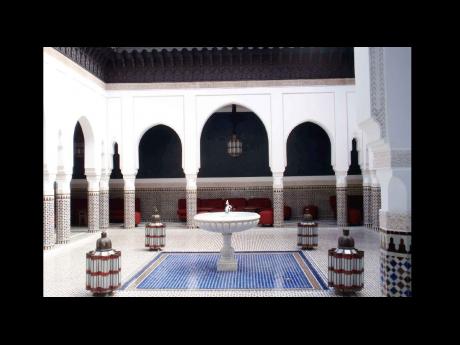
Just when we thought we could finally afford a few nights in this extraordinary locale, the hotel closed for renovations, which took three years. One can understand why. The craftsmanship required for tile work and intricate plaster designs in each of the more than 200 rooms, as well as the painted doorways and elaborate metal lighting fixtures kept many artisans employed. But oh how disappointing the colour scheme. Brown, beige, light blue, red and green tiles all together beneath pristine white sculpted designs are a jarringly unattractive mixture, something of which I was reminded every time I walked into our room. Central areas with striking two-colour tile designs are more appealing but too few intimate corners exist. Perhaps the makeover by Jacques Garcia contributed to our disappointment. The staff, however, were exceptionally attentive and the restaurants, both French and Moroccan, superb.
Tariq, on the clay courts, was a talented tennis pro while the huge swimming pool obviously delighted guests. Both were set in much-heralded gardens, though after the lush flowers of Jamaica only the purple-blooming jacaranda trees impressed us. But the birds! Never a moment passed when we didn't hear their sweet song or shrill cackling. Often they swooped through the balcony, then off to the garden palms. From our fourth floor we looked beyond city ramparts, to the distant airport on our right, olive orchards and flat brown land towards far-away snow-capped Atlas Mountains in front, and to the left the Medina, heart of old Marrakech.
A city of just over a million, Marrakech hasn't the multitude of rich monuments and museums of Cairo or Istanbul. Additionally, Morocco refuses non-Moslems entry to mosques, so we admired La Koutoubia, the city's landmark mosque from outside. A private English-speaking guide recommended by our hotel for the morning cost approximately US$30 in Moroccan currency with taxi another US$17 equivalent for an introduction to the Medina. Bahia Palace constructed by vizier Ba Ahmed Ben Moussa in the early 1900s in which he kept four wives and 24 concubines was our first stop. A short drive away we viewed the Saadian Tombs where grand sultans and royalty of that dynasty (1554-1659) are buried, completely hidden to the public until uncovered by French military in the 1920s. The tombs now form part of the Museums, Sites and Historic Monuments under the protection of the Ministry of Cultural Affairs.
Another quick ride and we began our walk passing by Derb Said Ahnssal, through narrow streets, past rose-coloured buildings, small side alleys, donkey carts and street vendors until emerging at Ben Youssef Medersa, a Koranic school dating from the 14th century and rebuilt by the Saadians in 1565, serving as an educational centre until 1960 for 900 students. Open to the public in 1982, one glimpses the austerity of scholarly life within their small cubicles.
More fascinating shops
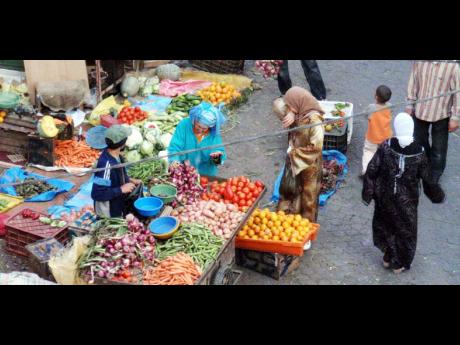
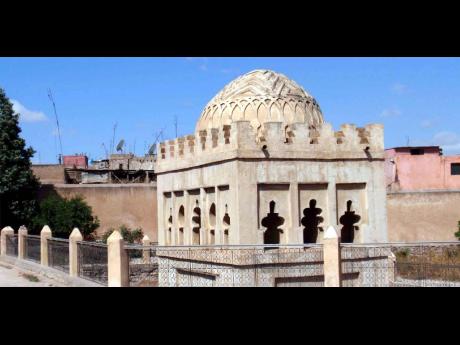
On the streets, more fascinating shops, then the splendid Quobba Almoravide, an 11th-century domed washhouse for ritual cleansing beside a mosque. Nearby the Museum of Marrakech, an architectural masterpiece, preserves impressive elements of Moroccan heritage. Through another colourful open-air market and we enter souks, wherein one finds fabulous handicrafts - carpets, ceramics, lamps, leather shoes and purses, clothing, textiles, olives, fruits, candies - all manner of goods. Many foreigners and locals are renovating buildings in the Medina, creating boutique hotels called riads, decorated lavishly with sumptuous offerings by local artisans. My favourite was La Sultana, at half the price of La Mamounia, it embodied the atmosphere I had expected there. Located in the Kasbah, south Medina, we enjoyed sunset on its roof overlooking an open-air market on one side, La Koutoubia on the other, with a stork's nest for added atmosphere. Dinner in their open courtyard with haunting music by a single traditional instrumentalist was delicious. Tchai'kana, another smaller riad is recommended highly by Jamaican friends who enjoyed exploring the Medina's narrow lanes. Morocco gained its independence from the French in 1956 and its government is a monarchy under King Muhammad VI. More than 10,000 Europeans live in Marrakech, an acknowledged leader in tourism. As such it is an important centre of employment and earner of foreign exchange. Security is unobtrusive, including police in civilian clothing, but highly effective.
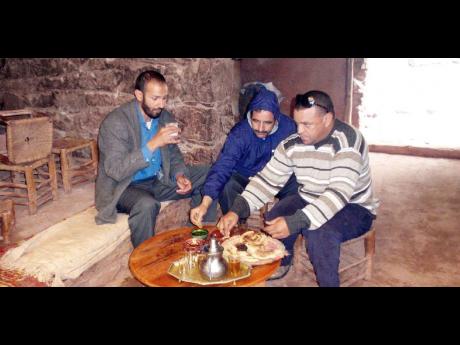
We greatly enjoyed a day trip to the Ourika Valley at the foothills of the Atlas Mountains, just two hours away. We stopped first at the Musée d'Aghbalou where truly beautiful antiques and local craft were on sale. Mick Jagger has a home nearby we're told, near the oldest mosque in the valley. We visited a Berber home, then at Setti Fatma, starting point for 'Walk of the Seven Waterfalls', we ambled along the rocky river observing women carrying bundles of produce on their backs, a man preparing tagine in conical stewpots, and uniformed schoolchildren playing. It began drizzling so we forgot the waterfalls and headed for Ramuntcho, a lovely local hotel/restaurant for Moroccan lunch. Our taxi driver charged us the equivalent of US$70 for the day and included a stop at Carrefour Almazar, a modern shopping mall on the outskirts of Marrakech.
Romantic setting
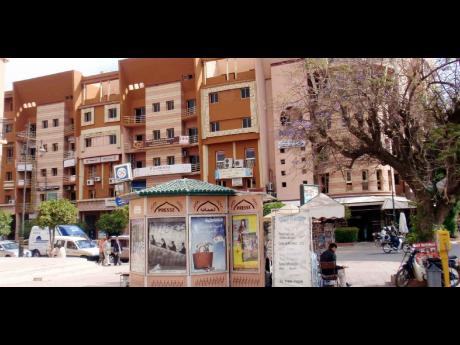
For breakfasts we hopped over to Gueliz, in modern Marrakech constructed after the French came to power in 1913. Grand Café de la Poste serves perfect French repasts, including the sweetest Moroccan orange juice and the sweetest honey in the world. La Trattoria de Giancarlo offered Italian cuisine in a romantic setting in Gueliz while a craving for authentic (and excellent) Thai food lured us to lunch at the Amanjena hotel, Km 12 on the Route de Ouarzazate, 20 minutes from town.
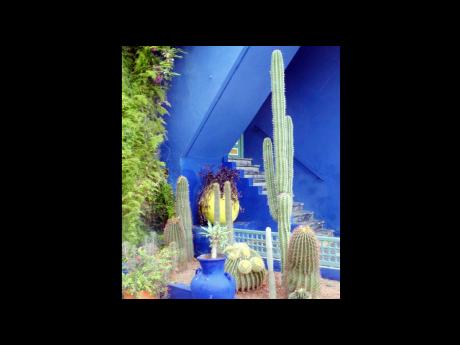
Majorelle Gardens are another French delight, named for artist Jacques Majorelle who opened them in 1947 with vivid cobalt blue backdrops. Designer Yves St. Laurent purchased and renovated the property. With his death in 2008, an exhibition of his "love" posters and a stone memorial remain in the gardens.
There are two casinos in town which we never visited but most visitors find their greatest entertainment in evenings at Jemaa El Fna, the gigantic square near La Koutoubia, famed for everything from colourful water carriers to snake charmers and food stalls.
Whether it's shopping for fabulous handicraft, dining in excellent restaurants or simply absorbing an exotic atmosphere, Marrakech is accommodating to Western ways and graciously welcomes visitors.
Hotels:
www.mamounia.com, www.Lasultanamarrakech.com, www.Tchai'kana.com
Restaurants:
French: Grand Café de la Poste, www.grandcafedelapost.com
French and Moroccan: www.mamounia.com, www.Lasultanamarakech.com,
Italian: La Trattoria de Giancarlo, www.latrattoriamarrakech.com,
Thai: Amenjena Thai, www.amanresorts.com
Shopping:
The Souks in the Medina,
Ensemble Artisanal in the Kasbah and Avenue Mohammed V, Gueliz, and Musée d'Aghbalou, 47 Km Ourika www.musee-aghbalou.t2u.com