
Loss of momentum
Published:Wednesday | June 1, 2011 | 12:00 AM
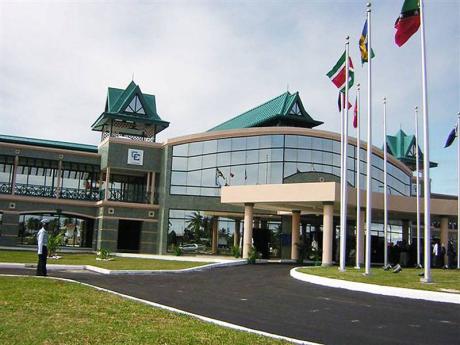
- Carib leaders acknowledge regional integration agenda lagging
Grenada's Prime Minister Tillman Thomas believes that one of the reasons for the lack of implementation of decisions within CARICOM is the fact that there is no legal basis for member countries to do so.
In a paper presented to the CARICOM leaders retreat in Guyana in May, and obtained by the Caribbean Media Corporation, Thomas, who is also the CARICOM chairman, said that at the February inter-sessional meeting held in Grenada, the regional leaders had acknowledged "a loss of momentum with regard to the regional integration agenda".
He said that the meeting had also acknowledged a general sense of dissatisfaction with the pace of CARICOM integration, and especially with the large gap between decisions taken and the extent to which these decisions are implemented.
"It is the view of some that the accumulation of scepticism and disillusionment resulting from the 'implementation deficit' can undermine the progress already made in building the Caribbean Community," Thomas said.
He said that an ad hoc committee had been convened to provide ideas that could assist the deliberations of the retreat and that the underlying issues that hinder effective implementation of decisions need to be addressed as a matter of urgency.
Thomas said that at the same time CARICOM needs to undertake concrete actions that deliver tangible benefits to the regional population, and that demonstrate the value of regionalism in ways that touch on their daily lives.
A package of proposals had been developed, addressing issues of governance, prioritising the benefits of economic integration, movement of community nationals and mobilising civil society, as well as an immediate action plan for the consideration of the leaders.
Thomas said that one of the underlying reasons for the "implementation deficit" within the 15-member bloc "is the absence a legal basis for decisions of the conference; supplemented by an institutional machinery with the requisite legal authority to effectively discharge responsibilities for implementation of these decisions."
The European Union (EU), he said, is a good example of a succession of stages by which authority was devolved to provide the legal basis for collectively made decisions in certain key areas.
'variable geometry'
Within CARICOM, applying a suitable mechanism, the principle of 'variable geometry', means that not all member states would have to participate fully and simultaneously in all components of the integration process.
This principle, along with those of 'proportionality' and 'subsidiarity' has provided the EU with sufficient flexibility in the phased implementation of decisions in spite of the wide differences in the 27-member bloc.
"This is a clear lesson of the experience of the European Union for CARICOM; and offers a way of overcoming the impasse in CSME implementation while preserving the longer run integrity of the integration process," said Thomas.
Thomas said the delegation of authority by member states to EU bodies is therefore limited to specific agreed areas of collective, legally based actions, applicable only to those member states agreeing to such an arrangement, subject to periodic review as well as being subjected to withdrawal of the delegated competence by any member state at its discretion.
"Presently, these areas are customs union; competition rules; monetary policy for member states using the euro; conservation of marine biological resources under the common fisheries policy; common commercial policy," he said.
four broad areas
For CARICOM, four broad areas are proposed as initial candidates for the delegation of authority: common market and customs union; external trade policy; regional security arrangements; and environment and climate- change policy.
But he argued to give effect to this it will be necessary for member states to enact enabling legislation, adding "for this purpose, the 'Single CARICOM Act' proposed by the Technical Working Group on Governance should be examined as a possible template for national legislation".
Thomas said that the appointment of a new secretary general should be regarded as an opportunity to initiate the re-engineering of the CARICOM secretariat in the light of the enhanced responsibilities and legal authority being proposed and for dynamic leadership of the integration process.
CARICOM leaders are yet to agree upon a replacement for Sir Edwin Carrington who stepped down as the region's op public servant at the start of the year after nearly two decades in office.
"The new secretary general should be capable of driving the regional integration project - one who is imbued also with a sense of political and diplomatic strategy, and who brings to the office sufficient personal stature to be a respected, courageous and independent chief executive," said Thomas.
The new recruit "should be free", he said, to formulate a management team.
- CMC