
Farmer George Evans mourns his tomatoes
Published:Saturday | June 4, 2011 | 12:00 AM


Paul H. Williams, Gleaner Writer
WALDERSTON, Manchester:
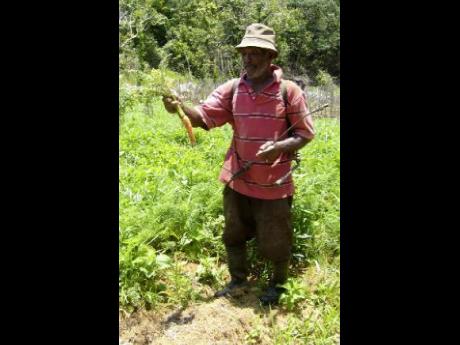
IN THE early afternoon sun on Friday, May 13, George Evans sprayed his patch of carrots in the district of Contrivance, Walderston, Manchester. Weeds had taken over the patch, and before they strangle and suffocate his produce, he was intent on exterminating them. Another disaster was not going to happen.
For, beside his patch of carrots there was a graveyard of rotten and rotting tomatoes. Evans told The Gleaner, which had happened upon this sorrowful sight, that the entire crop was lost, and so was every cent invested. This was his second crop. The first was bounteous and profitable, and Evans was expecting the same for this one. What then was the reason for this colossal disaster?
Bad seeds, cheap fungicide
The tomato seeds, the weather conditions and cheap fungicide seem to be the problem. "I may have used the wrong types of seeds because I could not get the seeds I wanted," Evans surmised, "This seed, if you have the right weather, you plant it out here and achieve a whole lot." The seeds he used, he said, are apparently for plants that grow under greenhouse conditions. If they are sown in the open, and there is too much heat and rain, fungi will set in, and that's what seems to have happened this time around. And to compound the problem, the cheap fungicide used to combat the problem was not effective.
"It's an act of God, and you really have nobody to blame," said, Evans, who said he lost about $50,000, in the failed venture. He, however, wants to see more intervention from the Rural Agricultural Development Authority (RADA) as it relates to advice to farmers and the poor quality of seeds that are sold. "If I had someone to call, I would feel much, much better, but there is no one to call.
No extension officer comes by like in the old days, no one to call," lamented the man who said he had registered with RADA years ago, "I am yet to get a visit from them."
The failure of this crop of tomatoes pales in comparison to other things the 71-year-old returned resident had lost in a life full of ups and downs. Some of the dramas are still unresolved. So, he's holding on, and with his patch of big, juicy carrots soon to be reaped, it certainly will be sweeter in the morrow.