
Return to prosperity
Published:Friday | November 11, 2011 | 12:00 AM
BY Dennis Morrison
In a column two weeks ago 'Private-sector austerity', I referred to data from the United States Census Bureau showing that after-tax profits in the American manufacturing sector have rebounded since 2010 to the point where in second-quarter 2011 they exceeded the pre-recession level in the corresponding period of 2007.
As I pointed out, this turnaround has been achieved essentially by aggressive cost-cutting and resulting productivity gains, as sales have recovered only modestly. For example, while after-tax profits jumped by 42.5 per cent in the second quarter of 2011 compared with the same period in 2010, sales went up by only 14 per cent.
In a Washington Post article of November 6, 'Wall Street's resurgent prosperity frustrates its claims, and Obama's' by Zachary A. Goldfarb, it was stated that America's largest banks earned profits of US$34 billion in the first half of this year, almost as much as in the same period in 2007, before the recession.
This was higher than in the similar period of any other year, confirming that Wall Street has 'roared back' — although the US economy is still struggling to recover from the great recession.
Indeed, Goldfarb points out that Wall Street firms earned more in the first two and a half years under Obama's tenure than in the entire eight years of the previous Bush administration.
US securities firms that include the trading arms of the big banks and other independent firms have done even better raking in profits of US$83 billion during the past two and a half years, as against US$77 billion for the entire period of the Bush administration.
Contrary to the hostile stance of the heads of America's big banks to the Obama administration, Wall Street owes its resurgence almost in total to assistance from the US Federal government.
First, the government put up a US$700-billion fund to bail out the banks as the financial crisis struck in September 2008. President Obama supported this intervention before he was elected and maintained it even in the face of public hostility about the banks' outrageous bonuses.
Second, the US Federal Reserve provided massive liquidity support running into trillions of dollars, cut interest rates that allowed the banks to borrow money cheaply, and ran lending programmes that were critical to the revival of stock and bond markets. The banks were also allowed to collect 'steady' returns on reserves they held at the central bank.
These critical lifelines served to calm the financial markets and create the conditions for Wall Street's return to prosperity.
The list of bailout recipients reads like a 'who's who' of the American banking industry, with Bank of America and Citigroup receiving US$45 billion each, followed by JPMorgan Chase and Wells Fargo at US$25 billion each.
Goldman Sachs, Morgan Stanley and Bank of America subsidiaries were also among the recipients, but at a much lower level. To cap it off, these funds were provided without conditionalities, and the banks after being bailed out were under no compunction to increase lending, a step which would have helped to spur spending and growth.
Critics of the bailout of the banks have also raised the concern that the largest banks have got even bigger after the crisis, and with their greater size it has helped them become more profitable.
They access capital at lower interest rates and are still perceived as being less risky than the smaller banks.
Bank of America and Morgan Stanley showed the biggest increases in size of assets, moving from $1.818 trillion to $2.265 trillion and from US$659 billion to US$839 billion, respectively.
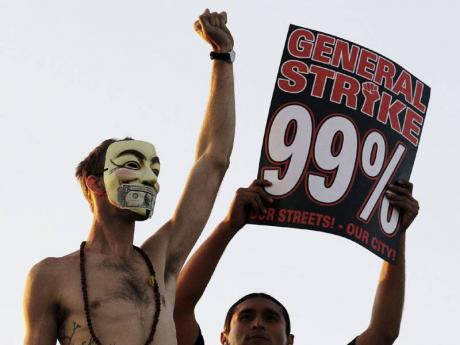
The frustration of the American public with Wall Street that is now manifested in the 'Occupy Wall Street' movement has, no doubt, been fuelled by the sense that the banks have got privileged treatment when the rest of the society - the '99 percenters' - has been left to grapple with joblessness, foreclosure on homes, and rising poverty.